Summary
Editor's rating
Value for money: worth it if you actually care about the pour
Design: looks light, pours tight
Comfort and ease of use: nice for daily coffee, less nice if you’re in a rush
Materials: light stainless steel, more solid than it looks
Durability: light build, but holds up in real use
Performance: heat and pour, no tricks
What you actually get when you buy it
Pros
- Very controlled, smooth pour thanks to the gooseneck spout
- Lightweight and comfortable to handle for longer pours
- Stainless steel, works on gas, electric, and induction with no plastic inside the water
Cons
- No whistle, no auto shut-off, easy to forget on the stove
- Effective boiling capacity is less than the stated 1.0L
- Not dishwasher safe and feels less robust than heavier kettles

Specifications
View full product page →| Brand | HARIO |
A kettle just for coffee nerds… or for normal people too?
I’ve been using the Hario V60 Buono 1.0L on a gas stove for a few weeks now, mainly for V60 and Aeropress, plus the odd cup of tea. This isn’t a general “family kettle” the way a big whistling one is. It’s a fairly compact, purpose-built kettle that’s clearly made with pour-over coffee in mind. If you’re used to a big electric kettle that blasts out boiling water, this feels more like a tool than an appliance.
The first thing that struck me when I took it out of the box was how light it is. Honestly, my first reaction was: “This looks a bit flimsy, did I just overpay for thin metal?” But after putting it through daily use on high flame, it handled it without any warping or weird noises. So the initial cheap-feeling impression fades once you actually put it to work.
Day to day, I’ve been using it 1–3 times per day for coffee. I usually boil 400–600 ml at a time, which is basically its sweet spot. It does what it’s supposed to do: it heats water and gives you a very controlled pour. No fancy electronics, no thermometer, no whistle. If you want features, this is not it. If you just want hot water, also not ideal. This sits in the middle: simple, but clearly aimed at people who care about how they pour.
Overall, my feeling so far is that it’s a pretty solid specialty kettle with a couple of caveats: no whistle, no dishwasher, and it’s not amazing if you mainly want to make big batches of tea. If you’re into pour-over and like the manual routine, it makes sense. If you just need boiling water fast for the whole family, there are better and cheaper options.
Value for money: worth it if you actually care about the pour
In terms of price, the Hario V60 Buono usually sits above generic kettles and below the fancy gooseneck electric kettles with built-in temperature control. So the question is: is it worth paying extra for a simple stovetop kettle just because of the spout and the brand? For someone who does pour-over almost every day, I’d say yes, it makes sense. The control you get over the pour is genuinely useful, and the build is good enough to feel like a long-term tool, not a disposable gadget.
If you mostly just want boiling water for tea bags, instant noodles, or big pots of tea, this is honestly overkill and also a bit small. You can get a bigger, whistling kettle for less money that will do that job better. Or an electric kettle that shuts off automatically and heats faster. This Hario is more of a coffee person’s purchase than a general household appliance.
Compared to cheaper gooseneck kettles, what you’re mainly paying for is: consistent pour, decent stainless, compatibility with all stovetops, and the fact that it’s a known product with a lot of users and feedback. There are cheaper options out there that try to copy the look, but quality can be hit or miss. If the price difference is big for you, those might be fine. If you’d rather buy once and be done, the Hario feels like a safe middle ground: not budget, not luxury, just fairly priced for what it does.
So value-wise, I’d call it good but not mind-blowing. You’re not getting crazy features; you’re paying for a simple, well-thought-out kettle that does one thing properly. If that one thing—controlled pouring for manual brewing—is important to you, the price is reasonable. If not, your money is better spent on a plain electric kettle and more coffee beans.
Design: looks light, pours tight
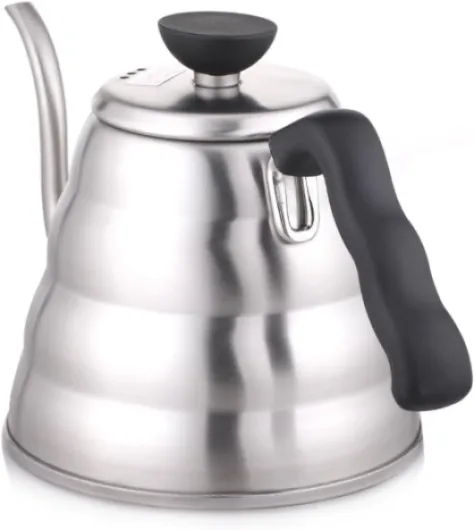
The design is very recognisable: the wavy stainless-steel body, the long gooseneck spout, and the slightly retro lid. It’s minimalist and pretty neutral, so it fits in most kitchens. It doesn’t scream “high-end gadget” or “cheap supermarket kettle” – it just looks like a simple, slightly quirky coffee tool. If you already own a V60 dripper, it matches nicely and makes your coffee corner look a bit more intentional.
The main design point is the gooseneck spout. This is where it earns its keep. The pour is slow and predictable. If you’re used to a regular kettle, you’ll immediately feel the difference. I can easily control tiny adjustments in flow: from a thin trickle for blooming coffee to a steady stream for the main pour. It doesn’t dribble or spit if you hold it at a normal angle. I can tilt it pretty far without losing control, which is exactly what you want for pour-over recipes.
The handle is angled away from the body and stays cool as long as you don’t let the flame lick up the side. On my gas stove, I had to be a bit careful with burner size: if you use a big flame that goes beyond the base, you’re asking for trouble with the handle. But when used on an appropriate burner, no burnt fingers, even after a full boil. The lid has three steam vents, and it’s easy to turn so they face away from the handle, which is important unless you enjoy steam on your knuckles.
One thing I didn’t love: the kettle looks thinner and more fragile than it actually is. If you’re rough with your gear or live with people who toss things around, it’s not the most confidence-inspiring object. It’s not junk, but it’s also not a thick, heavy-duty camping kettle. For home coffee use, though, the design is functional and practical. It prioritizes precision over toughness, which matches what this product is about.
Comfort and ease of use: nice for daily coffee, less nice if you’re in a rush
From a comfort point of view, the kettle is pleasant to handle if you’re doing one or two careful brews a day. The light weight means your wrist doesn’t get tired, even with a longer pour. The handle shape works well: I can grab it with a relaxed grip, and the angle gives good leverage when tilting. The balance stays decent as the water level drops, so you don’t suddenly feel it tipping too fast.
The lid fits snugly but not so tight that it’s a pain to remove. You can lift it using the little plastic knob without burning yourself, even right after boiling. The three steam holes on the lid are useful, but you do need to remember to turn them away from the handle. If you forget and have them facing your hand, you’ll get a blast of steam when it boils. Not ideal, but once you do it wrong once, you learn quickly.
Where comfort takes a hit is in the lack of feedback. No whistle, no click, nothing. You have to stay reasonably close, listen for the boiling sound, and watch for steam. If you’re someone who puts water on, walks away, and comes back when it whistles, you’ll probably overboil this more than once. It’s also not insulated, so the body gets very hot. That’s normal for a metal kettle, but you need to be aware if you have kids around or a cramped cooking area.
For the pour-over routine itself, though, comfort is good. It fits into the workflow nicely: heat water while grinding coffee, by the time you’re done it’s boiling, turn off the heat, let it sit a bit if you want a lower temp, and pour. It’s not a lazy person’s kettle; it’s more for people who actually like being involved in the process and don’t mind paying attention.
Materials: light stainless steel, more solid than it looks
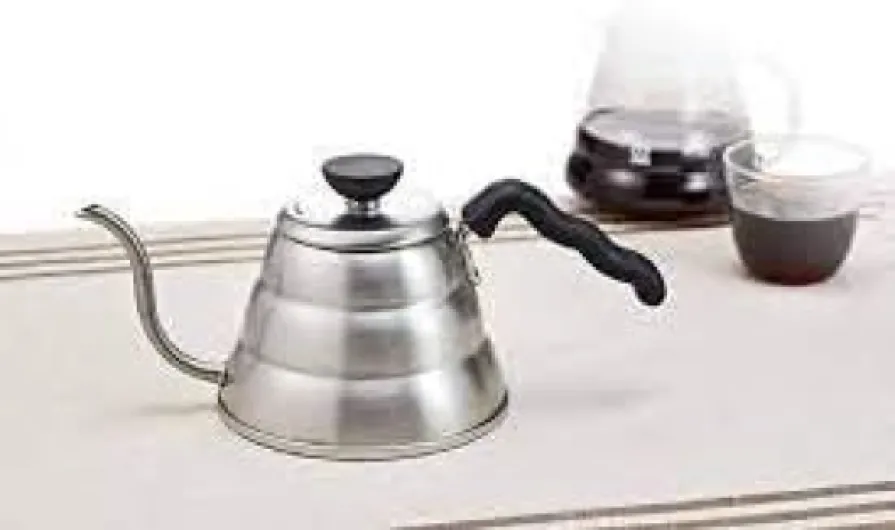
The body and lid are stainless steel, and that’s what most people will care about: no coated interior, no aluminum, no plastic touching the water. After several weeks of use with mostly filtered water, I haven’t seen any rust spots, weird discoloration, or flaking. A lot of users online mention the same thing, even after months: as long as you’re not leaving filthy hard water in it forever, it holds up well.
The steel is on the thinner side, which you notice the first time you touch it. It’s not that thick, heavy restaurant-grade feel. That said, in actual use on gas at high heat, it didn’t warp, didn’t buzz or rattle like cheap thin pots sometimes do, and the bottom stayed flat so it sits stable on the burner. So for me, it falls into the category of light but decent, not tank-like but not junk either.
The handle and lid knob are plastic, which some people will dislike, but practically it helps: they stay cool, and you can grab the lid easily without burning yourself. Just be careful that the gas flame doesn’t reach the handle; if you keep the flame under the base, it’s fine. There are also no plastic bits inside the kettle, unlike some electric kettles where you have plastic windows or internal parts in contact with the water. If you’re picky about taste or avoiding plastic, that’s a clear plus.
Cleaning-wise, the stainless interior is smooth and easy to rinse. It’s not dishwasher safe, and honestly, I wouldn’t put it in there anyway. A quick rinse and occasional descaling with citric acid or vinegar is enough. If you use very hard water, you’ll get scale like with any kettle, but it’s easy to deal with. Overall, the materials feel chosen for practicality: stainless for durability and neutrality, plastic only where needed for handling. Nothing fancy, but it gets the job done.
Durability: light build, but holds up in real use
Durability was my main concern when I first picked it up. The metal feels thin and the whole thing looks like it might dent if you look at it funny. After using it daily on a gas stove at fairly high heat, I haven’t seen any real issues: no warping, no rattling base, no loose handle. The spout in particular feels more solid than it looks; it hasn’t bent or twisted despite regular use and cleaning.
I’ve seen a lot of reports from people using it for months or years without major problems, as long as they treat it like a kitchen tool and not like a camping pot you throw in a backpack. I do think if you drop it on a hard floor or smack it against something, it could dent. It’s not built like a cast-iron pan. But for normal kitchen life—on and off the stove, in the sink, on the counter—it seems to hold up fine.
The stainless finish on mine is still clean with no rust spots. I dry it with the lid off when I remember, but I’ve also left a bit of water in it overnight a couple of times, and nothing bad happened. If you have very hard water, you’ll eventually get mineral buildup, but that’s a cleaning issue, not a structural one. A bit of citric acid or vinegar boil should keep it in check.
So, durability verdict: better than it feels in the hand, but not bombproof. If you’re reasonably careful and not throwing it around, it should last years. If you want something you can abuse, burn dry repeatedly, or take camping and bang around, this is probably not the right tool.
Performance: heat and pour, no tricks
On performance, I’d split it into two parts: heating speed and pour control. For heating, this is basically a small stainless pot with a lid. On my gas stove at a medium-high flame, around 500–600 ml of water goes from cold tap to a rolling boil in about 3–4 minutes. On induction it’s even a bit faster, based on what others report. It’s not faster than a good electric kettle, but it’s not painfully slow either. It’s fine for 1–2 cups of coffee or tea.
The bigger story is the pour. This is where it actually makes sense to buy this instead of just using any pot. The gooseneck gives very smooth flow control. I can pour a gentle stream for blooming and then ramp up to a thicker stream without it suddenly dumping water. Compared to a regular spout kettle, it’s night and day if you care about hitting pour times and patterns. I used it with a V60, a Chemex, and an Aeropress, and in all three cases I felt like I had better control over pouring speed and direction.
One important detail: the nominal capacity is 1.0L, but for boiling, you don’t want to fill it to the top. If you actually boil it near full, the water movement is pretty aggressive and it can feel risky. In real use, I think 400–800 ml is the realistic working range. Above that, it’s more of a water holder than a kettle you actively boil on high heat. If you want to brew big batches for multiple people, you might find yourself doing two rounds or using a bigger kettle instead.
The main performance downside: no whistle, no auto shut-off, no thermometer. If you’re distracted, it will just keep boiling. You have to watch the steam and listen for the rumble. For people used to electric kettles that click off, this is a downgrade in convenience. But if you’re used to basic stovetop gear, it’s normal. Bottom line: performance is solid where it matters for pour-over (control, consistency), and pretty basic otherwise.
What you actually get when you buy it
In the box, it’s very barebones: the kettle, the lid, and some paperwork you’ll probably ignore. No extras, no fancy accessories. The version I used is the 1.0L / 1000 ml size. In practice, you don’t want to actually boil a full liter in it. Realistically, you’ll comfortably boil around 700–800 ml without feeling like it’s about to splash or surge when the water is rolling.
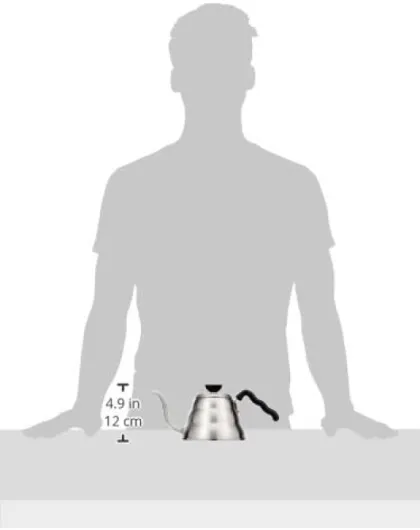
Size-wise, the footprint is pretty compact: about 10.4" deep x 6.3" wide x 5.3" high. On a small kitchen counter, it doesn’t dominate the space, and it fits easily on a standard gas burner or induction plate. It’s light at around 1.1 pounds, so if you’re used to heavy kettles, this feels almost toy-like at first. But that low weight is actually nice when you’re doing slow, controlled pours for a few minutes straight.
Hario markets this as compatible with gas, electric, and induction, and that checks out. I used it on gas; a friend has the same kettle on induction and it works fine, heats quickly, and sits flat. There’s no plastic inside the water chamber, only stainless steel, which is a plus if you’re trying to avoid plastic in contact with hot water. The handle and lid knob are plastic, but they don’t touch the water.
So in terms of presentation, it’s simple: a single-purpose kettle with no bells and whistles, literally and figuratively. If you’re expecting some kind of multi-function thing, you’ll be disappointed. But if you just want a dedicated pour-over kettle that lives on the stove and looks decent on the counter, this lines up with that pretty well.
Pros
- Very controlled, smooth pour thanks to the gooseneck spout
- Lightweight and comfortable to handle for longer pours
- Stainless steel, works on gas, electric, and induction with no plastic inside the water
Cons
- No whistle, no auto shut-off, easy to forget on the stove
- Effective boiling capacity is less than the stated 1.0L
- Not dishwasher safe and feels less robust than heavier kettles
Conclusion
Editor's rating
The Hario V60 Buono 1.0L is a specialized kettle that makes sense if you’re into pour-over coffee or other manual brewing methods where the pour actually matters. The gooseneck spout gives you precise control, the stainless-steel build is light but reliable, and it works on gas, electric, and induction. In daily use, it heats fast enough, pours very cleanly, and looks decent on the counter without taking up much space.
On the flip side, it’s not a great choice if you just want a general-purpose kettle. There’s no whistle, no auto shut-off, no temperature control, and the real working capacity is more like 700–800 ml if you’re boiling, not the full 1.0L. It’s also not dishwasher safe, and the thin metal means it’s not the toughest thing in the world if you’re rough with your cookware.
I’d recommend it to people who: brew V60, Chemex, Aeropress, or similar methods regularly; care about pour control; and don’t mind a simple, manual workflow. If you’re more about convenience, big batches, or set-and-forget boiling, you’re better off with a larger stovetop kettle or an electric gooseneck with temperature control. Overall, it’s a pretty solid, no-nonsense coffee tool that does its job well as long as you know what you’re buying it for.