Summary
Editor's rating
Value for money: decent, but there are cheaper options
Design: looks good, but not everything is perfect
Materials and build: glass looks nice but needs more care
Durability and day-to-day wear
Performance: it boils fast and does the job
What you actually get out of the box
Pros
- Boils water quickly thanks to 3000W power
- Glass body with illumination looks good and makes water level easy to see
- Clean pour spout and reliable auto shutoff in daily use
Cons
- Glass shows limescale build-up quickly, needs regular descaling
- LED illumination is weaker than product photos suggest
- Plastic handle and lid feel basic rather than premium

Specifications
View full product page →| Brand | Russell Hobbs |
A glass kettle that actually looks decent on the counter
I’ve been using this Russell Hobbs Illuminating 1.7L Glass Kettle as my main kettle for a while now, and I’ll be straight: it’s basically a normal kettle that happens to look nicer than the average plastic one. If you’re expecting some life-changing experience every time you make a cup of tea, calm down. It boils water, it lights up blue, and that’s pretty much the story. But in day-to-day use, there are a few things it does well and a few things that are a bit annoying.
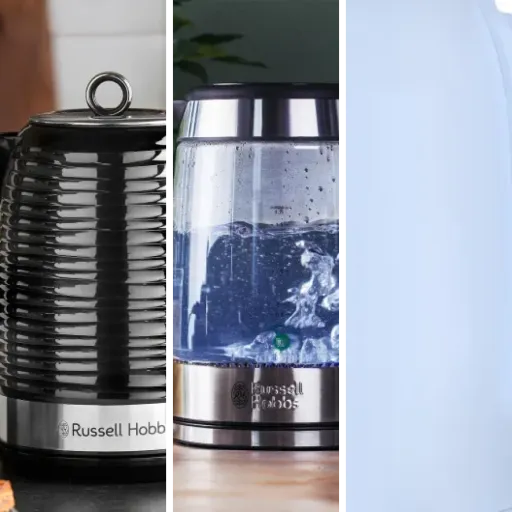
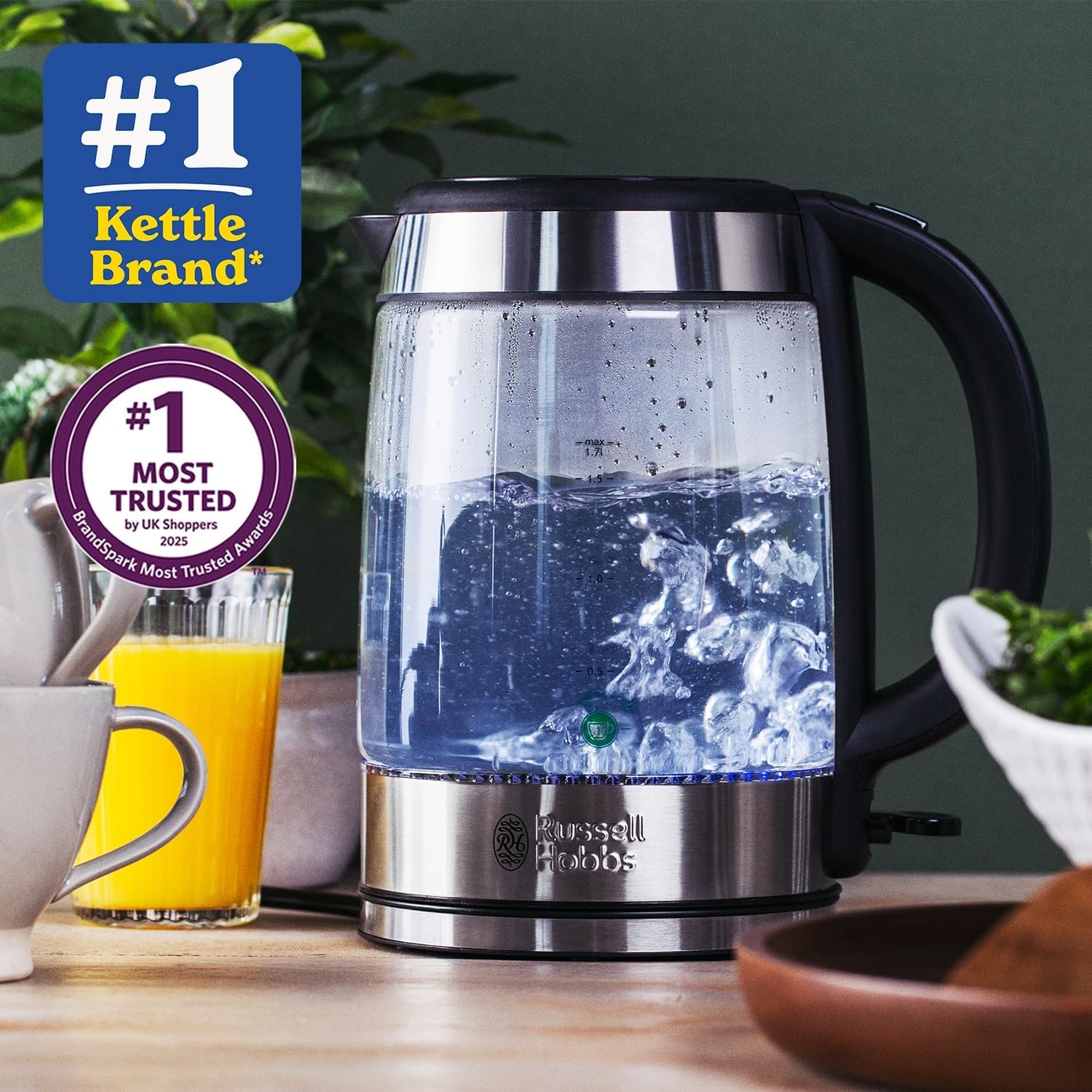
The first thing you notice is the glass body and the blue light when it boils. On the counter it looks cleaner and a bit more modern than those chunky white plastic kettles. You can see exactly how much water is inside, which is actually handy if you’re the type who just eyeballs it instead of reading tiny level markers. Compared to my old cheap supermarket kettle, this one definitely feels a bit more solid and less "disposable".
In practice though, you quickly move past the looks and focus on how fast it boils, how loud it is, and whether it spits water everywhere when you pour. Here, it does a pretty solid job. The 3kW power means a mug’s worth of water boils in around a minute or so, which matches what’s advertised. Full capacity obviously takes longer, but still feels reasonably fast. Noise-wise, it’s not whisper-quiet or anything, but it’s no worse than any other 3kW kettle I’ve owned. You can still have a conversation in the kitchen while it’s running.
So overall, my first impression was: good-looking kettle, heats water quickly, nothing mind-blowing. The more I used it, the more the little details started to stand out: the lid button, the pour spout, the limescale filter, and how easy (or not) it is to keep the glass looking clean. It’s not perfect, and there are definitely cheaper kettles that will just boil water just as well, but if you care a bit about aesthetics and like seeing the water boil, this one sits in a pretty reasonable middle ground for price versus what you get.
Value for money: decent, but there are cheaper options
In terms of value, this Russell Hobbs glass kettle sits in that middle zone. It’s not bargain-basement cheap, but it’s also not in the pricey "fancy temperature control" category. For the money, you’re basically paying for a fast 3kW boil, the glass body with illumination, and a known brand that generally doesn’t feel like total junk. If all you care about is boiling water as cheaply as possible, you can definitely find plastic kettles for less that will do the core job just as well.
Where it earns its price is in the overall feel and look. On the counter, it just looks nicer than a £15 supermarket jug kettle, and the glass makes it easier to see water levels and keep an eye on what’s going on inside. The removable anti-limescale filter, concealed element, and 360-degree base are all fairly standard at this price, but it’s good that they’re there. You’re not paying extra for weird gimmicks you’ll never use. You’re paying a bit more for a cleaner design and slightly better build than the cheapest options.
One thing to keep in mind is ongoing maintenance. Because it’s glass, you’ll probably descale it more often just to keep it looking presentable. That’s not a direct cost, but it is a bit of extra effort compared to a metal kettle where you don’t see the scale as clearly. If you’re lazy about that stuff, you might end up annoyed by how quickly it looks cloudy. That said, performance-wise, it holds up: fast boil, reliable auto shutoff, good capacity. For daily use in a small household or family, it feels like good value for money, just not some crazy bargain.
If you’re comparing this to higher-end kettles with temperature presets and fancy features, this one is simpler but cheaper, and for most tea/coffee drinkers that’s perfectly fine. If you’re comparing it to the absolute cheapest plastic kettles, you’re paying a bit more mainly for the look and brand. Personally, I think the price is fair for what you get, but if your budget is tight and you don’t care how it looks, you can save some money and still get hot water from a no-name kettle.

Design: looks good, but not everything is perfect
The design is clearly one of the main selling points. The glass body with the blue illumination looks good on the counter, especially in a slightly dim kitchen. It’s not some crazy light show, but the water lighting up blue while it boils is a nice touch. That said, the LEDs are not as bright as in some of the product photos you see online. They’re visible, but if you expect a glowing neon lamp, you’ll probably be a bit underwhelmed. For me, it’s enough: you can see it’s on, and it looks a bit nicer than a plain kettle.
The brushed stainless steel accents and the black handle give it a clean, modern look. Compared to my old all-plastic kettle, this one just looks less cheap. The glass also makes it easier to see if you’ve overfilled it, and you can literally watch the water start to bubble. In practice, the 1.7L size is pretty standard – it doesn’t feel bulky, and it fits under my tap without weird angles. The footprint on the base is compact enough that it doesn’t hog the whole worktop.
One thing I like in the design is the button to open the lid. You press it near the top of the handle and the lid flips up. That’s handy when you’re filling it one-handed at the sink. On my previous kettle, I had to yank the lid up manually, which was annoying when it was hot and slightly stuck from steam. Here, the button mechanism feels smooth and has worked fine so far. The spout is advertised as a "perfect pour" spout. Marketing words aside, it does pour pretty cleanly. I haven’t had much in the way of dribbling or splashing when pouring into mugs or a teapot, which is more than I can say for some cheaper kettles I’ve used.
On the downside, because it’s glass, you see every bit of limescale build-up. After a couple of weeks in a hard water area, you get that cloudy layer at the bottom and little white bits on the sides. It doesn’t affect function, but it makes the kettle look dirty faster than a metal one, so you end up descaling more often if you care about appearance. Also, the handle is comfortable enough but quite rigid plastic – it doesn’t feel premium, just "fine". Overall, the design is solid: not luxury, not junk, just a good-looking everyday kettle with a few small compromises.
Materials and build: glass looks nice but needs more care
The kettle is mainly glass and stainless steel, with a plastic handle and lid. The glass body is the big selling point. It looks cleaner than plastic, doesn’t pick up stains in the same way, and you can instantly see how much water you’ve got. Compared to a cheap plastic kettle, it also doesn’t have that slight plastic smell when new, which I appreciate. I could use it pretty much straight away without that usual "boil and dump the first few rounds" routine, even though I still did one rinse boil out of habit.
The stainless steel ring at the base and around the top feels sturdy enough. It’s not super thick, but it doesn’t feel flimsy. The base plate where the heating element is concealed is also stainless steel. Because the heating element is hidden, you don’t have that old-school metal coil sitting in the water, which makes cleaning a bit easier and generally looks better. The limescale tends to build up on the flat metal base instead, and you just descale it from time to time.
The handle is plastic, which is pretty standard at this price. It doesn’t get hot, which is the main thing. It’s not soft-touch or particularly fancy, but it’s not slippery either. The lid is also plastic with a bit of metal trim, and the hinge feels okay so far. I wouldn’t go slamming it hard every day, but normal use hasn’t shown any wobble or looseness yet. At about 1.2 kg empty, the kettle is light enough that the glass doesn’t feel fragile in the hand. When full, it obviously gets heavier, but still manageable for everyday use.
The trade-off with glass is maintenance. In a hard water area, you’ll see scale quickly. Inside, the anti-limescale filter in the spout catches some of the bits, which helps, but it doesn’t stop the build-up on the base. The filter is removable and washable, which is good, but you do need to remember to clean it or it can look pretty grim over time. Overall, the materials feel decent for the price – not high-end, not junk. If you’re clumsy or have kids that might knock it around, a full stainless or plastic kettle might survive abuse better, but for normal kitchen use, this feels solid enough.

Durability and day-to-day wear
Durability with a glass kettle is always the big question. I haven’t smashed it (yet), but I’ve been using it daily and it’s handled normal knocks and bumps without any cracks or chips. I’m not babying it, but I’m also not slamming it on granite worktops. If you treat it like a regular kitchen appliance and not like a football, it feels like it will hold up fine. The handle is still solid, no wobble at the join, and the lid mechanism hasn’t started sticking or misaligning.
Where you do see wear is in the limescale build-up. In a hard water area, you’ll notice a cloudy layer forming on the metal base pretty quickly – within a week or two if you use it a lot. Because the body is glass, you see every bit of it. Functionally, it still boils water, but it makes the kettle look older and dirtier than it actually is. Descaling with a standard kettle descaler or vinegar mix sorts it out, but this is something you’ll need to do regularly if you care about the look. The washable anti-limescale filter in the spout also needs a clean every now and then; it’s easy enough to pop out and rinse.
The 360-degree base and the power connection feel robust enough. I’ve had cheaper kettles where the base contact started to feel loose after a year, but this one still sits firmly and doesn’t cut out if you nudge it slightly while boiling. The cord is standard length – not especially long, not annoyingly short – and hasn’t frayed or twisted weirdly. The stainless steel trim has picked up a few minor surface marks from daily use, but nothing dramatic.
Overall, I’d say the durability is pretty solid for a mid-range kettle. The main risk is user error – dropping it, hitting it against a tap, or ignoring limescale forever. If you know you’re rough with stuff or you live in a very hard water area and hate cleaning, a solid metal kettle might hide the wear better. But if you’re okay with descaling every so often, this one feels like it should last a good few years of normal family use.
Performance: it boils fast and does the job
On the performance side, this kettle is pretty straightforward: 3kW power, 1.7L capacity, and a fast boil. In real life, that means a single mug’s worth of water boils in around a minute or slightly over, and a full kettle is done in a few minutes. It’s noticeably quicker than the 2.2kW plastic kettle I had before. If you’re making back-to-back drinks for a few people, that speed actually makes a difference – you’re not standing there waiting ages between rounds of tea or coffee.
The auto shutoff works reliably. Once it reaches the boil, the switch snaps back to off and the blue light goes out. I’ve never had it keep boiling or fail to stop. There’s also boil-dry protection, so if you accidentally switch it on with almost no water, it cuts out instead of cooking the element. I tested this by mistake once when I misjudged the level – it just clicked off after a short while and didn’t smell burnt or anything, which is reassuring.
Noise-wise, it’s about what you’d expect from a 3kW kettle: there’s a noticeable whoosh as it heats up, but it’s not ridiculous. You can still talk over it or listen to the radio. Compared to my old one, I’d say it’s similar or slightly quieter, but not by a huge margin. The illumination while boiling is mainly cosmetic, but it also makes it obvious from across the room that the kettle is on. No need to squint at a tiny indicator light.
Pouring performance is decent. The "perfect pour" spout is mostly marketing speak, but in practice it does pour cleanly. I didn’t get random streams running down the side or splashing everywhere, as long as I didn’t overfill it. The minimum fill line is low enough for a single cup, which is nice when you just want one drink and don’t want to waste energy boiling loads of water. Overall, in terms of performance, it’s nothing special but effective: boils fast, shuts off correctly, pours fine. That’s honestly all most people need from a kettle.

What you actually get out of the box
Out of the box, the Russell Hobbs Illuminating 1.7L kettle is basically three parts: the glass kettle itself, the 360-degree base, and the small instruction booklet that you’ll probably skim once and forget. There are no fancy extras or accessories. It’s a straightforward appliance: plug in base, put kettle on base, fill with water, flick the switch. If you’ve used any electric kettle before, you don’t need to learn anything new here.
The kettle has a 1.7L capacity, which is pretty standard and enough for a family. For context, that’s roughly 6–7 decent-sized mugs of tea. The power is 3000W, which is what gives you the fast boil. This isn’t some low-power travel kettle; it’s clearly meant to live on the kitchen counter and be used several times a day. The base is a 360-degree design, so you can drop the kettle on it from any angle. As a right-hander I don’t care much, but it’s actually nice for left-handed people or for tight spaces where you end up twisting it around.
The handle is plastic with a black finish, and the trim around the base and top is brushed stainless steel. The body is glass, so you see all the water and the blue illumination when it’s boiling. The water level markings are on the glass, but honestly, you mostly just look at the actual water level instead of the numbers. There’s also a simple on/off lever near the base with a light indicator. Nothing fancy, but it’s clear when it’s on or off.
Overall, the presentation is pretty minimal and simple. No overcomplicated controls, no temperature presets, no smartphone nonsense. Just a basic fast-boil kettle with a glass body and a light. If you want lots of settings and temperature control for coffee brewing, this isn’t it. If you just want something that looks nicer than a plastic jug and boils water quickly for tea, instant noodles, and coffee, what you get in the box matches that expectation quite well.
Pros
- Boils water quickly thanks to 3000W power
- Glass body with illumination looks good and makes water level easy to see
- Clean pour spout and reliable auto shutoff in daily use
Cons
- Glass shows limescale build-up quickly, needs regular descaling
- LED illumination is weaker than product photos suggest
- Plastic handle and lid feel basic rather than premium
Conclusion
Editor's rating
Overall, the Russell Hobbs Illuminating 1.7L Glass Kettle is a solid everyday kettle that looks better than most plastic options and boils water quickly. The 3kW power, 1.7L capacity, and simple controls make it very easy to live with. The glass body and blue illumination are nice touches, even if the lights aren’t as bright as some photos suggest. Day-to-day, it gets the job done: fast boil, clean pour, reliable auto shutoff, and a base that doesn’t feel cheap.
It’s not perfect. The glass shows limescale quickly, so if you’re in a hard water area you’ll be descaling more often if you care about appearances. The handle and lid are basic plastic – functional, but nothing fancy. And if you only care about boiling water for the lowest possible price, there are cheaper plastic kettles that will do the same core job. But if you want something that looks decent on the counter, lets you see the water level clearly, and comes from a brand with a decent track record, this is a good middle-ground option.
I’d recommend it to people who use a kettle several times a day, like the look of glass, and don’t mind a bit of extra cleaning to keep it clear. If you’re clumsy, have kids who might knock it around, or live somewhere with very hard water and hate descaling, you might be happier with a sturdier-looking metal kettle instead. For most households though, it’s a good value, no-nonsense choice that does exactly what you need without trying to be clever.