Summary
Editor's rating
Value for money: worth it or overkill?
Design and ergonomics: built for pouring, not for showing off
Materials and build: solid enough, but not “luxury”
Durability and long-term reliability
Heating, temperature control, and real-world use
What this Bonavita kettle actually offers
Pros
- Accurate enough variable temperature control with handy presets and 1-degree steps
- Gooseneck spout and ergonomic handle make controlled pour-over brewing easy
- Proven durability with many users reporting years of daily use without failure
Cons
- Price is high compared to basic kettles that simply boil water
- Build and finish feel decent but not truly premium for the cost
- Temperature can overshoot by a couple of degrees, which might annoy perfectionists

Specifications
View full product page →| Brand | Bonavita |
A kettle for people who actually care about water temperature
I’ve been using variable-temperature kettles for coffee and tea for a while, and the Bonavita 1L gooseneck is one I’ve spent a good amount of time with. This isn’t your random $15 plastic kettle from the supermarket. It’s clearly aimed at people who care about hitting 185°F or 205°F on purpose, not just “sort of hot”. If you’re doing AeroPress, pour-over, or you’re fussy about green tea, you’re exactly the target here.
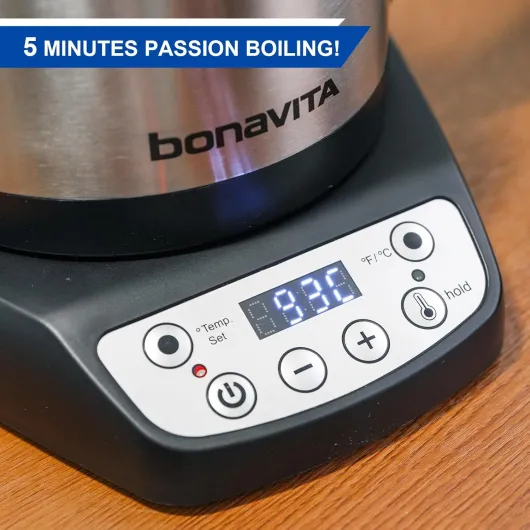
In day-to-day use, the first thing that stands out is how simple the controls are. One button to cycle through presets, +/- buttons to nudge the temp by one degree, and a hold button. That’s pretty much the whole story, and honestly that’s all you need. Compared to some overcomplicated kettles with apps and weird touch panels, this one feels almost old-school in a good way.
On the other hand, it’s not cheap, especially when you compare it to a basic electric kettle that just boils water. You’re paying extra for the gooseneck spout and the accurate temperature control. If you don’t use those two things, you’re basically burning money. I’ve used both cheap kettles and this Bonavita side by side, and for instant noodles or random cooking tasks, there’s zero magic here – it’s just hot water.
So the way I see it, this kettle makes sense if you’re brewing coffee or tea often and you actually use specific temperatures. If you just want boiling water as fast and as cheap as possible, there are better options. The rest of this review is based on using it mainly for pour-over coffee, AeroPress, and a bunch of tea, a couple times a day over a decent stretch of time.
Value for money: worth it or overkill?
Let’s be honest: this thing is not cheap. When it sits around the $90–$100 mark, it’s easily 3–5 times the price of a no-name kettle that just boils water. If you’re only occasionally heating water for instant coffee or ramen, it’s hard to justify the extra cost. A basic kettle will do the same core job: turn cold water into hot water. So value really depends on how you use it and how much you care about control and durability.
If you’re into pour-over, AeroPress, or you drink a lot of tea that needs specific temps (green, white, oolong), then the value starts to make sense. You’re paying for:
- Precise temperature control with presets and 1-degree steps
- Gooseneck spout for controlled pouring
- Hold function that keeps water at temp for an hour
- Proven longevity – people using it for many years
On the downside, the overall feel and finish don’t quite match the price. It’s decent, but it doesn’t feel like a luxury product when you hold it. Some people also expect absolute temp precision within 1°C every time, and it’s just not that perfect. For the price, a few folks will feel it should be a bit more polished or more accurate. And if you don’t use the gooseneck or the presets much, then yeah, you basically overspent for features you’re ignoring.
So my take: for coffee and tea nerds who brew daily, the Bonavita offers good value over the long run. For casual users who just want boiling water, it’s overkill and you’d be happier with a cheaper kettle and money left over for beans or tea. It’s not a rip-off, but it’s also not a bargain. It’s a specialized tool that’s fairly priced if you actually use what it offers.
Design and ergonomics: built for pouring, not for showing off
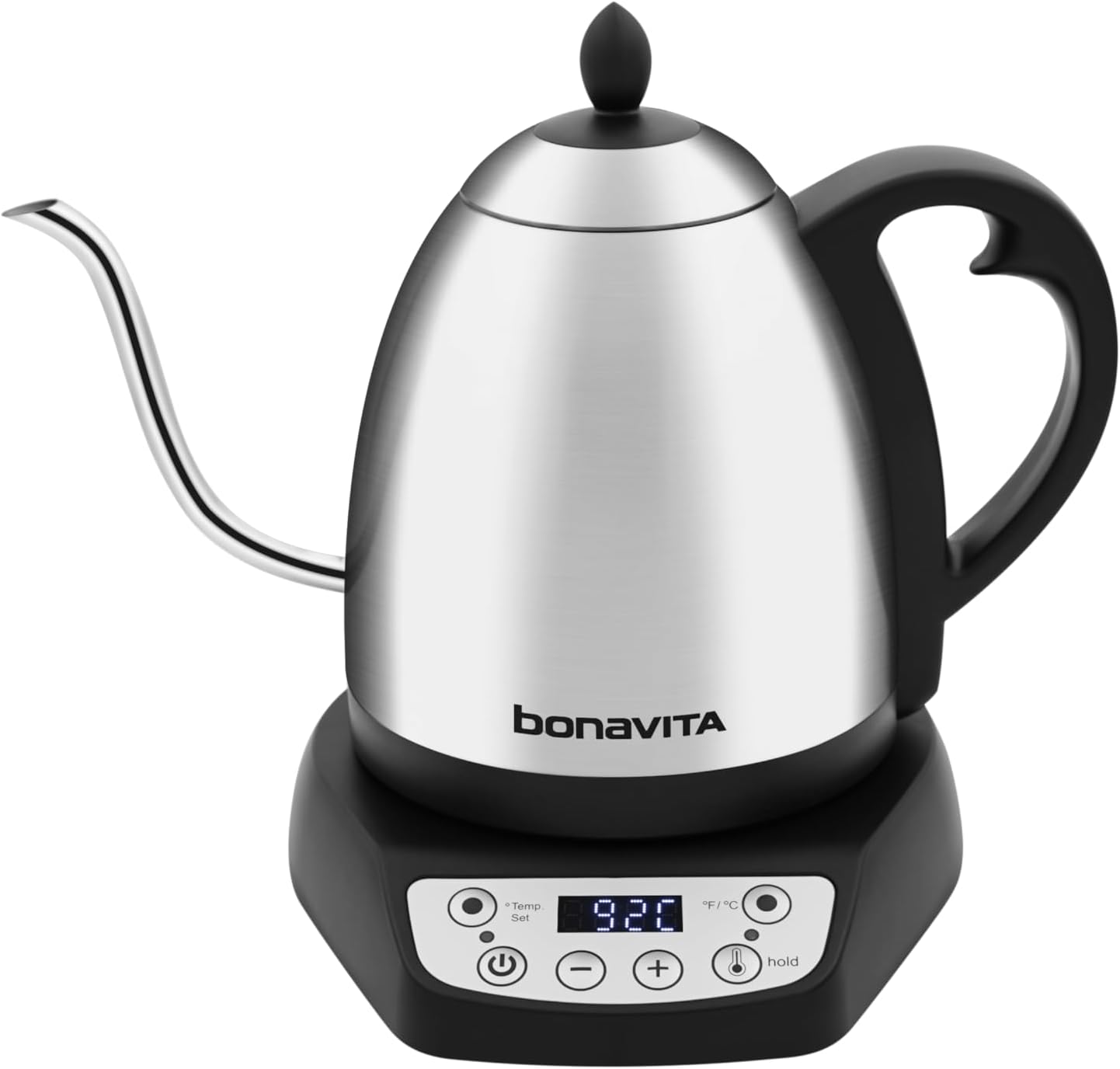
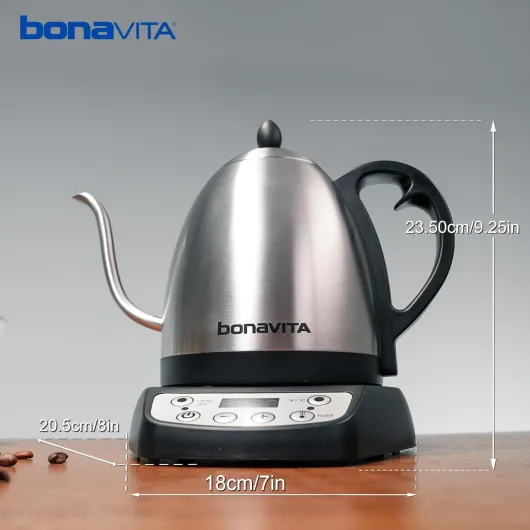
Design-wise, this kettle is clearly built around the gooseneck spout and the handle. The body is brushed stainless steel with a black plastic base and handle. It’s not something you buy to impress people on Instagram, but it looks fine on a countertop. The footprint is pretty compact at about 7.5" x 7", and it’s not tall enough to be annoying under cabinets. I’ve had bulkier kettles that were harder to place; this one tucks in nicely.
The gooseneck spout is the main star. It gives you a slow, controlled pour, which is exactly what you want for pour-over or AeroPress. You can easily control the flow from a thin trickle to a steady stream just by tilting, without water suddenly dumping out. Compared to a regular short spout kettle, it’s much easier to hit the coffee bed evenly without splashing or digging channels in the grounds. That does mean the spout is a bit more fragile – you don’t want to throw this into a moving box and let it bounce around. It has some flex, and if you bend it badly, you’re going to ruin the pour.
The handle feels decent in the hand: not luxury, but grippy enough and shaped so the kettle feels balanced when full. With 1 liter of water, the weight is manageable and the balance point is good, so you’re not fighting wrist strain while doing a slow pour. I’ve used some cheaper gooseneck kettles where the handle angle made it tiring; this one is better thought out. The base has clearly labeled buttons and a bright display, so even half-asleep in the morning, it’s easy to punch in the temp you want.
There’s also a plastic cover for the base to protect it from splashes. It doesn’t look fancy, but it’s practical if you tend to drip a bit when you lift the kettle. Overall, the design is functional and focused on usability. It’s not a design object, it’s a tool. If you want something that looks ultra premium, this isn’t it. But if you care more about how it pours than how it photographs, it gets the job done very well.
Materials and build: solid enough, but not “luxury”
The kettle body is made of 304 stainless steel, which is a pretty standard food-grade stainless you see in a lot of kitchen gear. The parts you touch – handle, some trim, parts of the lid – are BPA-free plastic. The base is all plastic with metal contacts where the kettle sits. Overall, it feels reasonably sturdy in the hand, but it doesn’t give that heavy, tank-like vibe you get from some higher-end kettles. It’s light, which is nice for pouring, but it also means it doesn’t feel super premium.
Inside the kettle, the stainless has held up well for people using it daily for years. You will get mineral buildup (scale) if you have hard water, but that’s normal for any kettle. A simple vinegar + water run at high temp usually clears it. Some users say they spotted what looked like rust at some point, but it turned out to be either scale or stains that came off with vinegar. So I wouldn’t panic about actual corrosion unless you really abuse it or never clean it. The spout is welded on and generally holds up fine, as long as you don’t bang it around or crush it in a cabinet.
The plastics don’t feel cheap, but they also don’t scream high-end. Buttons on the base are a good example: they’re basic, but people report hammering that preset button multiple times a day for years without it failing, so functionally they’re solid. The base contacts (the metal rings and pins) can occasionally get a bit finicky if there’s dust or minor oxidation, but usually just rotating the kettle on the base a few times sorts it out. Not ideal, but also not a deal-breaker.
In short, materials are decent and safe for daily use, but if you’re expecting “premium luxury appliance” levels of finish at this price, you might be a bit underwhelmed. It feels like a well-made tool, not a showpiece. For me, that’s fine. I care more that the metal doesn’t flake, the plastic doesn’t stink, and the contacts keep working. On those points, it’s pretty solid.
Durability and long-term reliability
This is where the Bonavita actually stands out compared to a lot of modern appliances: people are reporting 5+ years, even around 10 years of use without the thing dying. That’s rare these days. I’ve had cheaper kettles fail within 18–24 months (usually the base or the switch dies). With this one, long-term users say it just keeps going. Buttons still work, the display still shows clearly, the heating element still does its job.
You do need to descale it from time to time, especially if your water is hard. If you ignore that, you’ll get flakes of calcium that can come out through the gooseneck because the spout pulls from near the bottom. That’s not a defect, that’s just how mineral buildup works. A 50/50 vinegar and water run at high temp usually strips it off. If you’re picky about bits in your drink, either clean more often, use filtered/distilled water, or just don’t drink the last few drops from the cup. That’s honestly an issue with any kettle that touches hard water regularly.
There are a few weak spots. The gooseneck, as said, is not something you want to bend or smash. Treat it like a tool, not a hammer. The base contacts can occasionally misread the kettle or show weird temps if there’s some dirt or slight oxidation, but rotating the kettle while it’s seated tends to fix it. Some users reported random temperature jumps after more than a year, but Bonavita customer service apparently sent replacements even out of warranty in some cases, which is a good sign.
Overall, for an electric appliance that heats water daily, the durability is pretty encouraging. It’s not indestructible, but it doesn’t feel disposable either. If you take basic care of it – descaling every now and then, not abusing the spout, not soaking the base – you can reasonably expect it to last several years. In my book, that’s good value compared to buying a cheap kettle every 1–2 years when it craps out.
Heating, temperature control, and real-world use
In terms of raw performance, this kettle heats fast enough and holds temperature reliably. With 1200W, a full liter from room temp to near boiling takes about 4–5 minutes. Half a liter is obviously quicker. Compared to a microwave or a cheap basic kettle, it’s in the same ballpark or a bit faster, but the real difference is that you know exactly where you’re stopping: 176°F for AeroPress, 190°F for lighter roasts, 205°F for classic pour-over, or 140°F if you want warm water that won’t burn your mouth.
The 6 preset temps are genuinely handy. In practice, I ended up using the presets almost all the time instead of dialing in exact numbers. For example: I’d hit 176°F for my coffee, then after brewing, tap through to 208°F to top off the mug with hotter water. The kettle remembers the last used setting when you turn it back on, which saves time. The one-degree adjustment is nice if you’re picky, but most people will live on the presets and be happy. Temperature accuracy is close enough: some people measured it being about 2°F off, which is pretty normal for this type of appliance.
The hold function is one of the best parts. You hit “hold”, walk away, and it keeps the water at your target temp for up to an hour. That’s great if you’re making multiple cups in the morning or you like to sip tea all day. Without hold, it reaches temp and then starts cooling down, which is fine for a single brew but annoying for repeated use. I do think it’s slightly annoying that you have to remember to press the hold button; I’d prefer a setting that defaults to hold until you turn it off. But once it’s part of your routine, it’s fine.
Beyond coffee and tea, I ended up using it for random kitchen tasks: preheating thermos flasks, starting pasta or rice water, instant soups, sterilizing small utensils. Anywhere you need hot water fast, it works. So performance-wise, it’s not mind-blowing, but it’s consistent. It heats quickly, it hits close to the temp you want, it pours smoothly, and it doesn’t throw tantrums. That’s pretty much what you want from a kettle at this level.
What this Bonavita kettle actually offers
On paper, the Bonavita 1L digital gooseneck kettle is pretty straightforward: 1-liter capacity, 1200 watts, temperature range from 140°F to 208°F (in practice it maxes out right around boiling, even if the display says slightly less), and a hold function that keeps the water at your chosen temp for up to 60 minutes. It has 6 preset temperatures (140, 176, 185, 190, 205, 208°F) plus the option to adjust by one degree if you want to be picky.
The base has a small LED display that shows the current temperature and your target. You can switch between Fahrenheit and Celsius, and it remembers your last setting, which is nice if you don’t want to cycle through options every single morning. The kettle lifts off the base and can spin 360° on it, so you’re not fighting with a fixed position or a stiff connector. In regular use, the 1200W power feels decent: a full liter from room temp to near boiling takes roughly 4–5 minutes, which is in line with other mid-range electric kettles I’ve used.
Bonavita pushes the idea of “precision” pretty hard, and in practice, it’s reasonably accurate, but not laboratory-level. You’ll see people measuring and finding it’s off by a degree or two, which for normal coffee and tea is totally fine. If you’re the kind of person who freaks out over 2°C difference, you might be annoyed. But for most home brewers, it’s more than accurate enough, and the presets make it stupidly easy: one press for 176°F for lighter coffee, another for 185°F or 205°F depending on your habit.
Overall, in terms of features, it’s pretty solid: not full of gimmicks, but it covers the important stuff for coffee and tea nerds. No Bluetooth, no app, no voice assistant nonsense. It heats water, lets you pick an exact temperature, and keeps it there for an hour if you want. For me, that’s the sweet spot, but again, if you just want boiling water, most of these features will feel like overkill you paid extra for.
Pros
- Accurate enough variable temperature control with handy presets and 1-degree steps
- Gooseneck spout and ergonomic handle make controlled pour-over brewing easy
- Proven durability with many users reporting years of daily use without failure
Cons
- Price is high compared to basic kettles that simply boil water
- Build and finish feel decent but not truly premium for the cost
- Temperature can overshoot by a couple of degrees, which might annoy perfectionists
Conclusion
Editor's rating
The Bonavita 1L digital variable temperature gooseneck kettle is a solid, practical tool for people who actually care about how hot their water is and how it hits the coffee bed. It heats quickly, the presets are genuinely useful, the hold function makes mornings less chaotic, and the gooseneck spout gives you the kind of controlled pour that basic kettles just can’t match. Long-term users seeing 5–10 years of service without major issues is a strong point in its favor.
It’s not perfect. The build feels more “good appliance” than “premium gear”, the temperature can be off by a couple of degrees, and you have to remember to press the hold button if you want stable temp over time. The price will also feel high if you’re not really using the precision features. If all you want is boiling water for tea bags and instant noodles, this is more kettle than you need.
I’d say it’s a good fit for: home baristas doing pour-over, AeroPress fans, heavy tea drinkers who use different temps, and anyone who wants one kettle that will likely last several years. People who should probably skip it: casual users, students on a tight budget, or anyone who just slams water to a boil and doesn’t care about the exact number on the display. For the right user, it’s a pretty solid everyday workhorse; for the wrong user, it’s just an expensive way to make hot water.