Summary
Editor's rating
Is it worth the money compared to other options?
Compact and basic, but thought through for travel
All plastic build: light and practical, but feels budget
How it holds up and the risk of duds
Boil time, dual voltage, and real-world use on low power
What you actually get in the box
Pros
- Very compact and lightweight, easy to pack in bags or suitcases
- Low 600W power is suitable for campsites, caravans, and power banks
- Dual voltage switch allows use in different countries
- Includes two plastic cups and has cord storage for tidier packing
Cons
- All-plastic build feels cheap and not very premium
- Boil time is noticeably slower than a standard 2kW kettle
- Some reports of early failures suggest hit-and-miss durability

Specifications
View full product page →| Brand | Quest |
Tiny kettle, big question: is it actually useful on the road?
I picked up the Quest Black Compact Travel Kettle mainly for camping weekends and hotel stays where you either get no kettle or some huge 3kW thing that trips the electrics on a campsite. On paper it ticked a lot of boxes: 0.5L capacity, 600W, dual voltage, and it even comes with two cups. I wanted something that could run on low amps and actually fit in a backpack without hogging all the space.
After a couple of weeks of use in a camper and a few nights in budget hotels, I’ve got a fairly clear idea of what this kettle does well and where it’s just “meh”. It’s not a premium gadget, it’s basically a cheap plastic kettle that’s been shrunk down and given dual voltage. That’s the mindset you need to have when you buy it.
In day-to-day use, the main thing that stood out is how practical it is for simple tasks: quick tea, coffee, instant noodles, or heating water for toddler milk. It’s not fast, it’s not fancy, but it does heat water reliably most of the time. I didn’t baby it; I threw it in a bag, used it on an extension lead, and filled it to max line regularly.
If you’re expecting home-kettle performance, you’ll be disappointed. But if you just want something that sips power and boils enough water for one or two drinks without taking over your luggage, then it starts to make sense. The rest of this review is basically: what it’s good at, where it feels cheap, and whether I think it’s worth the money compared to just using whatever kettle you find on-site.
Is it worth the money compared to other options?
In terms of value, I’d call the Quest travel kettle good but not mind-blowing. You’re paying for three main things: compact size, low wattage, and dual voltage. If you actually need those three, it’s a sensible buy. For camping, caravans, motorhomes, or budget hotels where you don’t trust the provided kettle, it earns its keep pretty quickly. The fact it comes with two cups is a small bonus that saves you packing extras.
Where the value feels a bit weaker is if you compare it to just using a normal full-size kettle at home. For the same money, you could probably get a faster, sturdier standard kettle, but it won’t have the travel-friendly size or dual voltage. So you have to be honest about your use case. If it’s mainly for home, skip this and get something bigger. If it’s for the road, then the compromises suddenly feel reasonable.
The Amazon rating around 4.2/5 lines up with my feeling: most people are happy because it does what they need, but there are enough complaints about early failures and the cheap feel that it’s not perfect. I wouldn’t call it a bargain of the century, but for what it offers, the price is fair. You’re not overpaying for fancy branding or design, you’re basically paying for function.
If you travel a few times a year and like your own reliable kettle, the cost spreads out nicely. If you’re only going to use it once every couple of years, then it might be less justifiable, especially if your accommodation usually provides a kettle anyway. For regular campers or caravan users needing low wattage, though, I’d say the value is pretty solid.
Compact and basic, but thought through for travel
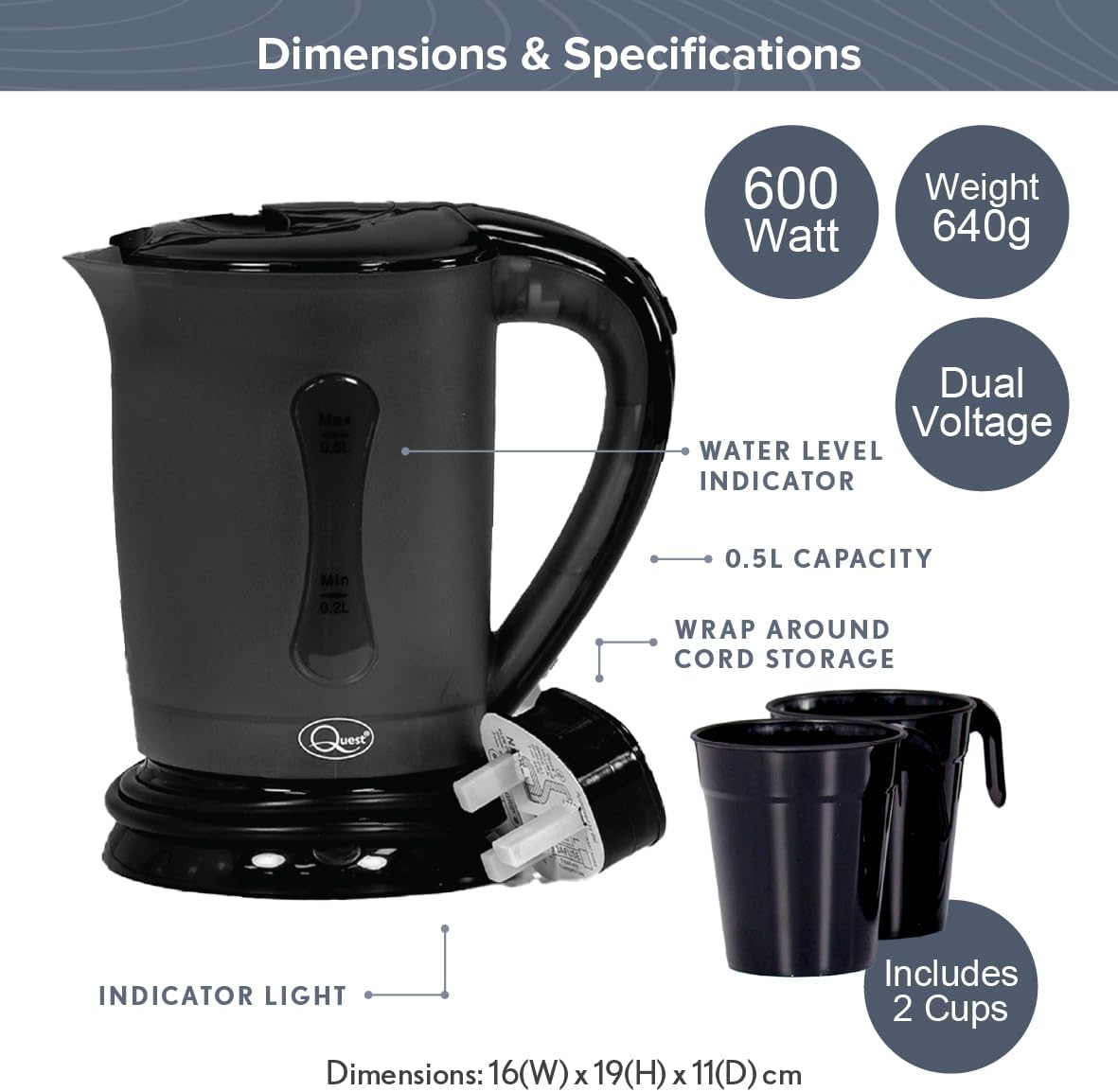
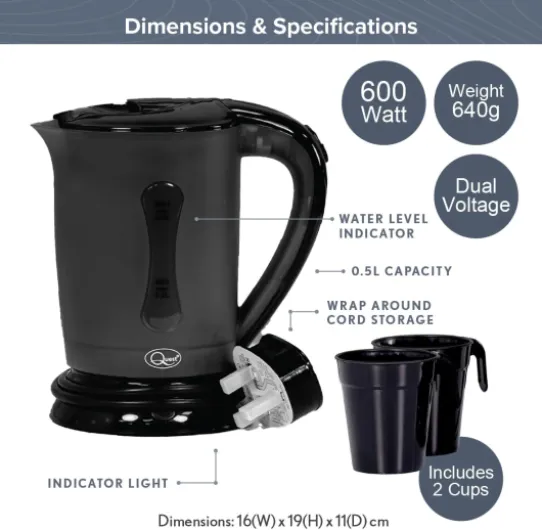
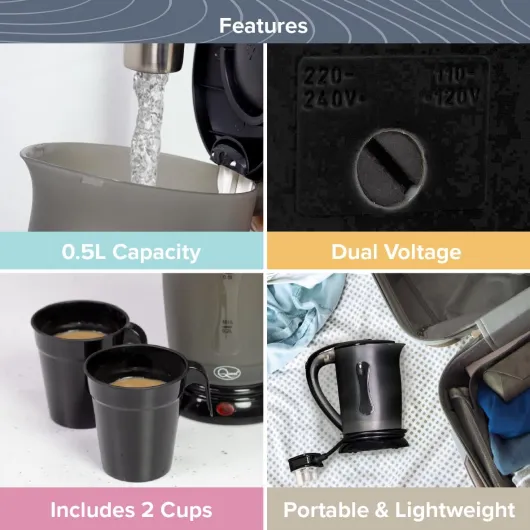
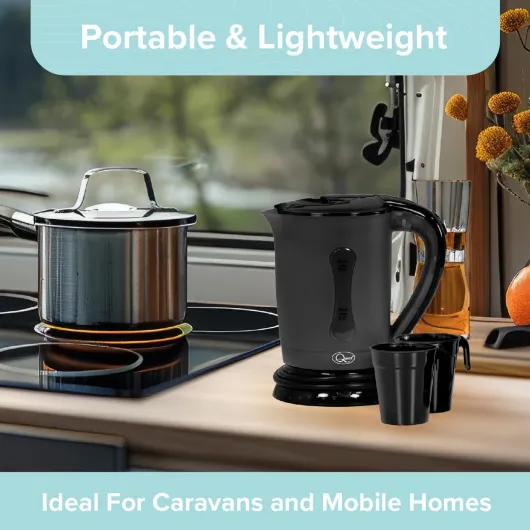
Design-wise, the Quest travel kettle is pretty straightforward. It’s a small black plastic kettle with a side water window, a simple on/off switch with an indicator light, and a flip-top lid. The main thing I noticed is the size: it really is compact. It fits easily in a backpack side pocket or a corner of a suitcase. Dimensions are roughly 16 x 10 x 17 cm, and it weighs about 0.5 kg, so it doesn’t feel like you’re lugging around a brick.
The handle is comfortable enough for what it is. It’s not cushioned or anything, but it’s shaped so you can pour one-handed without feeling like you’ll drop it. The spout is small but pours cleanly if you don’t overfill past the max line. I didn’t get much dribbling as long as I didn’t try to rush the pour. The flip-top lid opens wide enough to fill from a tap without having to angle it awkwardly, which is handy in cramped campsite sinks.
One design detail I did like is the cord storage in the base. You can wrap the cable around and tuck the plug in, so it doesn’t snake around your bag. It’s a small thing, but when you’re jamming it into a packed rucksack, a loose cable is exactly the kind of thing that snags on everything. This one stays reasonably tidy. The indicator light is clear: it’s on, it’s heating; it’s off, it’s done.
On the downside, it looks and feels cheap. It’s all plastic, and the finish is more “budget appliance” than anything else. I don’t mind that, but if you’re expecting something stylish on a hotel desk, this isn’t it. For me, design here is about space saving and usability, and in that sense, it’s pretty solid. It’s clearly built with travel in mind rather than kitchen aesthetics.
All plastic build: light and practical, but feels budget
The whole thing is basically plastic: body, handle, lid, and the included cups. That’s not a surprise at this price, and for travel it actually has some benefits. It keeps the weight down and you don’t have to worry about dents or chips like you would with metal. I tossed it into a bag with other gear a few times and it didn’t pick up any obvious marks or cracks, so in terms of basic toughness, it’s fine.
The plastic doesn’t feel premium, though. It’s more on the thin, hollow side rather than thick and sturdy. When it’s empty, it feels a bit toy-like. Once it’s filled with water, it feels more solid in the hand. The water level window is clear enough to read and didn’t fog up permanently or anything. At first boil, there was a slight plastic smell, which is pretty standard with cheap kettles. After a couple of full boils and rinses, that mostly went away. I’d definitely recommend doing a few clean boils before actually drinking from it.
The included cups are the same story: light, slightly flimsy plastic, but not unusable. They don’t deform with hot water, and the handles stay cool. They’re fine for camping or hotel use, but I wouldn’t want to use them daily at home. If you’re fussy about how plastic tastes, you might not love them, but for short trips they’re okay. I ended up keeping them as backup and mostly using my own mug.
One thing to flag is safety: it’s not double-walled, so the body gets warm, but not insanely hot like some metal kettles. I could touch the sides briefly without burning my fingers, but you definitely notice the heat. For me, the material choice is clearly about cost and weight, and in that context, it gets the job done. Just don’t expect it to feel like a high-end appliance.
How it holds up and the risk of duds
Durability is a bit mixed based on my experience and what I’ve seen from other buyers. My own unit has held up fine so far: a couple of weeks of fairly regular use, some travel, being packed and unpacked, and no issues. No leaks, no weird noises, and the switch still feels okay. For a lightweight travel kettle, that’s about what I expected. I don’t treat it gently, but I’m not abusing it either.
However, reading through other reviews, there are clearly some quality control hits and misses. You’ll see the odd comment about the kettle dying after a couple of weeks or just not turning on one day, even after checking the fuse. That tells me there are probably some bad batches out there. It’s not constant, because there are also loads of people saying theirs has lasted ages, but it’s something to keep in mind if you’re unlucky.
The plastic body itself seems fairly resistant to casual knocks and scrapes. I’ve bumped it in the sink and dropped it from a low height onto a carpet, and it survived without cracks. The hinge on the lid doesn’t feel especially strong, though. I wouldn’t force it open or slam it shut; it feels like the kind of thing that could get loose over time if you’re rough with it. Same for the power switch: it’s fine now, but you can tell it’s not built like a tank.
Overall, I’d say durability is acceptable for the price and purpose. This isn’t something I’d expect to last 10 years of daily use, but as a travel-only kettle you pull out for trips, it should be okay as long as you get a good unit and don’t abuse it. If you’re very unlucky and get a dud that dies in the first month, it’s annoying, so I’d test it thoroughly as soon as you receive it rather than leaving it untouched until your holiday.
Boil time, dual voltage, and real-world use on low power
Performance is where you really see the trade-off of that 600W power. This is not a fast kettle. With 0.5L of cold tap water, I was getting boil times in the 6–8 minute range depending on room temperature and voltage. Half full (around 250ml) was closer to 3–4 minutes. Compared to a 2kW home kettle, it feels slow, but on a campsite hookup or a power bank, it makes sense. It sips power instead of gulping it.
The dual voltage feature is actually useful if you travel abroad. There’s a little switch to change between 110–120V and 220–240V. You do have to remember to set it correctly, which is easy to forget if you’re tired after a long trip. Once set properly, it worked fine both on standard UK mains and on a small inverter setup. The lower wattage also makes it safer for older caravans and dodgy hotel wiring where big kettles sometimes trip breakers.
The auto cut-off worked reliably in my tests. It clicked off once the water hit boiling, and I didn’t see any signs of it boiling dry or trying to keep going. I also intentionally filled to just under the max line a few times and it handled it fine, no overflow or spitting. If you ignore the max fill and try to cram more in, you’ll likely get some splashing, but that’s on the user, not the kettle.
In daily use, it’s basically ideal for: two cups of tea or coffee, instant noodles, or heating water for baby formula. If you’re making drinks for a group, it’ll feel too small and too slow. For one or two people, especially in a camper or hotel room, the performance is decent. Not fast, not impressive, but consistent enough that you can turn it on, do a quick task, and come back to hot water without babysitting it.
What you actually get in the box
Out of the box, you get the kettle itself, two small plastic cups, and that’s pretty much it. No fancy carry case, no extra accessories. The manual is basic but clear enough: explains the dual voltage switch, max fill line, and basic safety stuff. Honestly, that’s all I expected at this price point. The whole pack is about as simple as it gets, which is fine for a travel item you’ll probably chuck around a bit.
The 0.5L capacity is enough for about two small mugs or the two included cups filled reasonably. In practice, I usually boiled it full for two drinks, or half-full for a solo coffee or to top up a baby bottle. The 600W rating is clearly stated, which is important if you’re using low-amp campsite hookups or a power bank/inverter. It’s not pretending to be powerful; it’s clearly labelled as low-wattage.
The two cups are lightweight plastic with small handles. They’re not pleasant like a proper mug, but they’re handy when you’re in a hotel with no cups or out camping and don’t want to pack ceramic. I used them a few times; they do the job, don’t get too hot to hold, and they stack easily. If you care about how your tea feels in the hand, you’ll probably still bring your own mug, but as a backup they’re fine.
Overall, the presentation is very no-nonsense: kettle, cups, done. It feels like something you buy for function, not for looks or unboxing joy. For a travel kettle, I’m okay with that. I’d rather they keep the cost down than throw in a fake “premium” pouch I’ll never use.
Pros
- Very compact and lightweight, easy to pack in bags or suitcases
- Low 600W power is suitable for campsites, caravans, and power banks
- Dual voltage switch allows use in different countries
- Includes two plastic cups and has cord storage for tidier packing
Cons
- All-plastic build feels cheap and not very premium
- Boil time is noticeably slower than a standard 2kW kettle
- Some reports of early failures suggest hit-and-miss durability
Conclusion
Editor's rating
Overall, the Quest Black Compact Travel Kettle is a simple, no-frills bit of kit that does what it says: it boils up to 0.5L of water on low power, in a compact body, and it works worldwide thanks to dual voltage. It’s not fast, it’s not pretty, and it definitely feels budget, but for camping, caravans, and hotel stays it’s genuinely useful. I liked the small size, the cord storage, and the fact I could run it on lower-amp setups without worrying about tripping anything.
It’s not perfect. The all-plastic build feels cheap, there’s a risk of the odd dud unit based on some reviews, and the included cups are more “handy backup” than “nice to drink from”. If you expect home-kettle speed or long-term daily durability, this isn’t the right choice. But if you’re realistic about it being a travel-only tool, it makes sense. For one or two people who want guaranteed hot water wherever they go, it’s a decent, practical option.
I’d recommend it mainly to campers, caravan and motorhome users, people using power banks/inverters, and anyone travelling to places where the room kettle is either missing or questionable. If you rarely travel or already have a good setup on the road, you can skip it. For my own use, I’m keeping it in the travel box – it’s not exciting, but it gets the job done and doesn’t take much space.