Summary
Editor's rating
Is the Hario Buono worth the money?
Design focused on control, not on looking fancy
Daily usability and how it feels in the hand
Stainless steel quality and how it holds up
How it holds up to daily use and heat
Boiling speed and pour control in real use
What you actually get with the Hario V60 Buono
Pros
- Very good pour control thanks to the slender gooseneck and light weight
- Compatible with gas, electric, and induction stoves, no plastic in contact with water
- Simple, durable construction that holds up well to daily use
Cons
- No whistle, thermometer, or auto shutoff – you have to babysit it on the stove
- Practical boiling capacity closer to 0.8–1.0 L, not ideal for large batches

Specifications
View full product page →| Brand | HARIO |
A gooseneck kettle that actually gets used every day
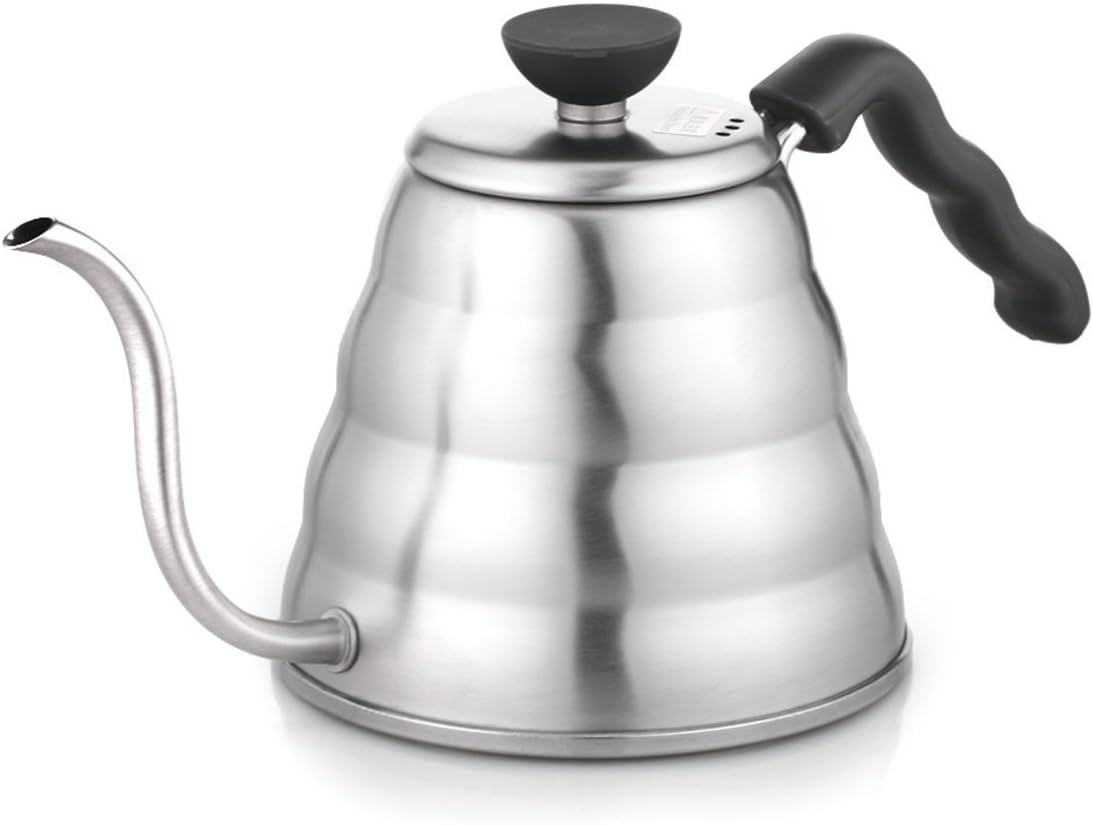
I’ve been using the Hario V60 Buono 1.2L on a regular basis for pour-over coffee and the occasional tea, and the short version is: it’s a simple kettle that does its job well without any fancy extras. No thermometer, no base, no app, no whistle – just metal, a handle, and a gooseneck. If you’re expecting bells and whistles, this isn’t it. If you just want hot water with good pouring control, it makes sense.
In practice, I usually heat around 500–800 ml at a time, which is exactly the sweet spot people mention. The official capacity is 1.2 L, but that’s really for storage/serving. If you actually try to boil it full, the water gets pretty wild and you’re asking for trouble. So think of it as a 0.8–1.0 L practical kettle, not a true 1.2 L workhorse for huge batches.
What stood out right away is how light it is compared to a big standard kettle or a chunky electric gooseneck. When you’re doing slow pour-overs every morning, that matters more than you’d think. My wrist gets less tired, and it’s easier to keep a steady flow without shaking or over-pouring. If you’re used to a regular spout, you’ll notice the difference on day one.
It’s not perfect though. The lack of whistle or indicator means you do need to pay attention. Walk away and forget it on the stove, and you’ll just hear angry boiling if you’re lucky. Also, for the price, it’s not cheap sheet metal from a random brand, but you are paying a bit for the Hario name and the look. Whether that’s worth it depends on how serious you are about pour-over and how often you actually make coffee by hand.
Is the Hario Buono worth the money?
On price, this kettle sits above random no-name goosenecks and below the fancier electric temperature-controlled models. You’re basically paying for three things: Japanese build, reliable pour control, and a design that’s been proven over time. You’re not paying for electronics, a base, or any smart features. If you already have a good stove and don’t care about exact temperature readouts, that trade-off can make sense.
Compared to a cheap Amazon gooseneck, you can definitely find lower prices. But with the cheaper ones, you often get wobbly spouts, inconsistent flow, weird metallic tastes at first, or handles that feel like they’ll snap after a year. With the Hario, you’re mostly paying to avoid those headaches. It’s not luxury, but it feels like a tool you’ll actually keep using instead of replacing after a short time. The Amazon rating around 4.4/5 with a lot of reviews reflects that: people like it, but it’s not some miracle product.
Against electric gooseneck kettles with temperature control, this one is obviously less feature-rich. If you want to dial in water to exactly 92°C or 96°C every time, an electric model is more convenient. But those are usually more expensive, more fragile (electronics, bases, cords), and bulkier. Here, you trade that for simplicity and lower risk of failure. If my stove works, this kettle works. That’s it.
So in terms of value, I’d say it’s good but not mind-blowing. If you’re deep into pour-over and brew by hand every day, the price is easy to justify because you actually benefit from the control and decent build. If you just sometimes make tea and mostly use a regular kettle, it’s probably overkill and not the best use of your money. It really shines for people who take manual brewing seriously but don’t care about gadgets and just want a reliable, well-behaved pour-over kettle.
Design focused on control, not on looking fancy
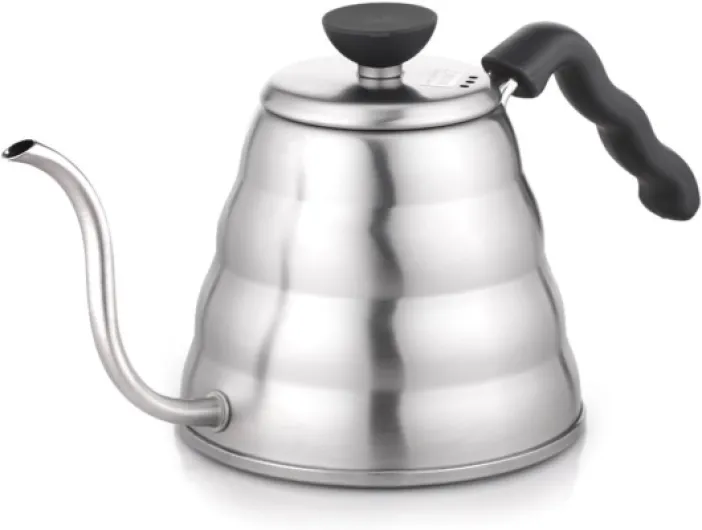
The design is all about controlled pouring. The gooseneck is long and fairly narrow, which gives you a slow, predictable stream once you get the angle right. Compared to a regular kettle spout that blasts water out, this one lets you go from a thin trickle to a steady stream without big jumps. For bloom pours and spiral pours on a V60, Chemex, or Aeropress, that control is the main reason to buy this thing in the first place.
The handle angle is actually thought through. It keeps your hand above and slightly behind the body, so you’re not directly over the steam. On my gas stove, as long as I keep the flame under the base and not licking the sides, the handle stays cool enough to grab without a towel. The plastic is pretty solid and doesn’t feel like it’s about to melt or loosen. Just don’t be stupid and let the flame hit the handle – that’s on the user, not the kettle.
Weight-wise, it’s lighter than most electric gooseneck kettles. At around 1.4 pounds empty, once you add 600–800 ml of water, it’s still manageable for slow, controlled pours. If you have wrist or shoulder issues, the lighter body is a plus. The lid has a small knob that’s easy to pinch, and it doesn’t get stuck or warped when the metal heats up, which I’ve had happen with cheaper kettles where the lid changes fit when hot.
On the downside, the design is very basic: no built-in thermometer, no fill line, no whistle. You need to eyeball the fill (I use the interior ridges as a rough guide) and listen/see for the boil. For the price point, a simple internal max-fill mark would have been helpful, especially since boiling it too full can lead to splashing. Still, the overall design is functional and clearly aimed at people who care about pour control more than gadgets or decoration.
Daily usability and how it feels in the hand
From a comfort point of view, this kettle is easy to live with if you mostly brew 1–3 cups at a time. The weight is light enough that a full 600–800 ml pour doesn’t strain the wrist, which I noticed compared to my heavier electric gooseneck. If you do slow pours for several minutes, that difference matters. The handle shape lets you grip it in a couple of ways: full grab from the side or more of a pinch grip at the top, depending on how much control you want.
The handle stays reasonably cool as long as you keep the flame under the base. On induction or electric, it’s a non-issue. On gas, if you crank the flame too high and let it lick the sides, you’ll eventually feel heat creeping up. That’s not really the kettle’s fault; that’s just bad burner discipline. The lid knob also stays grab-able even when the water is boiling, so you can open it without hunting for a towel.
Ergonomically, the gooseneck and handle angle together make it simple to control the rate of flow just by tilting your wrist more or less. After a couple of days, it becomes automatic. Compared to using a regular short-spout kettle, my pours are way more consistent and I spill less. I also noticed less fatigue in my forearm because I’m not fighting a heavy, front-loaded kettle full of water sloshing around. It’s just easier to handle.
The only real comfort downside is the mental load of having to babysit it on the stove. No whistle, no auto shutoff means you have to remember it’s on. If you’re the type who’s half-asleep making coffee, that’s something to think about. But while you’re actually using it, comfort and control are both good, and I don’t feel like I’m wrestling with it at any point.
Stainless steel quality and how it holds up
The body is stainless steel, and it feels like pretty decent quality, not flimsy tin that bends when you look at it. The walls are not super thick, so don’t expect cast-iron heft, but they’re thick enough that the kettle doesn’t dent just from normal handling. I’ve banged it gently against the sink and other gear a few times, and it still looks fine. If you drop it hard, sure, it’ll dent, but that’s true of most stainless kettles in this weight class.
Inside, the finish is plain stainless, no coating. With decent water (I use filtered or bottled because my tap is very hard), I haven’t seen rust spots or weird discoloration. People online mention running it almost always full of water and still no rust, which lines up with what I’m seeing so far. If your water is very hard, you’ll get mineral scale like with any kettle, but that’s not a materials failure, that’s just reality. A boil with citric acid or vinegar every so often should keep it under control.
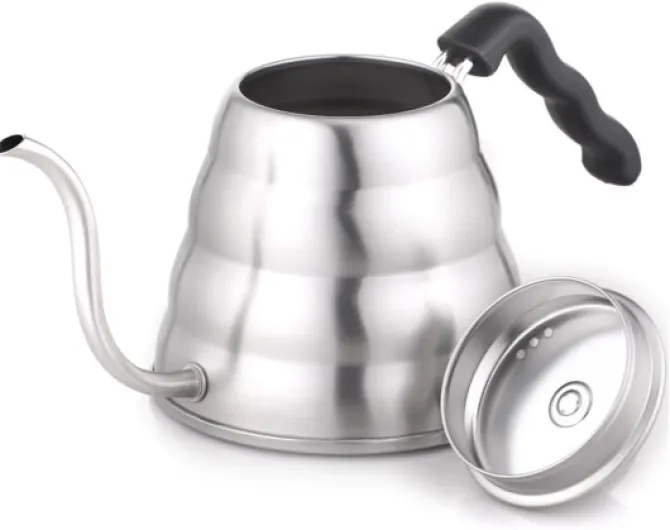
The handle and lid knob are phenol resin, basically a heat-resistant plastic. There are no plastic parts in direct contact with the water, which is nice if you’re trying to avoid hot plastic leaching into your drinks. The plastic feels sturdy and doesn’t flex when the kettle is full. After repeated heating cycles, I haven’t noticed any cracking or softening. Just keep the flame under control on gas; if you let it torch the side, you’ll eventually damage the handle, like with any plastic handle kettle.
It’s listed as dishwasher safe, but honestly, I don’t see the point. It’s easier to just rinse and occasionally descale. Dishwashers can leave spots on stainless over time, so if you care about how it looks, hand washing is safer. Overall, the materials are pretty solid for daily use. Not luxury-grade, but definitely not cheap junk either. For a kettle that often sits on the stove and gets used 1–2 times a day, I’m comfortable with how it’s built.
How it holds up to daily use and heat
Durability-wise, this kettle has a decent track record. It’s been on the market for years, and a lot of people use it daily in home setups and even in some coffee shops. In my own use, heating it once or twice a day, there’s no warping of the base, no loose handle, and no lid issues. The spout is well attached; it doesn’t feel wobbly or fragile the way some cheap gooseneck spouts do after a while.
The stainless steel finish hides small scuffs pretty well. You’ll get the usual fine scratches from normal kitchen life, but nothing dramatic. If you expect it to stay showroom perfect, you’ll be annoyed, but as a working tool, it’s holding up fine. The important part is that there’s no sign of rust or pitting with decent water and basic rinsing. If your tap water is very hard and you never descale, you’ll see white mineral buildup inside, but again, that’s not the kettle failing, that’s just maintenance.
The handle attachment points are solid. I’ve picked it up full by the handle many times without babying it, and there’s no flex or creaking. Same for the lid knob. Some very cheap kettles eventually loosen at those joints and start rattling or feeling sketchy; this one still feels tight. The base hasn’t discolored badly on gas either, as long as I keep the flame reasonable. You might get a bit of darkening over time where the flame hits, but nothing dramatic.
Could it be thicker and more bombproof? Sure, but then it would be heavier and more expensive. For the current price range, I’d say the durability is pretty solid for home use, even if you use it daily. If you’re planning to beat it up in a commercial setting all day long, I’d maybe buy two and rotate, but for a regular kitchen, it should last years if you don’t abuse it.

Boiling speed and pour control in real use
On a day-to-day basis, performance comes down to two things: how fast it boils and how well it pours. On my induction cooktop, 600–700 ml of water goes from room temp to a full boil in about 3 minutes on a medium-high setting. On gas, it’s roughly the same if I don’t baby it. It’s not the fastest thing in the world, but it’s absolutely fine for a morning routine – by the time I grind coffee and prep the filter, the water is ready.
The pour control is where this kettle actually earns its keep. Once you tilt it, the flow starts gently and ramps up smoothly. It doesn’t suddenly dump water like a regular spout, and it doesn’t dribble back down the neck unless you’re doing something weird. I can easily do slow bloom pours of 30–60 seconds without feeling like I’m fighting the kettle. For V60 or Chemex, that consistency is the whole point. Even for something simple like topping up a mug of tea, it’s just less messy.
One thing to know: it doesn’t whistle. There are just three small vent holes on the lid, and when it’s at a rolling boil you’ll see steam shooting up a couple of feet. You have to either stay close enough to hear the rumble or remember to come back in a few minutes. If you’re the type who sets water and then wanders off, this can be a real downside. I’ve let it boil too long once or twice, and it’s not ideal. No auto shutoff, no sound, just old-school stove logic.
Heat retention is average. The steel isn’t super thick, so it doesn’t hold heat for ages. If I boil 800 ml and then leave it off heat, it’s still hot enough for a second pour after a few minutes, but it cools quicker than a heavier kettle. Not a big deal for coffee where you want a specific temperature range and probably pour right away. Overall, as a tool for pour-over, it performs well. As an all-purpose family kettle, it’s a bit limited in capacity and missing some convenience features.
What you actually get with the Hario V60 Buono
Out of the box, there’s nothing complicated: just the kettle with its lid, no accessories, no extras. Mine came in a basic cardboard box with some simple printing and a bit of plastic to keep it from rattling around. It feels more like a tool than a fancy gift item. If you want unboxing theatrics, this isn’t that. On the flip side, there’s not much that can arrive broken or misaligned either, which I appreciate.
The kettle itself is a 1.2 L stainless steel body with a gooseneck spout and a black phenolic (plastic) handle and knob on the lid. No plastic inside the water chamber, which I know some people care about. The finish is a basic brushed/satin stainless steel, not mirror-polished. It looks fine on a counter, blends with most setups, but it’s not some decorative centerpiece. Think "clean and simple" more than "showpiece".
On the bottom, it’s clearly stamped "Made in Japan" and marked as induction compatible. I tested it on gas and induction; it behaved fine on both. The base is flat enough that it sits well on glass-top stoves too, and it doesn’t feel wobbly. There are three small steam vents on the lid that you’ll want to point away from the handle when you use it, otherwise you’re aiming steam at your fingers.
In terms of size, it’s compact compared to a big family kettle. If you usually boil water for 1–3 people, it’s fine. If you routinely make tea for a crowd, you’ll hit the capacity limit fast. For context: I can easily do two decent pour-over mugs or a Chemex for two, but if someone else wants tea right after, I’m boiling a second round. So the presentation is very clear: this is a dedicated pour-over / small-batch kettle, not your everything-for-the-family kettle.
Pros
- Very good pour control thanks to the slender gooseneck and light weight
- Compatible with gas, electric, and induction stoves, no plastic in contact with water
- Simple, durable construction that holds up well to daily use
Cons
- No whistle, thermometer, or auto shutoff – you have to babysit it on the stove
- Practical boiling capacity closer to 0.8–1.0 L, not ideal for large batches
Conclusion
Editor's rating
The Hario V60 Buono 1.2L is basically a solid, no-nonsense pour-over kettle. It heats water at a reasonable pace, pours with very good control, and feels light and easy to handle even when it’s reasonably full. The stainless steel and plastic combo is simple but effective, and there’s no plastic touching the water. It’s clearly designed for people who actually do manual coffee brewing, not for someone who just wants a generic kitchen kettle.
On the flip side, it’s not cheap, and it doesn’t have any of the convenience features that casual users like: no whistle, no built-in thermometer, no big capacity for serving a crowd. You need to pay attention when it’s on the stove, and you need to accept that it’s basically a specialized tool for small batches. If you mainly drink tea by the pot or you’re used to electric kettles with auto shutoff, this might feel a bit barebones for the price.
If you’re into V60, Chemex, Aeropress, or other manual brewers and you want a reliable gooseneck that just works day after day, the Buono is a pretty solid choice. If you’re a casual hot-water user who just wants something to boil water for anything and everything, you’ll probably be happier with a cheaper standard kettle or a feature-packed electric model.