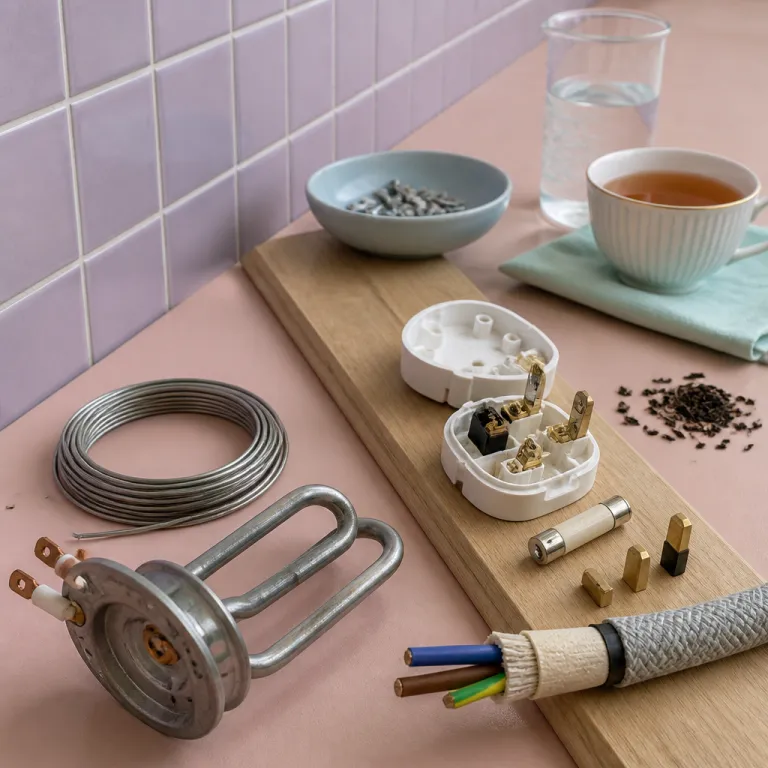
Why UK kettles boil faster than almost anywhere else
Ask why UK kettles boil faster and you quickly leave the kitchen. You end up in the wiring diagrams of British homes, where a nominal 230 volt mains supply, historically close to 240 volts in practice, and 13 amp ring circuits quietly dictate how fast a kettle can boil water. The result is a very specific appliance culture built around the 3 kilowatt electric kettle that can turn cold water into boiling water in roughly two and a half minutes under typical conditions.
The physics is blunt and it explains why UK kettles boil faster in everyday use. A standard British plug with a 13 amp fuse can safely deliver about 2 990 watts of power on a 230 volt circuit, so a typical 3 kilowatt water kettle pushes as much electrical energy as the socket will allow into its concealed heating element. That concentrated heat shortens boiling time dramatically, giving you hot water for tea or pour over coffee long before a US style 1 500 watt electric kettle or any stovetop kettles on a gas hob have finished their slower boiling process.
Compare that with North American kitchens where the mains voltage is about 120 volts. Even with a 15 amp breaker, the maximum practical power for electric kettles is usually around 1 500 watts, which means the same litre of water boils in around four and a half to five minutes and the water temperature climbs more slowly. When you watch how fast a UK electric kettle reaches the boiling point, you are really watching the national grid specification expressed as boiling speed at your countertop.
This high power ceiling also shapes how people think about energy and time. Heating 1 litre of water from room temperature to boiling takes roughly 0.093 kilowatt hours of energy; a 3 kilowatt electric kettle draws more energy per second, but because the boiling time is shorter, the total electricity used to boil water for tea is similar to that of less powerful kettles that linger at sub boiling temperature. In practice, the most energy efficient choice is usually to use a powerful but efficient electric kettle and only heat the exact volume of water you need.
That is why fast boil claims on UK kettles are not just marketing language. When a manufacturer says an electric kettle will give you a rapid boil for 250 millilitres in under a minute, they are leaning on the same 230 volt, 13 amp infrastructure that underpins the whole system. The culture of faster boiling is therefore not only about impatience for hot tea, but about how British homes were wired after the war and how that wiring still governs every boil kettle moment today.
Ring mains, 13 amp plugs and the accidental birth of the 3 kW kettle
The story of why UK kettles boil faster starts in post war Britain, not in a design lab. Engineers at the Institution of Electrical Engineers, working with what is now the British Standards Institution, created the ring main circuit to save copper while still delivering enough power for multiple heating appliances. By looping sockets on a ring and pairing them with a fused 13 amp plug, they made it safe for a single outlet to feed a 3 kilowatt electric kettle without tripping the system every time water boils.
That decision locked in a very particular relationship between household wiring, power and boiling water. A ring main at 230 volts and 13 amps can support several high power loads, so British consumers grew used to plugging in electric kettles, toasters and other heating devices without thinking about which circuit they were on. Over decades, manufacturers responded by standardising on 3 kilowatt kettles, optimised for fast boil performance and efficient transfer of heat into water.
In contrast, radial circuits in many other countries limit what a single socket will safely deliver. In the United States, a typical kitchen outlet at 120 volts and 15 amps caps an electric kettle at around 1 500 watts, which roughly doubles the boiling time for a litre of cold water compared with a UK model. That is a structural reason why stovetop kettles remain common there and why many households still boil water on gas hobs or even in microwaves instead of using high power electric kettles.
For a UK reader choosing an electric kettle today, this wiring history matters more than you might think. Because the plug and ring main can handle 3 kilowatts, you can focus on features that affect real world efficiency, such as minimum fill lines, accurate water level windows and lids that open wide enough to descale thoroughly. When you see a 2 kilowatt model on a British shelf, you are usually looking at a compromise on boiling speed rather than a genuinely more energy efficient design.
If you want to understand how wattage translates into boiling speed and energy use, it helps to compare simple numbers. Heating 1 litre of water from room temperature to boiling needs about 0.093 kilowatt hours; a 3 kilowatt kettle does that in roughly 1.9 minutes, while a 1.5 kilowatt kettle needs about 3.7 minutes for the same energy, so the total electricity used is essentially the same even though the UK kettle feels dramatically faster.
From National Grid surges to kitchen habits: a culture of fast boiling
Once you know why UK kettles boil faster on paper, you start to see how that power rating shapes behaviour. Surveys from UK government energy and consumer statistics consistently show that well over nine in ten British households own at least one electric kettle (for example, Department for Business, Energy & Industrial Strategy and Office for National Statistics appliance ownership data), which makes the kettle more common than many cooking appliances. The National Grid has even documented TV pickup events, when millions of people stand up during a commercial break, fill a kettle with cold water and switch on roughly 3 gigawatts of extra heating load in a few minutes.
Those surges are a direct expression of the 3 kilowatt standard and the national love of tea. Every time a water kettle clicks on, its heating element converts electrical energy into heat at a rate that would look extreme in many other countries, yet feels normal in a British kitchen. The boiling process is so quick that the time between deciding to make tea and pouring hot water over a teabag or coffee grounds is often under three minutes, which reinforces the habit of frequent, casual brews and makes the kettle a central part of daily routines.
Other countries with 230 volt systems share some of this culture, but the details differ. In much of continental Europe, electric kettles are common and can also reach 2 to 3 kilowatts, yet coffee machines and stovetop kettles still play a larger role in daily routines. Japan, with its 100 volt mains, took a different path entirely, favouring insulated thermal pots that heat water more slowly but hold it at a stable water temperature for hours, trading faster boiling for long term efficiency.
Australia sits somewhere between these models with 230 to 240 volt, 10 amp circuits that typically support around 2.4 kilowatt kettles. Boiling time is a little longer than in the UK, but still far ahead of US style 1.5 kilowatt electric kettles, so the expectation of fast boil performance is strong there too. What is unique in Britain is how the 3 kilowatt electric kettle, the ring main and the tea break have fused into a single cultural pattern that even grid operators must respect.
For the specialty coffee drinker, this culture of faster boiling has clear upsides. A high power gooseneck electric kettle such as the Fellow Stagg EKG or the Breville IQ can reach a precise brewing temperature quickly, then use a hold feature to maintain that temperature without wasting much energy. If you picture a simple diagram of a ring main feeding several sockets versus a single radial line feeding one outlet, it becomes easier to see why UK circuits comfortably support these powerful kettles where other systems do not.
Energy efficiency, boiling speed and choosing the right UK kettle
Knowing why UK kettles boil faster is only useful if it changes what you buy. The key trade off is not between a 3 kilowatt and a weaker kettle, but between boiling more water than you need and matching boiling time to your actual routine. A powerful but energy efficient electric kettle that lets you heat 250 millilitres precisely for a single mug will usually waste less energy than a slower model that tempts you to fill it to the maximum line every time.
Eco focused designs in the UK increasingly tackle efficiency through volume control rather than reduced power. They keep the 3 kilowatt heating element for faster boiling, but add clear markings for one cup, two cups and so on, so you can see exactly how much cold water to add for your next tea or AeroPress. Because water boils faster in a smaller mass, you get hot water quickly and the total energy used per drink falls, even though the instantaneous power draw remains high.
Variable temperature electric kettles add another layer of efficiency for coffee and tea enthusiasts. If you brew green tea at 80 degrees Celsius or pour over coffee at 94 degrees, there is no need to reach a full rolling boil and then wait while the water temperature drops. A good electric kettle with accurate temperature control, such as the Cuisinart CPK 17 or a high end gooseneck model, will heat only to the set point, shortening boiling time and reducing wasted heat.
Build quality also affects how efficiently a kettle turns electrical energy into heat in the water. A flat, concealed heating element at the base of the jug usually gives more even heating than exposed coils, while a well fitting lid and insulated walls slow the loss of hot air and keep the boiling process focused on raising water temperature. Over time, limescale build up on the element can lengthen boiling time and reduce efficiency, so regular descaling is not just about taste but about maintaining faster boiling performance.
Safety features matter too, especially when you are running a 3 kilowatt appliance several times a day. Look for reliable boil dry protection, a switch that cuts power when no water is present, and a stable 360 degree base that keeps the electric kettle firmly seated while water boils. For a curated list of models that balance fast boil performance, safety and energy efficiency, you can compare modern kettles with strong boil dry protection and see how different designs manage heat, power and boiling speed in real kitchens.
Key figures behind the UK's fast boiling kettle culture
- Independent surveys and government energy statistics indicate that over 90 percent of UK households own an electric kettle (for example, BEIS and ONS appliance ownership data), a higher penetration rate than in most European countries, which reflects how central fast boiling water is to daily tea and coffee habits.
- A typical 3 kilowatt UK kettle can boil 1 litre of water in about 2 to 2.5 minutes, while a 1.5 kilowatt kettle on a 120 volt US circuit often needs close to 4.5 to 5 minutes for the same volume, effectively halving boiling time in British kitchens.
- The UK National Grid has reported TV pickup events where simultaneous kettle use adds around 3 gigawatts of extra demand within minutes, a spike comparable to the output of several large power stations starting up at once.
- Standard UK plugs rated at 13 amps on 230 volt ring or radial mains can safely deliver around 2 990 watts of power, which is why 3 kilowatt kettles sit near the practical ceiling for small appliances on a single socket.
- Eco kettles with minimum fill lines around 250 millilitres can cut energy use per cup by up to 20 to 30 percent compared with routinely boiling a full 1.7 litre jug, even when both models share the same 3 kilowatt rating.