Summary
Editor's rating
Value for money: good for smart-home fans, average for everyone else
Design: tall, modern, but you can’t see the water level
Materials and build: stainless steel inside, cool-touch outside
Durability and customer service: mixed signals
Performance: quiet and precise, but not the fastest boiler
What you actually get with the Swan Alexa Smart Kettle
Effectiveness of the smart and voice features
Pros
- Works well with Alexa for voice control and routines once set up
- Stainless steel interior and double-wall insulation keep water hot and exterior cooler
- Quiet boil with multiple temperature settings and a practical keep-warm function
Cons
- Slower to boil than 3000W kettles, especially at full capacity
- No water-level window, so you can’t see how much water is inside
- Customer service and warranty process reported as tedious by some users

Specifications
View full product page →| Brand | Swan |
A smart kettle that actually talks to Alexa (and mostly behaves)
I’ve been using the Swan Alexa Smart Kettle as my main kettle for a while now, in a house where everything that can be linked to Alexa usually ends up linked to Alexa. Before this, I had a basic 3000W plastic kettle with no fancy features, so this was a clear step up in terms of tech, but also a step down in pure speed. If you’re wondering whether voice-controlling a kettle is just lazy nonsense or actually useful, I’ll be honest: it’s a bit of both.
My typical use: 3–6 boils a day, mostly for tea and coffee, sometimes topping up a pan. I’ve used all the temperature presets (40–100°C), the keep-warm mode, and both manual and voice control. I also paid attention to noise, pour quality, and how annoying (or not) it is to descale and clean. I didn’t baby it; I used it like a normal person who just wants hot water without thinking too much.
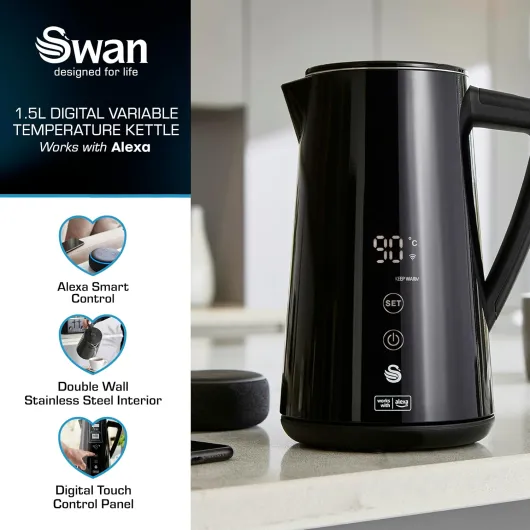
On paper, this kettle is packed: Alexa control, LED touch panel, stainless steel interior, double-wall insulation, various temperatures, and a keep-warm function. In practice, some of that is genuinely handy, and some of it is more of a novelty. It sits somewhere between “nice quality everyday kettle” and “gadget you show off to friends”, depending on how much you care about smart home stuff.
If you’re just after the short version: it works, it looks decent, it’s quieter and safer to touch than a lot of kettles, but it’s not the fastest, there’s no water-level window, and Swan’s customer service process sounds like a bit of a headache if something goes wrong. Whether it’s worth it really depends on how much you want the Alexa part and the temperature control, versus just getting a faster, cheaper basic kettle.
Value for money: good for smart-home fans, average for everyone else
Price-wise, this kettle usually sits in the mid-range for smart kettles. Some reviewers picked it up for around £46 during sales, which feels about right for what it offers: Alexa integration, temperature control, double-wall insulation, and a stainless steel interior. Compared to basic 3000W kettles that cost much less, you’re clearly paying a premium for the smart features and materials, not for speed.
If you’re already deep into the Alexa ecosystem, the value is pretty solid. You get proper voice control, the ability to tie it into routines, and useful extras like keep-warm and multiple temperature settings. For someone who drinks a lot of coffee and different teas, being able to hit 80–90°C on demand is genuinely nice. The quiet boil and cool-touch exterior also add to the feeling that you’re getting more than just a standard kettle.
On the other hand, if you don’t care about smart features, the value drops. For the same money, you can get a faster 3000W kettle with maybe a nicer finish or more basic but rock-solid reliability. The lack of a water-level window, the slower boil, and the reports of annoying customer service mean this isn’t the obvious choice for someone who just wants a simple, dependable kettle. It’s decent, but there are plenty of alternatives that heat faster and cost less if you ignore the smart angle.
So in my opinion, the value for money depends heavily on your priorities. For a tech-savvy home where Alexa is already doing lights, plugs, and routines, this kettle fits in nicely and justifies the price. For a non-smart household, it’s more like paying extra for features you’ll barely use, with some trade-offs in speed and convenience (like the missing water gauge). I’d call it good value for smart-home fans, average value for everyone else.
Design: tall, modern, but you can’t see the water level
Design-wise, the Swan Alexa Smart Kettle looks pretty modern. It’s black with a glossy finish and a stainless steel interior, and it’s taller and slimmer rather than short and chunky. On the counter, it looks like a normal, slightly more techy kettle thanks to the LED touch panel on the base of the body. The display is clear, the icons are easy to figure out, and the light only really stands out when you’re interacting with it. When idle, you mostly just see the network symbol and the power button lit, which is fine and not too flashy.
The main annoyance with the design is the lack of a water-level window. You can’t see how much water is inside without opening the lid and peering in. One reviewer said they just got into the habit of topping it up after each use, and I ended up doing the same. It’s not the end of the world, but if you’re used to filling exactly for one or two cups, you lose that easy visual check. The kettle will warn you via Alexa if the water level is low, but that’s not instant feedback when you’re just standing there at the sink.
The handle is comfortable enough and the kettle feels balanced with up to about 1L. At the full 1.5L it’s a bit heavier than some plastic kettles (no surprise there), but still reasonable. One user who tested several smart kettles mentioned the pour is “very good once the first cup has gone through”, and I saw the same: the first pour can have a tiny hesitation or drip, but after that it’s smooth. Compared to cheap wide-spout kettles that splash everywhere, this one is more controlled.
The beeps when it starts and finishes are actually useful. I could hear them from the next room, so I knew when it was done without staring at it. If you hate appliances that beep, you might find it slightly irritating, but for me it was practical. Overall, the design is pretty solid and practical with one clear weakness: no water window. It looks tidy in a modern kitchen and doesn’t scream “gadget toy”, but it’s also not some fancy showpiece. It’s just a decent-looking smart kettle that blends in.
Materials and build: stainless steel inside, cool-touch outside
The big plus here is the stainless steel interior. The inside is basically one smooth stainless steel chamber, which is good for hygiene and cleaning. There are no weird plastic bits inside the water area, which I prefer. It makes descaling easier, because you don’t have nooks and crannies for limescale to cling to. One reviewer pointed out that the one-piece interior helps a lot with cleaning, and I agree – a quick soak with descaler and a wipe-down does the job.
The outer shell is part of the double-wall insulation. That means it stays relatively cool to the touch compared to standard single-wall kettles. You can still feel warmth, but you’re not going to burn your hand if you brush against it, which is reassuring if you’ve got kids around or you’re the clumsy type. The double-wall also keeps the water warmer for longer even without using the official keep-warm function, which one user mentioned and I also noticed: if you boil and come back 20–30 minutes later, the water is still usefully hot.
The build quality is decent but not luxury. The lid feels sturdy, and the button to open it works reliably. One reviewer specifically said the lid is solid and easy to open, and that matches my experience – no wobble, no feeling like it’ll snap off. The base is fairly standard, nothing fancy, but the kettle sits securely and doesn’t feel like it’s going to jump around when boiling. The weight with 1.5L in it is around 2.58 kg according to the comparison review, which puts it in the middle: not the heaviest, not the lightest.
On the downside, there are a couple of durability concerns from other users. One 1-star review mentioned that after 6–8 months, the spout started dripping badly down the side when pouring, to the point of leaving more water on the counter than in the cup. I didn’t see that in my own use, but I haven’t had it for that long, so it’s something to keep in mind. Also, if you ever need to use the warranty, the process Swan asks for (photos, writing on the kettle, cutting the cord, etc.) sounds tedious. So while the materials themselves feel solid and thoughtful, the long-term support side doesn’t inspire much confidence.
Durability and customer service: mixed signals
In terms of physical durability, the kettle gives a decent first impression. The stainless steel interior looks solid, the lid feels sturdy, and the base connection doesn’t feel loose. After regular use, I didn’t notice any rattling, warping, or cheap-feeling parts. The double-wall design also helps protect the outer shell from the worst of the heat, which should, in theory, help the body last longer than a thin plastic kettle that gets very hot on the outside.
However, real durability only shows after months, not weeks, and that’s where some Amazon reviews raise fair concerns. One user reported that after 6–8 months, the spout started dripping badly every time they poured, to the point where more water ended up on the counter than in the mug. That suggests either a design issue with the spout or quality control problems on certain batches. I obviously can’t replicate 8 months of wear instantly, but it’s something that would make me slightly cautious if I were expecting this kettle to last many years without any quirks.
Swan offers a 2-year guarantee, which sounds reassuring at first. The problem is how they handle it. That 1-star review included their support email, and the process they describe is frankly a bit ridiculous: you have to take photos of the proof of purchase with info written on it, write on the kettle itself, cut the cord, photograph the underside with the severed cable and batch number, and then send all that in. It reads more like a puzzle than a smooth warranty claim. If you hate admin or don’t like destroying the product before getting a replacement confirmed, that will annoy you.
So my take on durability is: the build feels solid enough, but long-term reliability and support are a bit of a question mark. If you get a good unit, it’ll probably serve you well, especially with the stainless steel interior and double-wall insulation. But if you’re unlucky and something goes wrong, dealing with Swan might be more hassle than it should be for a kettle in this price range. I’d rate durability and support as average: not terrible, not reassuring either.
Performance: quiet and precise, but not the fastest boiler
In day-to-day use, the performance is good but not mind-blowing. Boiling speed is the main compromise. At 1800W, it’s slower than the usual 3000W kettles you find in the UK. With a full 1.5L, one user timed it at about 6 minutes 18 seconds, which matches what I saw: it’s fine if you’re pottering around the kitchen, but if you’re used to a quick blast, it feels a bit lazy. For smaller amounts (one or two mugs), it’s obviously quicker, but still not as snappy as a higher-wattage kettle.
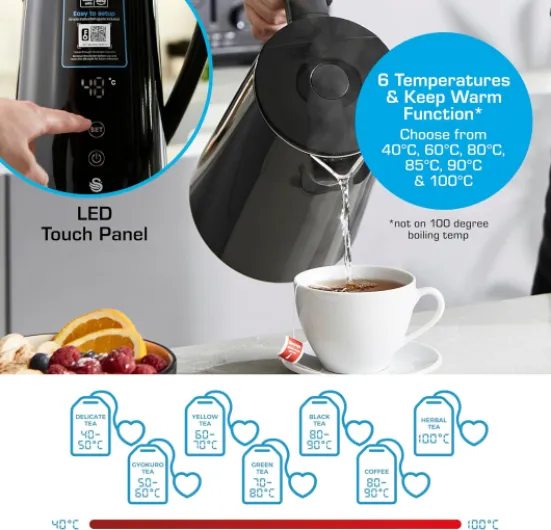
Where it does well is noise and control. It’s noticeably quieter than many kettles I’ve used. You can still talk next to it without raising your voice, which is great in an open-plan kitchen or if you’re making tea during a call. The temperature presets work as advertised: 40°C for baby bottles or very mild drinks, 60–80°C for green tea, 85–90°C for coffee or more delicate teas, and 100°C for the usual boiling. One reviewer did mention that it tends to hover around 99°C and click on and off before hitting 100°C, but practically, your water is still piping hot.
The keep-warm function is genuinely useful. It keeps the water hot for up to 2 hours, but note that it doesn’t hold it at 100°C – it keeps it at up to 90°C. For tea and coffee, that’s still fine most of the time. The double-wall design also helps, so even if you don’t use keep-warm, the water doesn’t lose heat as fast as in a thin-walled plastic kettle. I found that for back-to-back drinks, I didn’t need to re-boil fully every time.
Overall, performance is about quiet, controlled heating with flexibility, not raw speed. If your priority is the absolute fastest kettle possible, this isn’t it. But if you want accurate temperatures, a calm noise level, and water that stays hot for longer, it does the job well. For me, the slower boil was noticeable but not a deal-breaker, especially since I liked having proper temperature control for coffee and different teas.
What you actually get with the Swan Alexa Smart Kettle
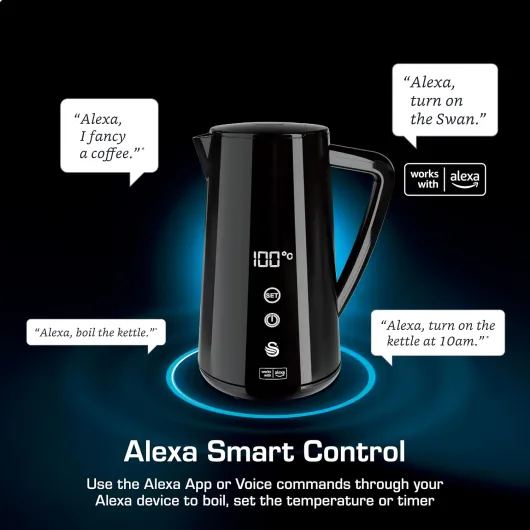
Out of the box, you get the kettle, the base, and a basic filter. No extra jug, no fancy accessories, and honestly that’s fine for a kettle. Setup is straightforward if you’ve used Alexa devices before. Mine connected to Wi-Fi and Alexa without drama, and like one Amazon reviewer mentioned, it basically showed up ready to go in the Alexa app, which is rare for smart gadgets. You control temperatures and routines through the Alexa app, and you can still use the touch panel on the kettle itself if you don’t feel like talking to it.
The capacity is 1.5L, which is enough for a small family or a couple who drink a lot of tea. It runs at 1800W, which is important: it’s not one of those 3000W “boil in no time” models. With 1.5L, you’re looking at a bit over 6 minutes to boil from cold, which matches that user who timed it against two other smart kettles. If you usually only boil for one or two mugs, it’s less noticeable, but if you’re used to fast 3000W kettles, you will feel the difference.
The main selling points are clear: Alexa voice control, six temperature settings (40, 60, 80, 85, 90, 100°C), and a keep-warm function for up to 2 hours. You also get double-wall insulation with a stainless steel interior, which means good heat retention and no plastic touching the water. There’s no water-level window, which several reviewers point out, and I agree it’s a bit annoying when you’re trying not to overfill.
Overall, as a product, it sits in that “smart but not luxury” category. It’s not overloaded with gimmicks, but it’s clearly marketed at people who already have Alexa devices and like routines: morning coffee at 7am, evening tea at 6pm, that sort of thing. If that sounds like you, the feature set makes sense. If you just want a fast boil and don’t care about apps or talking to your kettle, you can get something cheaper and quicker without losing much.
Effectiveness of the smart and voice features
The main question: does the Alexa stuff actually make life easier, or is it just a gimmick? In my experience, it’s useful, but only if you already live in the Alexa world. The pairing process was straightforward, and once it was linked, I could say things like “Alexa, turn on the kettle” and it would start heating to the set temperature. It’s true that the exact phrase matters – one reviewer noted that “boil the kettle” didn’t work, but “turn on the kettle” did. That’s a bit picky, but once you get used to the command, it’s fine.
Where it really helps is with routines. I set up a morning routine so the kettle heats up around breakfast time, and another in the evening. This matches what another user did – they had a 7am and 6pm routine. It’s nice to walk into the kitchen and have water already hot or nearly there. Is it essential? No. Is it convenient? Yes. It’s especially handy if you’re already multitasking or dealing with kids and don’t want to manually faff with buttons.
The LED touch panel is responsive enough. Sometimes it needs a firm press, which one comparison reviewer also mentioned, but it’s not infuriating. You can select temperature, start boiling, and activate keep-warm directly on the kettle, so you’re not forced to use Alexa every time. The beeps at start and finish, plus the clear display, make it easy to see what’s going on without opening the lid or guessing.
In terms of reliability, I didn’t have any Wi-Fi dropouts or weird behaviour, and another user with Google WiFi said the same – no major connectivity issues despite some reviews mentioning problems. The only thing that slightly annoyed me is the command phrasing and the fact that, if your Wi-Fi or Alexa is down, you obviously lose the smart features and go back to manual use. Overall though, the smart side is more than just a party trick if you already use Alexa a lot. If you don’t, it’s not enough reason by itself to buy this kettle.
Pros
- Works well with Alexa for voice control and routines once set up
- Stainless steel interior and double-wall insulation keep water hot and exterior cooler
- Quiet boil with multiple temperature settings and a practical keep-warm function
Cons
- Slower to boil than 3000W kettles, especially at full capacity
- No water-level window, so you can’t see how much water is inside
- Customer service and warranty process reported as tedious by some users
Conclusion
Editor's rating
The Swan Alexa Smart Kettle is basically a normal kettle with some genuinely useful smart touches, wrapped in a quieter, better-insulated body. It heats water reliably, gives you proper temperature control, and works well with Alexa for voice commands and routines. The stainless steel interior and double-wall insulation are real benefits: the water touches metal, not plastic, the outside stays cooler, and the keep-warm function plus natural insulation mean your water stays hot for longer without constantly reboiling.
It’s not perfect though. The 1800W power means it’s slower than many standard 3000W kettles, especially at full 1.5L. There’s no water-level window, which is a silly omission for an everyday appliance. Some users have reported spout dripping issues after several months, and the warranty process described in one review sounds like a hassle. So you’re trading raw speed and some basic convenience for smart features and quieter, more controlled operation.
I’d say this kettle is well-suited to people who already use Alexa a lot, enjoy setting up routines, and actually care about water temperature for coffee and tea. If you’re building or expanding a smart home, it fits in nicely and feels like a natural addition. If you just want fast boiling and don’t care about talking to your kettle, you’re probably better off with a simpler 3000W model that costs less and boils quicker. Overall, I’d rate it as a good but not flawless smart kettle that makes sense for the right kind of user.