Summary
Editor's rating
Value for money: worth it if you use the features, overpriced if you don’t
Design: modern look, decent footprint, slightly fiddly touch base at first
Materials & build: solid feel, double wall is useful, but not lightweight
Durability & long-term use: feels like it’ll last, but time will tell
Performance: good control and keep-warm, slightly slower than basic kettles
What this Bosch Sky kettle actually offers in real life
Effectiveness in daily life: does the fancy stuff actually get used?
Pros
- Useful 7-step temperature control (70–100°C) for different teas and coffee
- Keep-warm function up to 30 minutes reduces constant reboiling
- Solid double-walled stainless steel body that stays cooler to the touch
Cons
- More expensive than basic kettles with similar boiling power
- Slightly slower to boil than some rapid-boil models
- Touch controls may annoy people who prefer a simple physical switch

Specifications
View full product page →| Brand | Bosch |
A kettle for people who are a bit too picky about hot water
I’ve been using the Bosch Sky TWK7201GB kettle at home for a few weeks now, and it’s pretty clear this isn’t your basic “on/off and boil” kettle. It’s aimed at people who care about water temperature, want something that looks decent on the counter, and are willing to pay extra for that. If you just want the cheapest way to boil water, this isn’t it. But if you make a lot of tea or coffee and you’re tired of guessing temperatures, it starts to make sense.
In day-to-day use, the two things that stand out the most are the touch controls with temperature slider and the keep-warm function. Those are the features I actually used, not just looked at once and forgot. I went in a bit sceptical, thinking it would be overkill, but it changed how I make tea and coffee because I stopped boiling water to 100°C for everything like a caveman.
On the flip side, it’s not perfect. It costs more than a basic kettle, it’s a bit slower than some 3000W “no-frills” models I’ve had, and the touch controls take a few days to feel natural. Also, if you’re used to super cheap plastic kettles, the weight and bulk of this one will be noticeable, especially when full. Nothing dramatic, but worth knowing if you have wrist issues or hate heavy appliances.
Overall, my feeling after living with it is: it’s a pretty solid kettle for fussy tea/coffee habits, but overkill if you just mash the boil button and walk away. In this review I’ll walk through how it looks, how it performs, what works well, and what annoyed me a bit, so you can see if it fits how you actually use a kettle, not just how the spec sheet looks.
Value for money: worth it if you use the features, overpriced if you don’t
Let’s talk about the awkward bit: price. This Bosch Sky kettle sits well above the bargain-bin kettles and even above some mid-range models. You’re clearly paying a premium for the Bosch brand, the temperature control, the touch base, and the double-wall construction. If you just need boiling water and don’t care how you get there, you can easily spend half the money (or less) on a basic 1.7L 3000W kettle and be perfectly happy.
The value starts to make sense if you actually use what you’re paying for. If you:
- Drink green/white tea and want lower temperatures.
- Make filter or pour-over coffee and want something below boiling.
- Like the idea of a keep-warm function for multiple drinks or cooking.
- Prefer something that feels sturdier and looks a bit more modern on the counter.
On the other hand, there are other kettles with temperature presets on the market, some cheaper, some more expensive. Compared to the cheaper ones, Bosch does feel more solid and better finished, but you’re also paying for that brand confidence and the 2-year warranty. If budget is tight and you just want basic temp presets, you might find a model that’s slightly less polished but cheaper. If you’re sensitive to noise and speed, remember this one is a bit slower than some basic rapid-boil models, so you’re not getting a speed boost for the extra money.
In short, I’d rate the value for money as decent but not mind-blowing. It’s good value if you’re the kind of person who will actually use the temperature settings and keep-warm every day. If you’re not, then you’re basically buying an expensive normal kettle with a fancy base, and at that point, it’s hard to justify the price over a simple, reliable budget model.
Design: modern look, decent footprint, slightly fiddly touch base at first
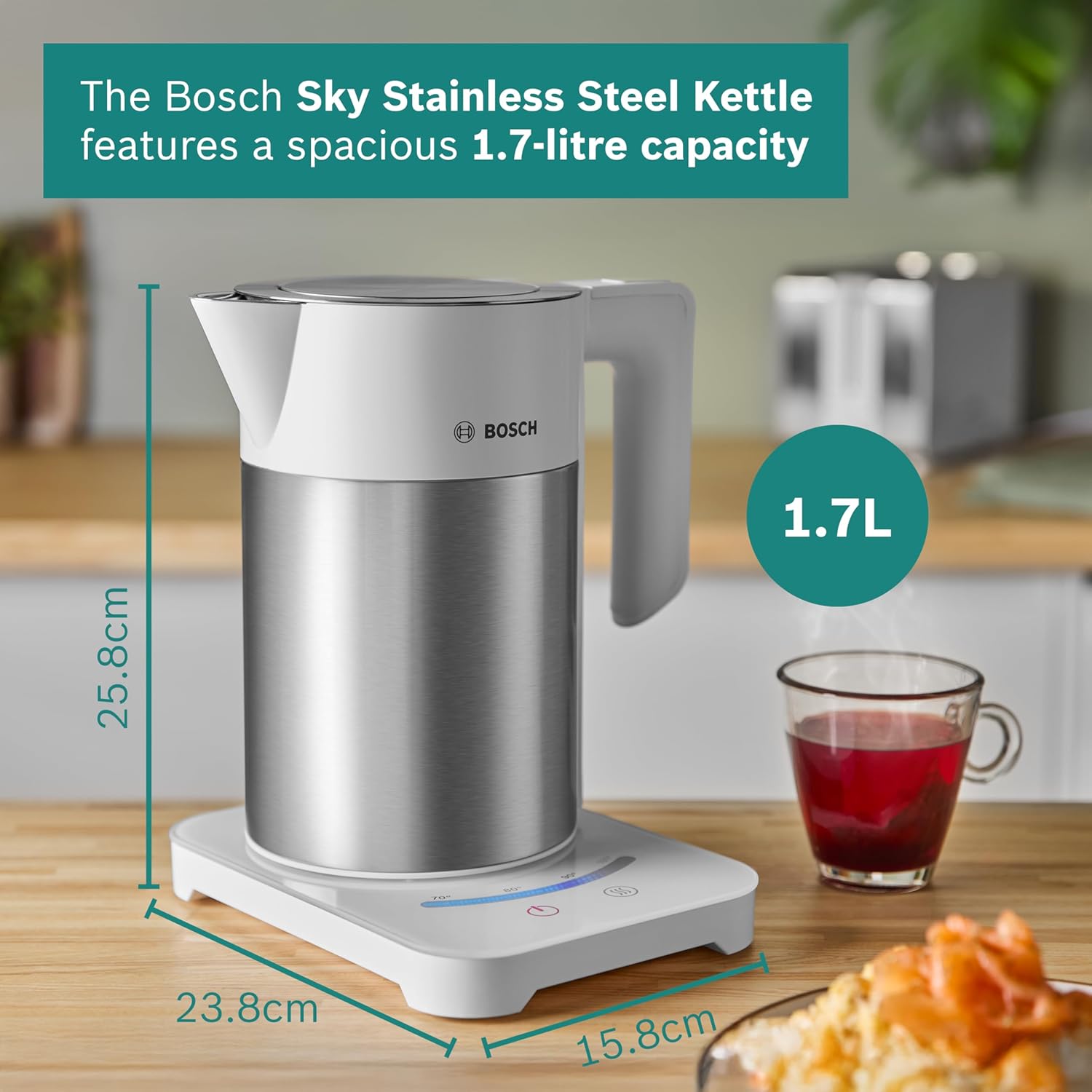
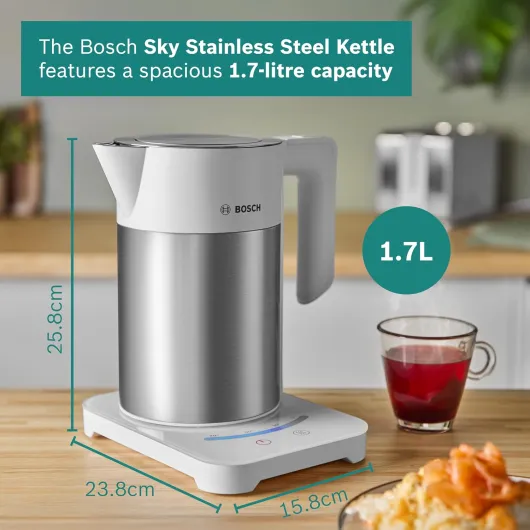
Design-wise, this kettle is clearly meant to look a bit more "premium" than the average plastic jug. The white and silver finish is clean and neutral, so it doesn’t shout for attention on the counter. It’s not tiny, but it’s not a monster either. The official dimensions are around 23.8 x 15.8 x 25.8 cm, and that matches how it feels: about the same footprint as a standard 1.7L kettle, just a bit more solid and blocky. It doesn’t feel flimsy when you grab it by the handle, which I appreciated compared to some wobbly-budget kettles I’ve used.
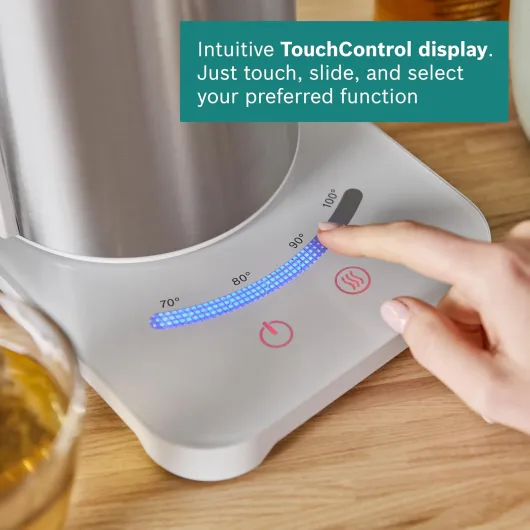
The big difference is the base with the touch controls and slider. Instead of a physical switch, everything is on a flat touch panel. At the beginning, I found it a bit weird because there’s no clicky feedback, just beeps and visual indicators. After a few days, though, it became normal: you plonk the kettle down, tap the power symbol, slide to the temp you want, and off it goes. If you hate touch controls on appliances, this might annoy you, but if you’re fine with them on a hob or microwave, it’s okay. The layout is fairly simple and not overloaded with icons.
One good point: the spout design is actually decent. A lot of kettles either dribble or blast water everywhere. This one pours in a steady, controlled stream. I used it to top up a French press and fill small mugs without splashing all over the counter, which is more than I can say for a couple of “designer” kettles I had before. The flip-up lid is also straightforward: one press, it opens wide enough to fill under the tap, no awkward angles.
On the downside, because of the double-wall construction and the electronics in the base, the whole setup looks and feels a bit bulkier than a super basic kettle. It’s not huge, but if you’re tight on worktop space or like very minimal, super-slim appliances, this is more in the "chunky but tidy" category. Overall, I’d say the design is practical and modern, not flashy. It fits nicely in a normal kitchen, and once you get used to the touch base, it’s straightforward to live with.
Materials & build: solid feel, double wall is useful, but not lightweight
The Bosch Sky kettle uses a stainless steel jug with double-walled insulation, and that’s one of the things that actually matters in day-to-day use. My previous single-wall metal kettle got properly hot on the outside, to the point where brushing your hand against it right after boiling was unpleasant. With this Bosch, the outside still gets warm but much less hot, so it’s less risky if you’ve got kids around or you’re just clumsy in the morning. The double wall also helps keep the water warm a bit longer, which ties in nicely with the keep-warm function.
The overall build feels pretty solid. It weighs about 1.8 kg empty, which is heavier than a cheap plastic one, and you do feel that when you pick it up. With a full 1.7L of water, it’s not exactly light, but it’s manageable. If you’re used to lightweight plastic kettles, this will feel more substantial, for better or worse. Personally I prefer that heavier, sturdy feel, but I can see someone with wrist issues finding it a bit much when it’s filled to the max line.
Inside, the heating element is enclosed, which is good news for cleaning and limescale. There’s also a limescale filter in the spout. I’m in a hard water area, so kettles usually get crusty pretty fast. After a couple of weeks with regular use and one basic descale, the inside still looked fairly clean, and there were no annoying flakes coming through into drinks. The manufacturer says “descale regularly” and wipe clean the outside, which is standard. The polished surfaces do show water spots a bit if you splash, but a quick wipe sorts it.
In terms of long-term confidence, Bosch gives a 2-year warranty, and the whole thing feels like it can survive daily use without falling apart. You don’t get that cheap hollow plastic vibe. So from a materials and build standpoint, I’d say it’s solid and practical, with the main trade-off being that the sturdier construction and double wall make it heavier than the budget stuff. If you want something feather-light, this isn’t it, but if you want something that feels like it will last a while, it’s a decent bet.
Durability & long-term use: feels like it’ll last, but time will tell
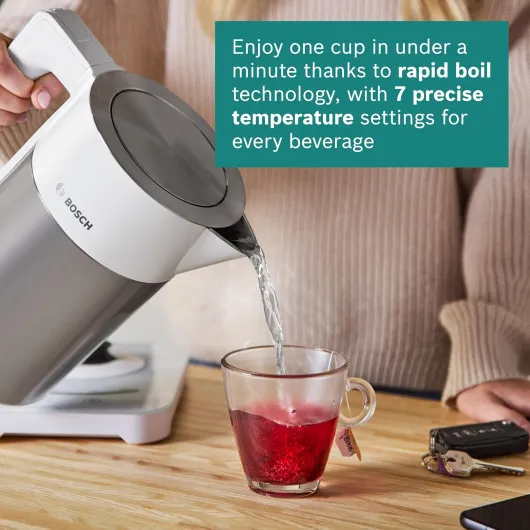
I obviously haven’t owned this kettle for years, but based on a few weeks of daily use and the general build, it feels like something that should hold up better than a flimsy supermarket model. The stainless steel double-walled body and solid handle don’t flex or creak, and the lid mechanism feels firm rather than cheap and rattly. With a lot of cheaper kettles I’ve had, you can tell after a month that the lid and handle will be the first things to go; here, everything still feels tight and well put together.
The enclosed heating element is a plus for durability because it’s less exposed to limescale build-up than older-style open elements. Combined with the limescale filter, that should help it last longer in hard water areas, as long as you actually descale it regularly. I gave it one basic descale during testing, and it was straightforward. No weird corners or exposed coils where limescale can cling forever. The outside cleans up easily with a cloth, although water marks will show a bit on the polished parts if you splash a lot.
The touch controls are the one area where I have a tiny question mark about very long-term durability. There’s no mechanical switch to wear out, which is good, but if the electronics in the base go weird after a few years, that’s harder to fix than a simple toggle switch. That said, Bosch isn’t some no-name brand, and you do get a 2-year manufacturer warranty, which is more than some budget kettles offer. I’d still treat the base with a bit of care: don’t soak it, don’t slam heavy things on it, and you should be fine.
Overall, my gut feeling is that this kettle should comfortably outlast the really cheap models if you descale it regularly and don’t abuse the touch base. It feels like a "buy once, keep for several years" sort of product rather than a "replace every 12–18 months" kettle. Obviously, only a few years of use will confirm that, but based on build and brand, I’m reasonably confident in its durability.
Performance: good control and keep-warm, slightly slower than basic kettles
In terms of raw performance, this kettle does the job well, but it’s not the fastest thing I’ve ever used. With 3000W power and 1.7L capacity, it’s in the same category as most UK kettles, but the double-wall construction and temperature control logic seem to make it feel a touch slower than some no-frills rapid-boil models. For example, boiling a full kettle felt maybe 20–30 seconds slower than my old cheap jug kettle. Not a huge deal, but if you’re obsessed with speed, you’ll notice it a bit.
Where it wins is temperature control. Having 7 temperature settings from 70°C to 100°C is actually useful if you drink different types of tea or do pour-over coffee. I ended up using it roughly like this:
- 70–80°C for green tea so it doesn’t taste bitter.
- 90–95°C for coffee and herbal teas.
- 100°C for black tea, instant stuff, and cooking.
The keep-warm function is genuinely handy if you’re making multiple drinks or cooking. It keeps the water at the set temperature for up to 30 minutes. In practice, I used it when I knew I’d want a second cup soon or when I was cooking pasta and topping up boiling water into a pan. It doesn’t keep it piping hot indefinitely, but it saves you from constant full reboils. One thing to know: sometimes you need to tap the function again to bring it back up to temp, otherwise you might catch it a few degrees lower than you expected.
Noise-wise, it’s not silent, but not obnoxious. I’d put it at a medium noise level: you hear it, but it’s not that aggressive roaring sound some kettles make. You can still talk in the kitchen without shouting over it. Overall, the performance is focused more on control and convenience than on being the absolute quickest. If you want precision and don’t mind a slightly slower boil at times, it’s good. If you only care about speed and price, a basic rapid-boil kettle will serve you just as well for less money.
What this Bosch Sky kettle actually offers in real life
On paper, the Bosch Sky TWK7201GB is a 1.7L cordless kettle with 7 temperature settings (70°C to 100°C), a keep-warm function (up to 30 minutes), and a touch control base. It runs at 3000W, so it’s in the same power range as most decent UK kettles, and it has a double-walled stainless steel jug that’s meant to keep it cool to the touch on the outside while keeping water hot inside. That double wall is not just a gimmick; in daily use, the outside really does stay much cooler than my last single-wall metal kettle.
In practice, the main thing that changes your routine versus a normal kettle is the temperature selection. You don’t just flip a switch. You put it on the base, use the touch slider to pick a temperature (70, 80, 90, up to 100°C), and hit start. There’s a small beep when it reaches the set temp. For me, it went like this: green tea at 80°C instead of boiling, coffee around 90–95°C, and full 100°C for black tea and cooking. After a few days, I stopped overthinking it and just tapped the same couple of settings out of habit.
The keep-warm function is the other key feature. You can keep the set temperature for about 30 minutes. In real life that meant: I boiled once, then made two or three drinks without reboiling, or topped up a saucepan with hot water for pasta or rice without waiting again. It doesn’t keep it hot forever, and you do need to re-trigger it sometimes, but it cut down on constant reboils and pointless waiting in the kitchen.
Included in the box is basically just the kettle, the base with the touch controls, and a limescale filter in the spout. No fancy extras. It’s clearly aimed at someone who wants a clean-looking, slightly techy kettle rather than the cheapest plastic jug. If you’re coming from a £20 supermarket kettle, this will feel like a small upgrade in how you interact with it, but also a jump in price that you should only pay if you actually care about those temperature features.
Effectiveness in daily life: does the fancy stuff actually get used?
Effectiveness for me comes down to a simple question: did the features change how I actually use a kettle, or did I just end up using it like a normal one? With this Bosch, I genuinely used the temperature settings and keep-warm function regularly, not just in the first two days. After a week, my routine had shifted from “boil everything to 100°C by default” to choosing 80°C for green tea and around 90–95°C for coffee without thinking too much about it. The result: fewer bitter teas and slightly better-tasting coffee, without any extra gadgets on the counter.
The keep-warm part was most effective on busy mornings or evenings when I was making multiple drinks. I’d boil once, leave it on keep-warm, and then come back 10–20 minutes later for another cup without waiting through a full boil again. Same thing when cooking: I’d keep it warm while prepping food, then pour near-boiling water straight into a saucepan for pasta or rice. It’s not life-changing, but it did cut down on the annoying “wait for the kettle again” moments.
Where it’s a bit less effective is for people who just want to hit a switch and ignore everything else. The touch controls and temperature slider are simple enough, but they do require that extra second of choosing a setting. If you live with someone who hates techy controls, expect a bit of moaning at first. Also, if you never drink green tea or decent coffee and only ever go full boil, you’re basically paying for features you’re not using.
Overall, I’d say the kettle is effective for people who actually care about water temperature and drink a variety of hot drinks. If all you do is quick tea bags and instant noodles, it still works fine, but you won’t really benefit from the features you’re paying extra for. In my case, it genuinely made my daily tea/coffee routine a bit more controlled and less random, which is exactly what I wanted from a temperature-control kettle.
Pros
- Useful 7-step temperature control (70–100°C) for different teas and coffee
- Keep-warm function up to 30 minutes reduces constant reboiling
- Solid double-walled stainless steel body that stays cooler to the touch
Cons
- More expensive than basic kettles with similar boiling power
- Slightly slower to boil than some rapid-boil models
- Touch controls may annoy people who prefer a simple physical switch
Conclusion
Editor's rating
The Bosch Sky TWK7201GB is basically a kettle for people who are a bit fussy about how they heat water. It’s not just boil-or-don’t-boil. The 7 temperature settings and keep-warm function actually change how you use it if you drink different types of tea or coffee. In daily use, I found myself using 80°C for green tea, around 90–95°C for coffee, and 100°C for cooking and black tea, and I stopped guessing or boiling everything to death. The double-wall body stays much cooler on the outside than a standard metal kettle, which is reassuring if you’ve got kids or you’re just half asleep in the morning.
It’s not perfect though. It’s more expensive than a basic kettle, it’s slightly slower than some rapid-boil models, and the touch controls take a little getting used to. If you only ever slam the switch to full boil and don’t care about temperature, you’re wasting money here. But if you actually care about brewing properly and like the idea of not reboiling water constantly thanks to the keep-warm, it starts to feel like a sensible upgrade rather than a gimmick.
I’d recommend this kettle to: tea and coffee drinkers who want control over temperature, people who make multiple drinks in a row, and anyone who prefers a solid, modern-looking kettle over a rattly plastic jug. I’d say skip it if: you’re on a tight budget, you only ever use boiling water, or you hate touch controls on appliances. Overall, I’d give it a solid 4/5: very good for the right user, a bit overkill for everyone else.