Summary
Editor's rating
Value for money: you’re paying for looks, not features
Design: the main reason people buy it
Ease of use: nice handle, short cable, quirky lid
Materials and build: plastic, but not toy-like
Durability and reliability: looks solid, but some red flags
Performance: boils like a normal mid-range kettle
What you actually get out of the box
Pros
- Very distinctive design that looks good on the counter
- Boils at a normal speed and is quieter than many metal kettles
- Lightweight for its size and comfortable to pour from
Cons
- Price is high for a kettle with basic features
- Short power cable limits where you can place it
- Some user reports of switch failures raise doubts about long-term reliability

Specifications
View full product page →| Brand | Alessi |
A designer kettle for people who actually use their kitchen
I’ve been using the Alessi Plissé MDL06 B/UK electric kettle in black for a few weeks now, basically every day for tea, coffee, and the occasional instant noodles. I didn’t buy it just for the design, but let’s be honest: you mainly go for this one because it looks nice on the counter. I wanted to see if it’s just a pretty object or if it actually works like a proper daily kettle.
Before this, I had a very basic stainless steel kettle from a supermarket brand. It boiled water fast, was noisy, and looked like something from a student flat. Swapping to the Alessi was a big visual upgrade, but I was a bit worried about two things: the plastic material and the price. A plastic designer kettle can quickly feel like you’re paying for looks and getting mediocre performance.
Over a few weeks, I paid attention to simple things: how fast it boils, how loud it is, how easy it is to fill and pour, and if anything feels cheap or fragile. I also watched out for any plastic smell or taste in the water, because that’s always the fear with thermoplastic kettles. I used it for small amounts (one mug) and full loads close to the 1.7 L max.
Overall, it does the job as a kettle, but it’s not perfect. It looks good, boils at a normal speed, and is quieter than my old one. On the downside, you’re clearly paying extra for design, the water level is not super easy to see, and the long-term durability is a bit of a question mark, especially with some users reporting switch issues. If you want something purely practical, there are cheaper options. If you care how your counter looks, this starts to make more sense.
Value for money: you’re paying for looks, not features
Let’s talk about the price because that’s where the Alessi Plissé becomes a bit tricky. Functionally, this is a basic electric kettle: 1.7 L, 2400 W, on/off switch, auto shut-off. No temperature settings, no keep-warm mode, no fancy filtration. If you strip away the design, it does the same job as a lot of mid-range kettles that cost a fair bit less. So purely in terms of features, the value is not outstanding.
Where your money actually goes is the design and the Alessi name. If you like having nice-looking objects in your kitchen and you see this kettle as part of the decor, then the price starts to make more sense. It genuinely looks nicer than most kettles you’ll find in a supermarket, and it does feel more thought-through visually. If you catch it on sale, like some reviewers did on Amazon, the deal feels more reasonable. At full price, you really have to care about aesthetics to justify it.
Compared to a basic stainless steel kettle, you’re not getting better boiling performance or extra features. You’re mostly getting quieter boiling, lighter weight, and a more interesting shape. On the flip side, you might be taking on a bit more risk with long-term durability, especially around the switch, which isn’t ideal when you’re paying a premium. The Amazon rating of 4.3/5 lines up with my feeling: people are generally happy, but there are enough small issues that it’s not flawless.
So in terms of value, I’d say: good if you care about design and catch it at a discount, average if you pay full price, and not ideal if you only care about function. If your main goal is boiling water as cheaply and reliably as possible, there are better options. If you want your kettle to look decent on Instagram or just not ruin your kitchen vibe, this one fits the bill, with a few compromises.
Design: the main reason people buy it
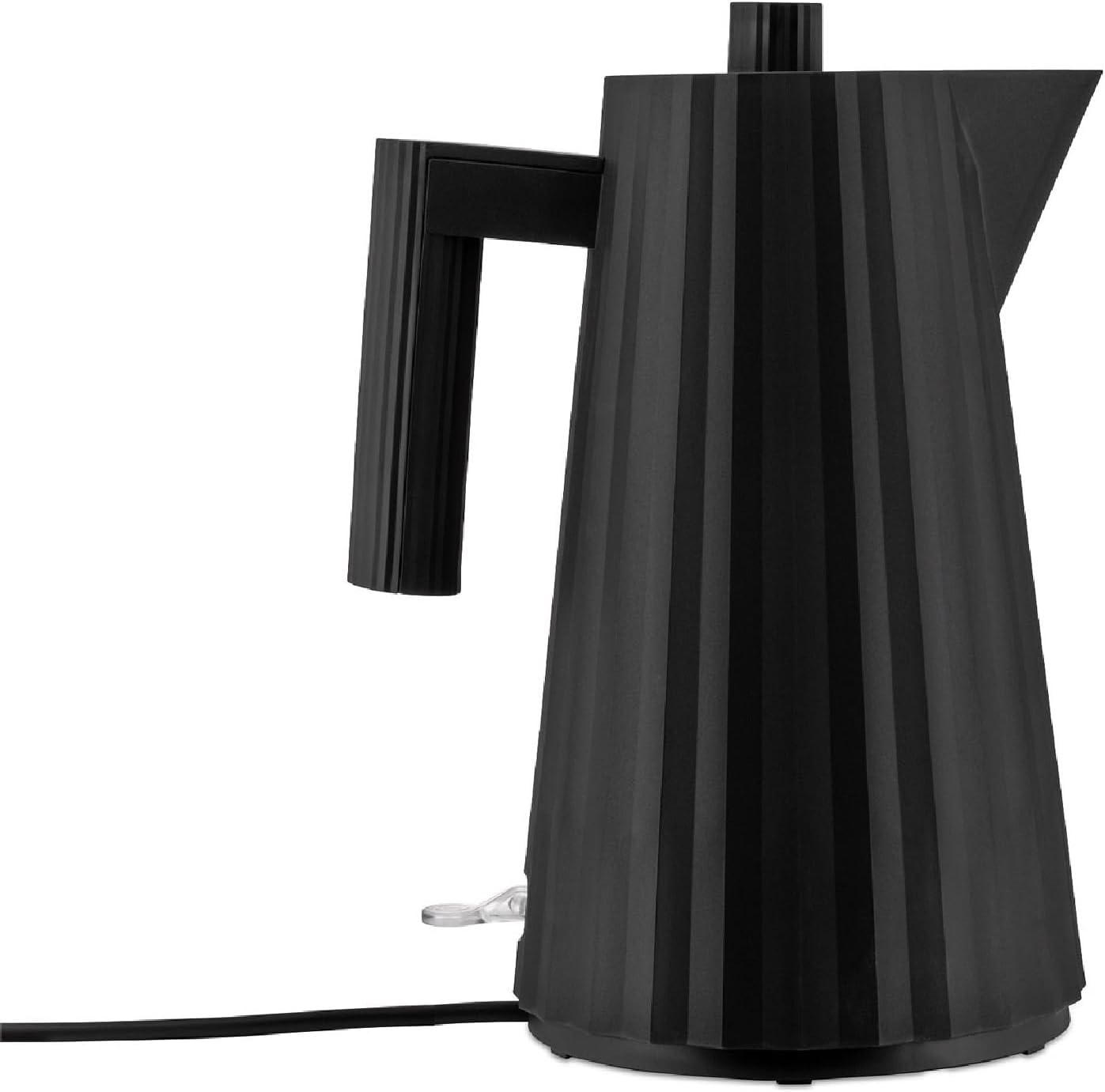
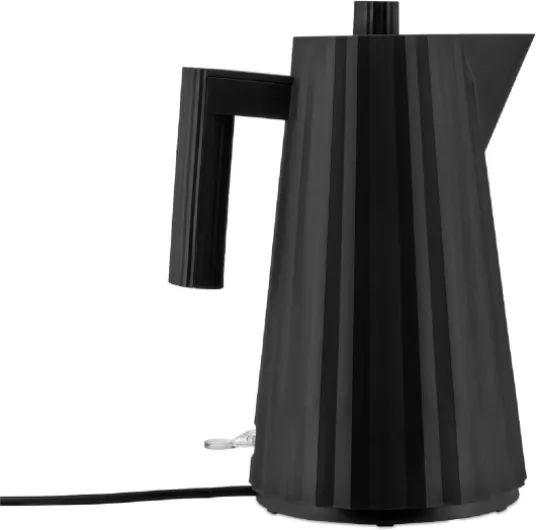
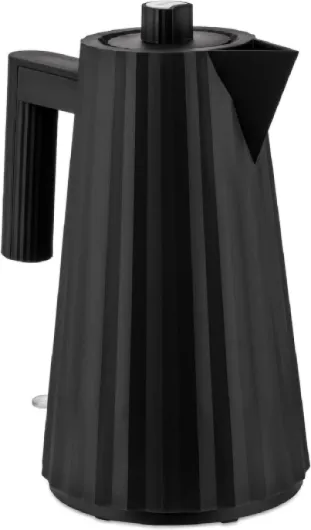
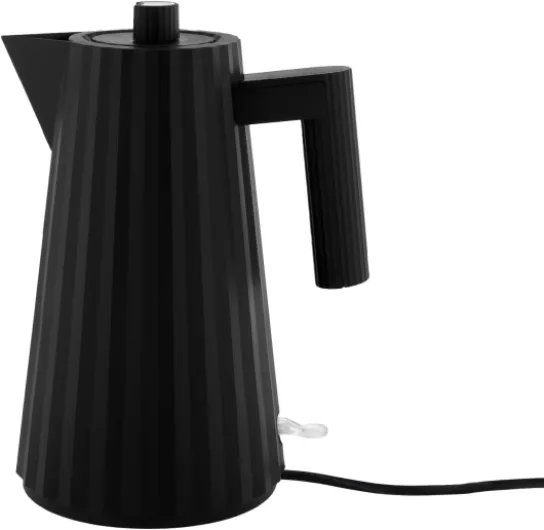
Design is clearly the big selling point here. The Plissé name fits: the body looks like folded fabric with vertical pleats all around. On the counter, it doesn’t look like a typical kitchen appliance; it looks more like a decorative object. In black, it blends in with most modern kitchens and doesn’t scream for attention, but it still looks different enough that guests comment on it. If you’re into minimal or modern interiors, it fits nicely.
One detail I liked is the overall shape and proportions. It’s tall and fairly slim (about 29 cm high, 21 cm long, 16 cm wide), so it doesn’t hog counter space. Compared to my old bulky stainless steel kettle, this one looks more vertical and less like a metal blob. The handle is integrated into the design without feeling awkward, and the lid has that little “pull back” motion instead of just lifting straight up, which feels a bit unusual at first but you get used to it after a couple of days.
You can get it in black, red, grey, or white, but I went for black because I didn’t want to worry about staining or yellowing over time. On a practical level, the pleated surface looks nice but does collect dust and splashes a bit more than a smooth body. You see water marks and limescale droplets a bit, especially if you have hard water. You’ll probably find yourself wiping it down more often if you want it to stay sharp-looking.
In short, the design is the reason to pay the Alessi price. If you don’t care what your kettle looks like, this is overkill. But if your kitchen is open-plan and you see this thing all day, I get why someone would choose it. It’s not just another metal cylinder. Just be ready to give it a quick wipe now and then to keep those pleats from looking grubby.
Ease of use: nice handle, short cable, quirky lid
In everyday use, the kettle is generally comfortable but not perfect. The handle is big and easy to grip, even when the kettle is full. The weight distribution is decent, so you don’t feel like it’s going to twist out of your hand when pouring. The on/off switch is right under your thumb when you grab the handle, and the red light that comes on while boiling is clear enough that you can see from across the kitchen whether it’s running or not.
The lid mechanism is a bit unusual. Instead of pulling straight up, you pull it back. At the beginning I found it slightly awkward, especially when trying to fill it quickly from the tap. After a few days you get used to the motion, but it’s not as intuitive as a simple flip-top or standard lift-off lid. The good side is that it feels secure when closed; I never had it pop open while pouring. The spout pours cleanly, with no big drips down the side, as long as you don’t overfill past the max line.
The cable length, at about 29 cm, is honestly too short. You almost have to position the kettle right next to the wall socket. If your kitchen layout isn’t friendly to that, you’ll probably end up using an extension lead, which defeats the clean design a bit. The base itself rotates 360°, so you can place the kettle in any direction, which is handy if more than one person uses it from different sides of the counter.
One last practical point: cleaning. Because of the pleated exterior, wiping it down takes a bit more effort than a smooth metal kettle. Water marks and fingerprints do show, especially on darker colours, so if you care about it looking neat, you’ll spend a bit more time with a cloth in hand. Inside, limescale builds up like any kettle and you just descale it normally. So in terms of comfort: easy to handle and pour, slightly annoying cable length, and a lid that takes a couple of days to get used to.
Materials and build: plastic, but not toy-like
The kettle is made from thermoplastic resin, which basically means: yes, it’s plastic. If you’re used to stainless steel or glass kettles, you’ll notice the difference immediately. That said, it doesn’t feel cheap in the hand. The plastic is thick, the finish is nicely painted, and nothing flexes or creaks when you grab it. It feels more like a solid household object than a flimsy budget kettle from a supermarket.
Inside, the water doesn’t touch bare metal surfaces like in some steel kettles, which some people like because it avoids metallic taste. I didn’t notice any plastic smell or flavour after the first couple of boils. I did two flushes with full water, boiled and emptied, before actually making tea, and after that the water tasted normal. Compared to a very cheap plastic kettle I used in the past, this one is clearly a step up in terms of material quality.
However, it’s still plastic, and that comes with trade-offs. It won’t dent like metal, but it can scratch, and long-term heat exposure might dull the finish a bit. Also, plastic around boiling water always raises the usual health concerns for some people. If you’re very strict about avoiding plastic in contact with hot water, this is obviously not the product for you. For me, it was acceptable, but I know people who would only go for glass or stainless steel for that reason.
The base and switch feel reasonably solid, but I’ve seen multiple user reviews complaining about the switch failing over time, sometimes on their second unit. I haven’t had that issue yet, but it doesn’t inspire huge confidence for the long-term. So in terms of materials, I’d say: pretty solid for a plastic kettle, clearly higher quality than entry-level models, but not bulletproof. You’re still dealing with plastic and some potentially fragile moving parts.
Durability and reliability: looks solid, but some red flags
On first contact, the kettle feels well made for a plastic appliance. The body is rigid, the handle is firmly attached, and there are no weird gaps or rattles. After a few weeks of daily use, nothing has loosened, the lid still closes properly, and the base connection is still tight. From a purely physical point of view, it gives the impression that it can handle normal household use without falling apart in a few months.
However, reliability is not just about how it feels; it’s also about what happens after a year or two. That’s where some of the Amazon reviews are a bit worrying. There are several comments about the switch failing over time: it either doesn’t stay down, or it stops turning on properly. One reviewer even said this was their second Plissé kettle with the same issue. For a product in this price range, that’s not great news. It suggests that the internal mechanism of the switch might be a weak point.
I obviously haven’t had it long enough to confirm those long-term problems myself, but it’s something to keep in mind. If you’re the type of person who keeps a kettle for 5–7 years, I’m not 100% convinced this one will last that long without any hiccups. It’s made in China for Alessi, which isn’t automatically a bad thing, but it’s another sign that you’re paying more for the design and brand than for heavy-duty engineering.
So I’d rate durability as acceptable but not rock solid. The plastic body will survive normal bumps, but it might scratch and show wear. The main risk seems to be the switch and possibly other internal electrics over time. If you’re okay with potentially dealing with warranty or replacement after a couple of years, fine. If you want something you can forget about for a decade, a simpler stainless steel model from a more utilitarian brand might be a safer bet.
Performance: boils like a normal mid-range kettle
On the performance side, this kettle is very straightforward. At 2400 W, it boils a full 1.7 L in what I’d call a “normal” time for a UK kettle. Roughly speaking, you’re looking at around 3–4 minutes for a full load and about 1.5–2 minutes for a big mug’s worth. It’s not ultra-fast, but it’s not slow either. Compared to my old 2200 W stainless kettle, it felt slightly quicker with small amounts and roughly the same with a full load.
Noise-wise, it’s actually one of the nicer surprises. Several Amazon users mention it, and I agree: it’s quieter than many metal kettles I’ve used. You still hear the typical water heating sound, but it’s more muffled, probably thanks to the plastic body. If you’re in an open-plan space and hate that aggressive roaring noise some kettles make, this one is easier to live with. You can still talk over it without feeling like you’re yelling.
The auto shut-off works as expected: the switch flips off cleanly once it reaches a boil. I tested it a few times by watching it and it never failed to turn off. There’s also boil-dry protection, so if you accidentally switch it on empty, it should cut out, but I didn’t push that too far because I don’t feel like breaking a fairly expensive kettle deliberately. One thing I did notice is that if you remove the kettle from the base right after it clicks off and then put it back down quickly, the switch doesn’t accidentally re-engage, which is good.
The main annoyance in use is the water level indicator. As one reviewer said, you kind of have to tilt the kettle or bring it closer to eye level to properly see how much water is inside. In daily life, that means you often just guess the amount by feel instead of checking the actual markings. So performance-wise: it boils water reliably, at a standard speed, with low noise. No bonus features, no fancy temperature presets, just basic functionality dressed in nice clothes.
What you actually get out of the box
Out of the box, the Alessi Plissé MDL06 B/UK feels like a mix between a design object and a standard kettle. You get the kettle itself in thermoplastic resin, the 360° base with an English plug, and a very short manual that you’ll probably skim once and ignore. There’s no fancy extra feature: no temperature control, no keep-warm, nothing smart. It’s a simple on/off kettle with a design twist.
The capacity is 1.7 litres, which is pretty standard and enough for a few big mugs or a small teapot. The power is 2400 W on 240 V, so it boils at a normal speed, similar to most mid-range kettles in the UK. The weight is about 1.54 kg empty, which is lighter than many metal kettles but not super light. Once you fill it, it has a bit of heft, but the handle is large enough to manage it without feeling unsafe.
The cable is only about 29 cm, and that’s honestly on the short side. In practice, it means you need a socket fairly close to where you want to keep it on the counter. If your plug is far away or behind appliances, you might have to reorganise your setup, which is a bit annoying for something this expensive. The base itself is compact and doesn’t take up much space.
Function-wise, it’s very straightforward: a single switch that lights up red when boiling, auto shut-off when it reaches the boil, and protection if you accidentally turn it on with no water. No visible bells and whistles beyond that. So in terms of features, it’s basically a normal kettle dressed up nicely. If you’re expecting high-tech functions for the price, you’ll be disappointed. If you just want a standard kettle that looks nicer than average, that’s exactly what this is.
Pros
- Very distinctive design that looks good on the counter
- Boils at a normal speed and is quieter than many metal kettles
- Lightweight for its size and comfortable to pour from
Cons
- Price is high for a kettle with basic features
- Short power cable limits where you can place it
- Some user reports of switch failures raise doubts about long-term reliability
Conclusion
Editor's rating
The Alessi Plissé MDL06 B/UK is basically a normal kettle dressed like a designer object. It boils water at a standard speed, it’s quieter than many metal models, and it’s easy enough to handle and pour from. The 1.7 L capacity and 2400 W power are exactly what you’d expect from a typical UK kettle. So in terms of pure function, it gets the job done without doing anything special. The main reason to buy it is how it looks on your counter.
If you care a lot about your kitchen’s appearance and want appliances that match a modern or minimalist style, this kettle makes sense. The pleated design is visually interesting, and in black it fits into most setups without looking cheap. Just be aware you’re paying a premium for that look, and you still have some practical downsides: a short cable, a water level that’s not super easy to read, and a few worrying reviews about the switch failing over time. It’s not a disaster, but it’s not perfect either.
I’d recommend this kettle to people who see it as part of their decor and are okay with spending more for design, especially if they can grab it during a sale. If you just want a reliable workhorse to boil water for years with zero fuss, a simpler stainless steel model from a more utilitarian brand will probably give you better long-term value. Overall, it’s a good-looking, decent-performing kettle, but you need to be honest with yourself that you’re paying mainly for style.