Summary
Editor's rating
Is it actually worth the price, or just kitchen jewellery?
Chunky, quiet, and very KitchenAid-looking
Daily use: handle, weight, noise, and heat on the outside
Metal body, double wall, and why it feels so heavy
Built like it wants to outlive your cheap kettles
Boil speed, temperature control, and real-life use
What you actually get out of the box
Pros
- Sturdy double-wall stainless-steel build that feels made to last
- Adjustable 50–100°C temperature control that’s actually useful for tea and coffee
- Quieter than many kettles and keeps water hot for longer
Cons
- Heavier and bulkier than a basic plastic kettle
- High price compared to simple kettles with no temperature control

Specifications
View full product page →| Brand | KitchenAid |
A fancy kettle I actually use every day
I’ve been using the KitchenAid Artisan 5KEK1522BMS temperature control kettle (the 1.5 L one in Medallion Silver) for a few weeks now. I bought it mostly because my cheap supermarket kettle died and I was tired of replacing them every year. This one is clearly in the "why is a kettle this expensive?" category, so I went into it a bit suspicious, expecting mostly style over substance.
Day to day, it’s basically my most used appliance after the coffee machine. I work from home, so it’s doing several boils a day for coffee, tea, instant noodles, and the occasional saucepan shortcut. That makes it pretty easy to see quickly what’s good and what’s just marketing. I’m not babying it; I fill it, flick the switch, and go. No special treatment.
The short version: it heats water fast, it’s quieter than the usual cheap kettles, and the temperature control is actually useful if you drink different types of tea or use a French press. On the other hand, it’s heavy, it takes up a fair bit of space on the counter, and the price is clearly on the high side for a kettle. If you just want boiling water as cheaply as possible, this isn’t it.
So in this review I’ll walk through how it’s built, how it performs, and if I honestly think it’s worth the money after using it daily. No fancy adjectives, just what it’s like living with this thing in a normal kitchen with normal habits.
Is it actually worth the price, or just kitchen jewellery?
Let’s talk about the awkward bit: the price. This KitchenAid kettle is definitely on the expensive side for something whose job is basically "make water hot." You can get a basic kettle that boils water for a fraction of the price. So the question is whether the extra cost is justified in real life, not just on paper specs. For me, the value comes down to three things: build quality, temperature control, and daily comfort (noise and insulation).
If you only ever boil water to 100°C for tea bags and you don’t care about noise or how long it lasts, then no, this kettle is probably not good value for you. A cheap model will do the job. But if you drink different types of tea, do pour-over coffee, or just like being able to choose the temperature, the adjustable range from 50–100°C is genuinely useful. It’s not just a gimmick; you really end up using it if you care at all about how your drinks taste.
On durability and feel, you’re paying for that solid, double-wall stainless-steel build. Compared to the £20–30 plastic kettles that crack, leak, or get nasty after a year or two, this feels like it’s in a different league. If it actually lasts, say, 5–7 years of daily use, then the cost spread over that time doesn’t look so bad. Obviously that’s a bit of a bet, but based on the feel and the user reviews, it’s not unrealistic.
So overall, I’d say the value is decent if you care about build quality, quieter operation, and temperature control, and you’re okay paying extra for something that feels more like a proper appliance. If you’re just looking for the cheapest way to boil water, it will feel overpriced. It’s not a bargain, but it’s also not just "kitchen jewellery" – it actually brings some practical benefits that you notice day to day.
Chunky, quiet, and very KitchenAid-looking
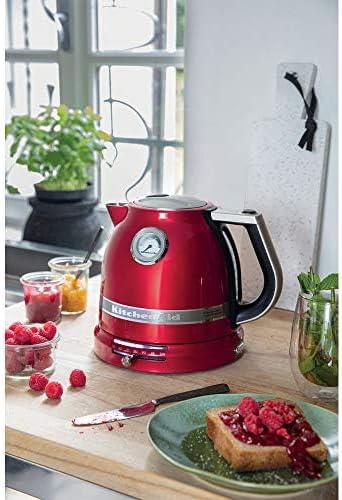
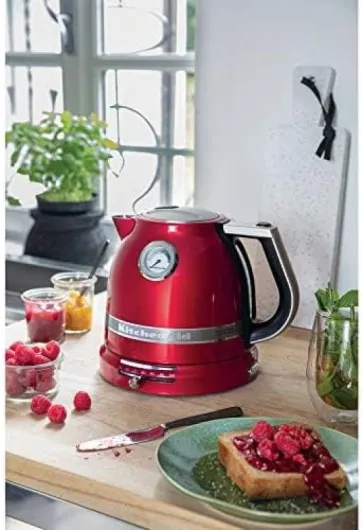
The design is very obviously KitchenAid: rounded, retro-ish shape, thick handle, and that solid, almost "industrial kitchen" look. It’s not slim or discreet. On my counter, it absolutely stands out next to a normal toaster. If you like that style, it’s a plus; if you prefer minimal, this will look a bit bulky. The footprint is roughly 25 x 25 cm, so it eats up some counter space, especially the depth. I had to shuffle a few things around to give it a permanent spot.
The Medallion Silver colour is pretty neutral. It’s not mirror chrome, it’s more of a brushed/satin metal effect, which I prefer because it doesn’t scream for attention and doesn’t show every single fingerprint. There is some shine, but it’s fairly controlled. The temperature gauge on the side is actually readable at a glance, not just decorative. The blue lights and the little chime when it boils feel a bit "gadgety" but they’re not over the top. They just tell you "hey, I’m done" without being annoying.
One thing I noticed quickly: the spout shape is well done. Pouring is controlled and it doesn’t dribble down the side, even when you’re pouring slowly for a pour-over coffee or topping up a cup to the brim. The lid opens wide enough to fill it easily under the tap, and it doesn’t feel flimsy. Everything you touch feels solid – the handle, the lid hinge, the temperature selector. It gives the impression that it’s made to last longer than the typical flimsy plastic kettle.
On the downside, the design is not particularly compact, and it’s not the lightest thing to move around. If you have limited counter space or small hands, the chunky handle and wide body might feel a bit much. But if you like that "proper appliance" vibe and want something that looks consistent with a stand mixer or a decent espresso machine, it fits nicely into that kind of kitchen setup.
Daily use: handle, weight, noise, and heat on the outside
In daily use, the kettle is generally comfortable, with a few caveats. The handle is thick and easy to grip, and it feels stable when you pour, even when it’s full. The weight is noticeable, though. When I fill it close to the 1.5 L max and carry it from the sink to the base, I feel the difference compared to my old plastic kettle. It’s not a dealbreaker for me, but if you have a weaker grip or any joint problems, it’s worth thinking about.
The dual-wall construction is one of the nicer comfort features. When it’s just boiled, the outside is warm but not scalding, so you’re less likely to burn yourself if you brush against it. I’ve accidentally touched the body a few times right after boiling, and it was fine – not something I’d do on purpose, but it’s clearly cooler than a single-wall metal kettle. It also keeps the water warm for longer, which means if I boil for tea and then want a top-up 10–15 minutes later, the water is still pretty hot without a full reboil.
Noise-wise, it’s quieter than most kettles I’ve had. You still hear it, obviously, but it’s more of a low hum than a harsh roar. I can have a conversation in the kitchen while it’s boiling without raising my voice. Compared to a very loud Bosch kettle a friend has, this one is clearly more pleasant to live with, especially if your kitchen is near a living room or workspace.
On the ergonomics downside, the wide body and weight make it a bit awkward to pour slowly with one hand if you have small hands. It’s fine for me, but someone with less strength might need two hands when it’s full. Also, the chime when it finishes is a nice touch, but there’s no way to adjust the volume. It’s not aggressive, but if you hate any beeps in your kitchen, that might annoy you. Overall, though, in terms of comfort and daily handling, it’s pretty solid, just not the lightest or most compact option.
Metal body, double wall, and why it feels so heavy
The kettle is mainly stainless steel with a dual-wall construction. That double wall is one of the key features: it keeps the outside cooler and the water hot for longer, and it also helps with noise reduction. When you pick it up empty, it feels heavier than a standard single-wall metal or plastic kettle. Once you add water, you definitely feel the weight, especially when it’s full at 1.5 L. It’s not unmanageable, but it’s not feather-light either.
The outer finish on the Medallion Silver model looks and feels solid. After a few weeks of use, including the occasional splash and wipe, there are no marks or peeling. I’ve just been wiping it down with a damp cloth as recommended (they say hand wash / wipe clean). Inside, it’s a plain metal interior, no fancy coatings. That’s a plus for me: less to wear off over time. There is a standard limescale filter in the spout area, nothing fancy but it does the job of catching bits if you live in a hard water area.
The handle is plastic but feels robust and well attached, with a good thickness. It doesn’t flex or creak when the kettle is full. The base is also plastic, with the temperature control dial integrated. The cord isn’t very long, but that’s pretty standard. You get some cord storage under the base if you want to shorten it. Overall, the materials feel like they’re picked for durability rather than lightness.
Compared to cheaper kettles I’ve used, this feels like it can survive being used heavily every day for years. That said, it’s still made in China like most appliances, so it’s not some magic indestructible object. But in the hand, it’s closer to the feel of a solid stand mixer than a £20 supermarket kettle. If you’re sensitive to weight or you have wrist issues, keep in mind that the combination of stainless steel and double wall does make it heavier than average.
Built like it wants to outlive your cheap kettles
Durability is one of the main reasons I went for this model, especially after seeing that people on Amazon were buying a second one only after several years. The whole thing feels robust: the body doesn’t flex, the handle is solid, and the lid mechanism feels tight. There are no rattles or loose bits when you shake it gently. It gives the impression that it’s designed to survive daily abuse for a long time, not just sit pretty on the counter.
After a few weeks of heavy use (multiple boils a day), there are no signs of wear beyond some normal water spots inside from limescale, which is expected where I live. The exterior finish still looks like new after basic wiping with a cloth. No chipped paint, no weird discoloration around the base. The base itself feels sturdy, and the connection between kettle and base is still snug, not wobbly. That’s usually where cheap kettles start feeling tired after a while.
The double wall probably helps the longevity of the outer finish too, because the outer shell isn’t getting blasted by full heat every single boil. It also reduces the stress on the handle area, since the outside doesn’t get as hot. Inside, since it’s just bare metal, you can descale it like any normal kettle with vinegar or descaling solution without worrying about fancy coatings.
Of course, I can’t pretend to know how it will behave after five years of use, but compared to budget kettles I’ve owned, this one clearly sits a level higher in build quality. If something fails, it will probably be an electrical component rather than the physical structure falling apart. So if you’re tired of replacing flimsy kettles every 12–18 months, this feels like a decent attempt at a "buy once, use for years" approach, even if that’s never guaranteed with modern appliances.
Boil speed, temperature control, and real-life use
Performance-wise, the kettle does what it’s supposed to do and does it well. At 3000W, it boils a full 1.5 L pretty fast – roughly in the same range as other high‑wattage kettles I’ve used, maybe a touch quicker thanks to the design. For smaller amounts (one or two mugs), it’s very quick. You flip the switch, and by the time you’ve got your mug and tea bag sorted, it’s close to done. Nothing magical, just solid, consistent heating.
The adjustable temperature control is where it stands out from basic kettles. You can set it anywhere from 50°C to 100°C. In practice, I use three main settings: around 70°C for green tea, 90–95°C for coffee and some herbal teas, and 100°C for everything else and for cooking. The kettle stops at the target temperature and chimes. If you’re used to just boiling everything, it takes a bit of habit change, but once you get used to it, it’s nice not to burn delicate teas or overheat water for coffee.
The temperature gauge on the side is more useful than I expected. After a first boil, if I come back 15–20 minutes later and see it’s still at, say, 60–70°C, I know I only need a short reheat. It doesn’t have a fancy keep-warm mode like some kettles, but the double wall plus the gauge sort of gives you a manual version of that. For me, that’s enough and avoids leaving it on power unnecessarily.
In terms of reliability, it’s been consistent so far: no random shut-offs, no weird smells, no plastic taste in the water (it’s all metal inside). It just heats and stops as it should. The only thing I’d flag is that it doesn’t have lots of extra features beyond the temperature control – no timer, no app, no dedicated keep-warm button. Personally I’m fine with that; fewer things to break. If you want all the smart features, this is more of a simple, robust performer than a techy gadget.
What you actually get out of the box
Out of the box, you get the kettle itself, the base with the power cord, and the usual bits of paper. No extra accessories, no filters or special tools. The first impression is that it feels like a small metal tank. It’s a 1.5 litre kettle with a pretty chunky body and a solid handle. It runs at 3000W on 240V, so it’s in the usual UK/eu fast-boil territory. The Medallion Silver version I have is a sort of satin metallic grey, not shiny chrome, which helps with fingerprints a bit.
The base has the adjustable temperature control: from 50°C up to 100°C in steps (enough for green tea, coffee, and full boil). On the side of the kettle, there’s a built-in temperature gauge that shows the current water temperature even when it’s off the base. In practice, that gauge is more useful than I expected: you can see if the leftover water is still warm enough or if you need to reboil from scratch.
There’s no complicated interface. You basically: set your target temperature on the base, fill the kettle, put it on, and press the lever. It chimes when it reaches temperature and there are blue indicator lights. It’s fairly simple, which I liked. No app, no Wi‑Fi nonsense, just a temperature dial and a switch. The capacity is 1.5 L, which for me is plenty: it does about 5–6 mugs of tea or a full French press without needing to refill.
In terms of expectations, the product page and the actual product match pretty well. It is big, it is heavy, and it definitely feels more like a small appliance than a lightweight kettle. If you’re coming from a plastic budget kettle, this will feel like overkill at first. But if you like the KitchenAid mixer vibe, this fits right in with that style and level of build.
Pros
- Sturdy double-wall stainless-steel build that feels made to last
- Adjustable 50–100°C temperature control that’s actually useful for tea and coffee
- Quieter than many kettles and keeps water hot for longer
Cons
- Heavier and bulkier than a basic plastic kettle
- High price compared to simple kettles with no temperature control
Conclusion
Editor's rating
After using the KitchenAid Artisan 5KEK1522BMS daily, my take is pretty simple: it’s a solid, heavy-duty kettle with useful temperature control and quieter operation, wrapped in that typical KitchenAid look. It heats water fast, the adjustable temperature from 50°C to 100°C is genuinely handy if you drink more than just basic black tea, and the double-wall design keeps the outside cooler and the water hot for longer. The build feels sturdy enough that you don’t get the usual "this might die in a year" vibe you get with cheap plastic kettles.
On the flip side, it’s not perfect. It’s heavy, fairly bulky, and clearly expensive for a kettle. If you only ever boil to 100°C and don’t care about noise, insulation, or long-term durability, you can definitely save money with a basic model. This is more for people who appreciate solid appliances, already like the KitchenAid ecosystem, or are tired of replacing flimsy kettles every year. If that’s you, the price starts to make sense. If you just want boiling water on a tight budget, skip it and get something simpler.