Summary
Editor's rating
Value for money: worth it if you actually use the features
Design: compact, modern, but not flawless in everyday handling
Materials and build: feels solid, but you’ll notice the limescale
Durability and maintenance: feels sturdy, but expect regular descaling
Performance: does the temperature control really help?
What you actually get out of the box
Effectiveness in daily life: from sleepy mornings to tea sessions
Pros
- Useful five-step temperature control (60–100°C) that actually helps for tea and coffee
- Compact 1L size with double-wall body that stays cooler to the touch
- Keep-warm function reduces repeated boiling when making several drinks
Cons
- 1L capacity is small for families or guests, often needs multiple boils
- Transparent inner chamber shows limescale very clearly, needs regular descaling
- Pricier than basic kettles, not great value if you only ever use 100°C

Specifications
View full product page →| Brand | Bodum |
A temperature-control kettle that tries to be smarter than a basic one
I’ve been using the Bodum BISTRO 1L double-wall electric kettle with temperature control for a couple of weeks, and I’ll be straight: it’s a decent upgrade from a cheap basic kettle, but it’s not life-changing. If you mainly drink instant coffee or just want boiling water as fast as possible, this is probably more features than you really need. But if you drink different teas or use a French press or pour-over coffee and care about water temperature, then the extra buttons actually start to make sense in day-to-day use.
The main thing that pushed me to try it was the temperature control (60/70/80/90/100°C) and the keep-warm function. My old plastic kettle was either off or boiling like crazy, and I was constantly waiting for water to cool down for green tea or coffee. With this Bodum, I can just hit 80 or 90°C and pour straight away without faffing around. That’s the real use case here: less guesswork, fewer burned teas.
In practice, the 1-litre capacity is enough for 2–3 big mugs or a teapot, so it feels more like a personal or couple’s kettle than a family one. If you’re used to 1.7L kettles, this will feel small at first. The 2000W power is pretty standard in the UK, and boil times are roughly in line with other kettles I’ve had: not slow, not ultra-fast, just normal. The double-wall design is nice on paper, but it’s not magic; the outside is cooler than single-wall metal, but it’s still warm.
Overall, my first impression is: solid but not mind-blowing. It looks nicer than a cheap supermarket kettle, it’s quieter than some, and the temperature presets do actually get used, not just sit there. On the other hand, there are a few small annoyances in daily use, and for this brand and feature set, I kind of expected a bit more polish. So, good product, but far from perfect.
Value for money: worth it if you actually use the features
On value, this really depends on how you drink your hot drinks. If you just hammer boiling water for tea bags and instant coffee, you can get a cheaper 1.7L kettle that will do that just fine. This Bodum is priced higher because of the temperature control, double-wall design, and keep-warm function. So the question is basically: do you actually care about those features enough to pay extra?
Compared to a basic supermarket kettle, you’re paying more but getting:
- More precise temperatures for different drinks (green tea, coffee, etc.).
- Better insulation and a cooler-touch exterior.
- A more compact footprint, which is nice in small kitchens.
- A brand that generally has decent design and build quality.
Compared to other variable-temperature kettles from brands like Russell Hobbs, Sage, or Bosch, the Bodum sits roughly in the middle. Some competitors offer bigger capacity, digital displays, or more advanced controls. This one keeps it simple: five presets, no screen. You’re paying partly for the Bodum design and branding, and partly for the double-wall and glass look. So value-wise, I’d call it fair but not a bargain.
If you’re someone who drinks a lot of tea and coffee at home and you want a small, decent-looking kettle with real temperature control and you don’t need a huge 1.7L monster, it’s a sensible buy. If you’re on a tight budget or live in a big household where everyone just wants boiling water fast, I’d go for a cheaper, bigger kettle instead and spend the difference on better coffee or tea.
Design: compact, modern, but not flawless in everyday handling
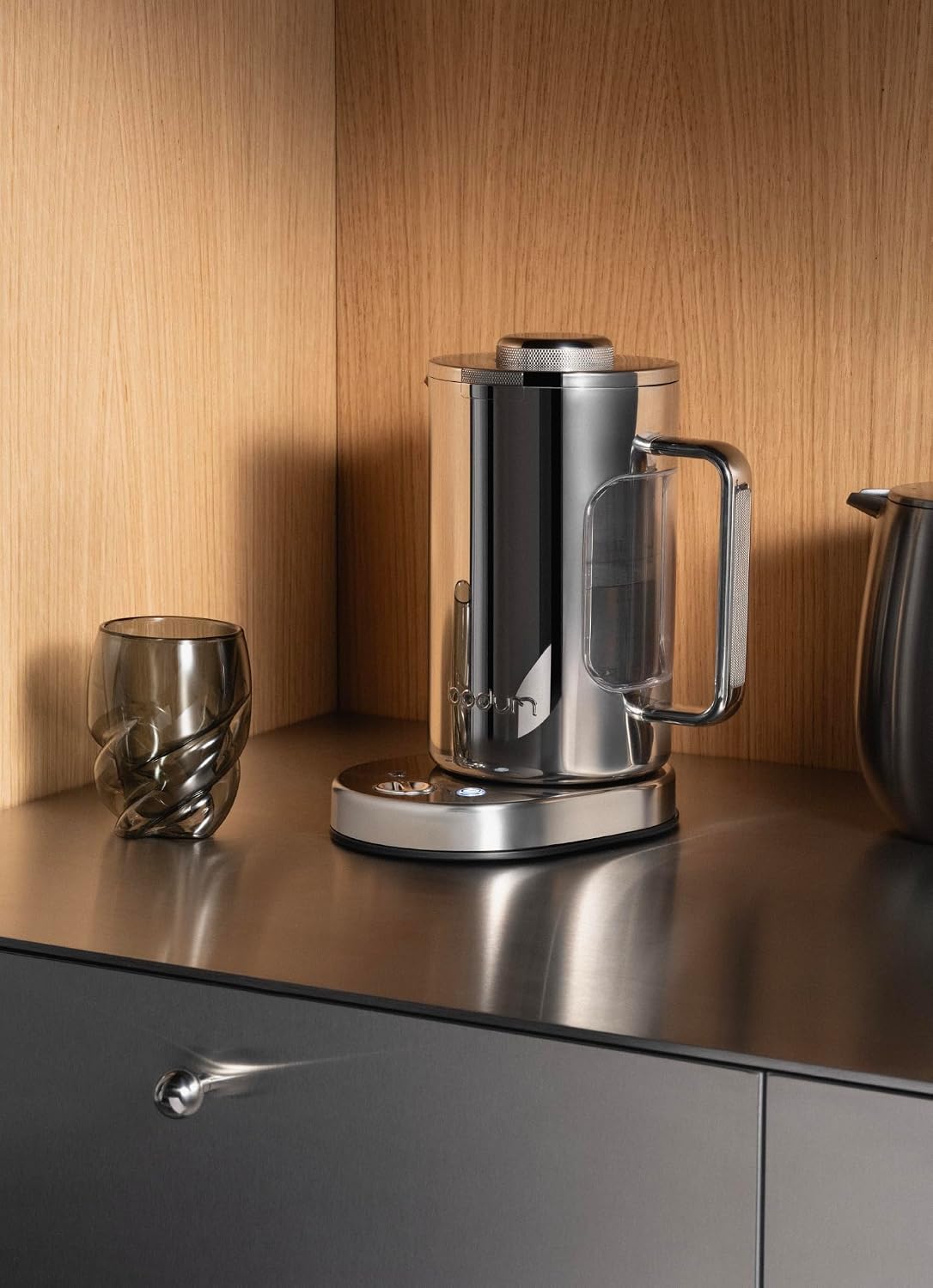
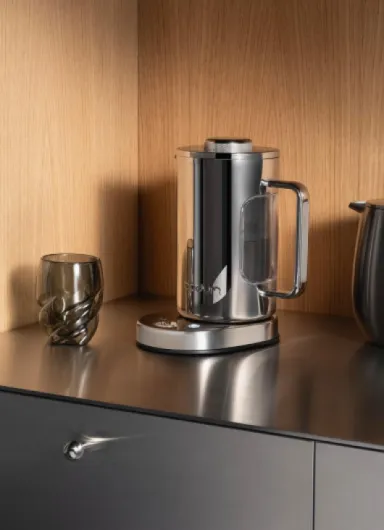
Design-wise, the Bodum BISTRO kettle sits somewhere between "nice-looking appliance" and "generic stainless thing". The chrome/stainless steel with glass inner chamber gives it a modern look, and the double-wall body makes it look a bit chunkier than a basic metal kettle, but still compact. At 21.5 x 21.5 x 27.5 cm, it doesn’t hog the counter. For a small kitchen, that’s a plus. It tucks into a corner easily and doesn’t look cheap next to a decent coffee machine.
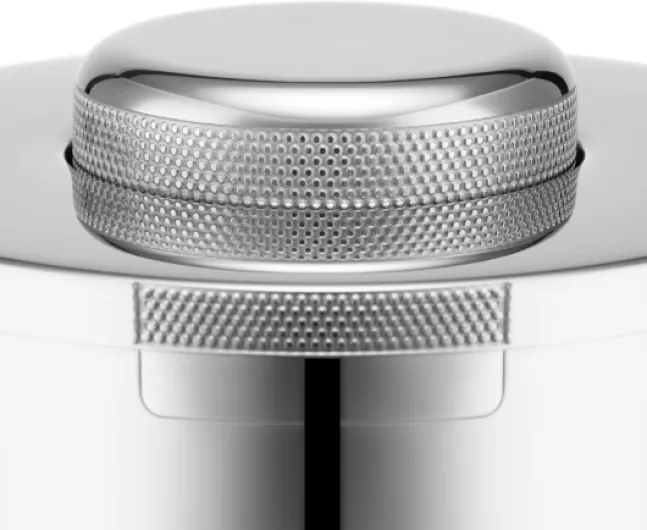
The handle is comfortable enough, with a good angle and distance from the hot body. I never felt like my fingers were at risk, even when it was at 100°C. The lid opens with a button, and it’s reasonably smooth, but not perfect: sometimes I had to give it a slight nudge to fully open. Nothing dramatic, but it doesn’t have that super crisp, precise feel you sometimes get on higher-end gear. The spout pours cleanly most of the time, but if you fill right to the max and pour fast, you can get a little drip down the side – not a disaster, just something I noticed.
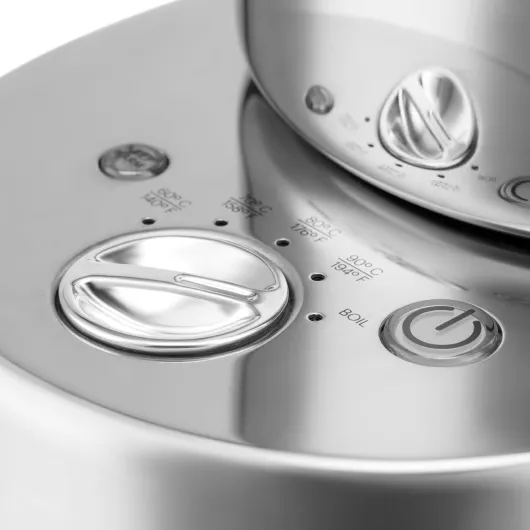
The control layout on the base is clear: the temperature buttons are in a row, and each one lights up when selected. It’s pretty easy to see at a glance what you’ve chosen. However, because the controls are on the base, you have to bend down a bit if it’s at the back of the counter. Also, the text/icons are not huge, so if your vision isn’t great or your kitchen light is poor, you might squint a bit at first. Once you build the habit (green tea = 80, coffee = 90, etc.), you almost do it by muscle memory, though.
One small design annoyance: the transparent inner chamber looks cool when it’s new, but you can see limescale build-up very clearly, especially in hard water areas. That’s not a functional problem, more of an aesthetic one, but if you hate seeing white marks, be ready to descale fairly often. In short, the design is pretty solid and practical, with a few small quirks that don’t break it but keep it from feeling premium.
Materials and build: feels solid, but you’ll notice the limescale
The kettle uses a mix of stainless steel, glass, and plastic. The outer body is metallic (chrome look), the inner chamber is transparent (so you can see the water level and the boil), and there are plastic parts for the handle, lid mechanism, and base. In the hand, it doesn’t feel flimsy. The body is rigid, the handle doesn’t flex, and the lid doesn’t wobble. For something made in China at this price point, I’d say the build is pretty solid, not cheap-feeling.
The double-wall construction is the main material feature here. The idea is simple: inner wall handles the hot water, outer wall stays cooler and adds some insulation. In use, the outer surface still gets warm, but nowhere near "ouch" level like some single-wall stainless kettles I’ve had. If you have kids around or you’re clumsy, that’s reassuring. It also seems to keep the water hot a bit longer than my old thin metal kettle, though it’s not like a thermos – don’t expect it to stay hot for hours without the keep-warm function.
The downside of the transparent inner chamber is visibility of limescale. After a few days in a hard-water area, you start to see white spots and a ring at the water line. This happens with any kettle, but here it’s more obvious because you can see inside so clearly. Descaling with vinegar or a descaler tablet works fine and the glass cleans up easily, but it’s one of those "you see everything" situations. If you like your appliances to look pristine, you’ll be doing maintenance a bit more often.
On the base and buttons, the plastics are okay – not luxury, not trash. The click on the buttons is a bit soft, but they respond reliably. The power cord is standard thickness and doesn’t feel like it’s going to crack after a year. Overall, in terms of materials, I’d say: good enough for daily use, feels durable enough, but it doesn’t give off that heavy, premium, all-metal vibe. For a Bodum product, that’s about what I expected.
Durability and maintenance: feels sturdy, but expect regular descaling
I obviously haven’t had this kettle for years, so I can’t pretend I know exactly how it will age, but based on a few weeks of use and comparing it to other kettles I’ve owned, I’d say it feels built to handle daily use. The handle is solid, the hinge on the lid hasn’t loosened, and the base contact feels stable when you place the kettle down. There’s no rattling, no weird vibrations, and the heating performance hasn’t changed so far.
Where durability and maintenance really show up is with limescale and cleaning. Because of the glass/transparent inner chamber, you see every deposit. In a hard-water area, I started to see buildup within a few days. That’s normal, but it’s more visible here than in a fully metal kettle. The good news is: it’s easy to descale. A basic vinegar/water mix or a descaling sachet clears it up, and the glass doesn’t stain permanently. You just have to accept that you’ll be doing this quite regularly if your tap water is hard.
The exterior metal surface holds up fine so far. I haven’t noticed scratches from regular wiping with a sponge and cloth. Fingerprints show a bit on the chrome finish, but not as badly as on some shiny stainless appliances. The plastic on the handle and lid feels like it will survive being knocked around a bit, but I wouldn’t test it by dropping it from a height. It’s not that heavy-duty industrial plastic; it’s more in the "good household quality" category.
If something is going to fail long-term, my guess would be the lid mechanism or the base electronics, just based on general kettle experience, not because I’ve seen a problem yet. Right now, everything works as it should. Overall, I’d rate durability as good but not bulletproof. Treat it decently, descale it regularly, don’t slam the lid, and it should last a fair few years. If you’re expecting a tank that will survive a decade of abuse in an office kitchen, that might be optimistic.
Performance: does the temperature control really help?
On performance, the kettle’s 2000W heating element does pretty much what you’d expect: it boils 1L of water in around 3–4 minutes, depending on starting temperature. That’s roughly on par with other kettles I’ve owned. It’s not the fastest I’ve ever seen, but it’s not annoyingly slow either. Noise-wise, it’s quieter than my old cheap plastic kettle but it still makes the usual boiling sound – nothing dramatic, you can still talk in the kitchen without shouting.
The part that actually changes daily use is the five temperature settings: 60, 70, 80, 90, and 100°C. In practice, I used them like this:
- 60–70°C: almost never, maybe once for a fancy tea just to try.
- 80°C: for green tea, to avoid bitterness.
- 90°C: for coffee (French press and pour-over) and some herbal teas.
- 100°C: for black tea, instant noodles, general cooking.
The keep-warm function is honestly the feature I didn’t think I’d use and then ended up using a lot. If I’m making several drinks over 15–20 minutes – like when friends are over – being able to keep the water at 90 or 100°C without reboiling is handy. It saves a bit of time and probably a bit of power. It doesn’t keep it hot forever, but for a short session of tea or coffee, it does the job. Also, the auto shut-off works properly: once it hits the set temperature, it stops heating, and if you forget it, it doesn’t sit there boiling itself to death.
So in terms of performance, I’d summarise it like this: it gets the job done reliably, the temperature control isn’t a gimmick (if you actually care about it), and the keep-warm mode is genuinely useful. If you only ever hit the 100°C button, then you’re basically paying for features you’re not using, and a cheaper kettle will feel the same. But for mixed tea/coffee use, this is a noticeable step up from a no-frills kettle.
What you actually get out of the box
Out of the box, you get three things: the kettle itself with its double-wall body, the 360° base with the control buttons, and a very basic manual. No fancy extras, no filters or cleaning tools. The base is fairly compact and round, with the temperature buttons and keep-warm button on the front. The cable length is okay for a normal kitchen counter – not super long, not tiny. You’ll probably still want it near a socket, but you’re not glued to the wall either.
The kettle is officially 1 litre, which in real use means: if you fill it near the max line, you can make around 3 medium mugs of tea or coffee, or one big French press plus a bit. If you’re used to filling a big 1.7L kettle "just in case", this one will feel more intentional: you boil what you need, not a lot more. The water level markings are inside the transparent chamber, so you can actually see how much you’re putting in. That’s handy when you’re half asleep in the morning and don’t want to guess.
The controls are simple: five temperature buttons (60, 70, 80, 90, 100°C), a power/boil button, and the keep-warm button. No screen, just indicator lights. It’s easy enough to understand after one or two uses, even if you don’t read the manual. You pick a temperature, hit start, and it heats until it reaches it and then stops. If you hit keep-warm, it keeps it at that temperature for a while instead of letting it cool off straight away.
So on the presentation side: it’s pretty straightforward. Nothing fancy in the box, no surprises, and it feels like a slightly more "grown-up" kettle than a basic plastic one. If you’re expecting a smart app, timer, or Wi‑Fi nonsense, this is not that. It’s just a kettle with a few extra buttons that mostly focus on getting the temperature right.
Effectiveness in daily life: from sleepy mornings to tea sessions
Effectiveness for me is: does it make my daily routine simpler or is it just extra button-pressing? After using it morning and evening for a while, I’d say it does simplify things a bit, especially if you drink different types of hot drinks. For example, my old routine for green tea was: boil water, wait 5–10 minutes, forget about it, then reheat or just drink it lukewarm. Now I just hit 80°C, and it’s drinkable straight away. Same for coffee – 90°C gives me decent extraction without having to guess when the water cooled enough.
Another thing I noticed is I waste less water and energy. Because it’s only 1L and the water level is so visible, I don’t overfill it as much. Before, I’d often boil 1.5L to make one mug, just out of habit. Here I tend to fill exactly what I need. Combined with the keep-warm function, I’m not constantly reboiling a full kettle. Hard to quantify the exact savings, but in practice it just feels less wasteful.
One minor downside in effectiveness: the smaller capacity can be annoying if you have guests. If you’re making tea for four people with big mugs, you’ll probably do two rounds of boiling. It’s not the end of the world, but if you often host or have a big family, a 1.5–1.7L kettle is simply more practical. Also, because the controls are on the base, if you slide the kettle around a lot or move it to clean, you can accidentally hit a button. It doesn’t start boiling by itself without the kettle on, but it’s still a small quirk.
Overall, in terms of effectiveness, I’d say: for one or two people who drink a mix of coffees and teas, it fits really well into daily life. It’s not perfect, and it won’t suddenly turn you into a barista, but it reduces guesswork and small annoyances. For bigger households or people who just hammer the 100°C button and don’t care about the rest, the extra functions are nice-to-have rather than truly useful.
Pros
- Useful five-step temperature control (60–100°C) that actually helps for tea and coffee
- Compact 1L size with double-wall body that stays cooler to the touch
- Keep-warm function reduces repeated boiling when making several drinks
Cons
- 1L capacity is small for families or guests, often needs multiple boils
- Transparent inner chamber shows limescale very clearly, needs regular descaling
- Pricier than basic kettles, not great value if you only ever use 100°C
Conclusion
Editor's rating
Overall, the Bodum BISTRO 1L double-wall electric kettle is a pretty solid choice if you actually care about water temperature and don’t need a giant capacity. It heats reliably, the five temperature presets are genuinely useful for green tea and coffee, and the keep-warm function fits nicely into everyday use when you’re making several drinks in a short time. The double-wall design keeps the outside cooler than standard metal kettles and helps retain heat a bit longer, which is a nice safety and comfort bonus.
It’s not perfect, though. The 1L size is on the small side for families or guests, the transparent inner chamber makes limescale very visible, and the overall feel is good but not premium. For the price, you’re paying for features and design rather than raw capacity. If you mostly drink black tea with boiling water, a cheaper basic kettle will do the same job for less money. If you’re into green teas, herbal infusions, or manual coffee brewing and you want simple temperature control without going into full "barista gadget" territory, this Bodum is a pragmatic middle ground.
So, who should get it? People in small households who drink a mix of teas and coffees and want a compact, decent-looking kettle with real temperature presets will be happy with it. Who should skip it? Big families, people on a tight budget, or anyone who only ever uses 100°C and doesn’t care about the rest. For them, this kettle is just extra features they’ll never use.