Summary
Editor's rating
Value for money: worth it if you actually use the features
Design and usability: more practical than flashy
Materials and build: feels solid, but not luxury
Durability and maintenance: solid so far, but needs regular descaling
Performance and daily use: where the tech actually helps
What this Bosch Sky kettle actually offers in real life
Does it actually make a difference versus a normal kettle?
Pros
- Accurate 7-step temperature control is genuinely useful for tea, coffee, and baby bottles
- Double-walled body keeps exterior cooler and water hotter for longer
- Good build quality with clean, non-dribbling pour and quiet operation
Cons
- Higher price than basic kettles, so not great if you never use the extra features
- Touch controls can feel a bit fussy at first, especially with wet hands

Specifications
View full product page →| Brand | Bosch |
A kettle that feels a bit overkill… until you live with it
I’ve been using the Bosch Sky Variable Temperature Cordless Kettle (TWK7203GB) for a while now, and at first I honestly thought it was a bit much for just boiling water. Touch controls, 7 temperature settings, keep warm… it sounds like someone tried to turn a simple kettle into a gadget. But once I slotted it into my normal routine of coffee, tea, quick noodles and hot water bottles, some of those features actually started to make sense in a boring, everyday way.
To give some context, I came from a very basic 1.7L plastic kettle: one switch, full boil, noisy, and it looked tired after two years in a hard water area. I wanted something sturdier, not plastic on the inside, and ideally with temperature control for coffee and green tea. Bosch is not the cheapest, but I’ve had their dishwasher and washing machine for years without problems, so I was curious to see if their kettles were in the same league in terms of build.
From the first few days, what stood out wasn’t the fancy temperature slider, it was how the body stays relatively cool and how quietly it runs compared to my old one. It’s still a kettle, so you hear it, but it doesn’t roar. The other thing I noticed quickly is the pour: the spout is precise, and I don’t end up with water on the counter when filling a cafetière or a narrow-neck flask. That sounds minor, but when you use it 10 times a day, it matters more than you’d think.
It’s not perfect. The base with touch controls feels a bit fussy at the start, the price is clearly higher than a basic supermarket kettle, and if you only ever slam it to 100°C, you’re paying for features you’ll never touch. But if you actually care about water temperature, or you’re making baby bottles, coffee, or different teas, the extra control does start to justify itself. Overall, it’s a pretty solid “daily driver” kettle with some tech that is nice rather than just gimmicky.
Value for money: worth it if you actually use the features
Price-wise, this Bosch sits noticeably above the cheapest kettles you can grab in a supermarket. You’re paying for the brand, the double-wall stainless steel interior, the temperature control, and the touch base. If all you want is boiling water and you don’t care about looks, noise, or temperature precision, then no, this is not the best value for you. A £20–£25 basic kettle will do the same core job of making water hot.
Where the value starts to make sense is if you care about:
- Green tea or coffee brewed at specific temperatures
- Baby bottles and needing something around 80°C
- Keeping water hot for multiple drinks without reboiling
- A cooler exterior for safety and comfort
Compared to other variable temperature kettles, it’s roughly in the same ballpark as most branded options. Some cheaper models offer similar features but often cut corners on materials, noise, or reliability. Personally, I’d rather pay a bit more once than replace a flimsy kettle every year, especially after reading a few horror stories about leaks and electrical issues on no-name brands. The 2-year warranty and Bosch’s general reputation also factor into the value calculation for me.
So is it a bargain? Not really. It’s a pretty solid mid-to-high tier option. If you’ll use the temperature settings and keep warm regularly, it’s money well spent. If you just want something that boils and don’t care about the extra control, you can save quite a bit and get a simpler kettle without feeling you’re missing much.
Design and usability: more practical than flashy
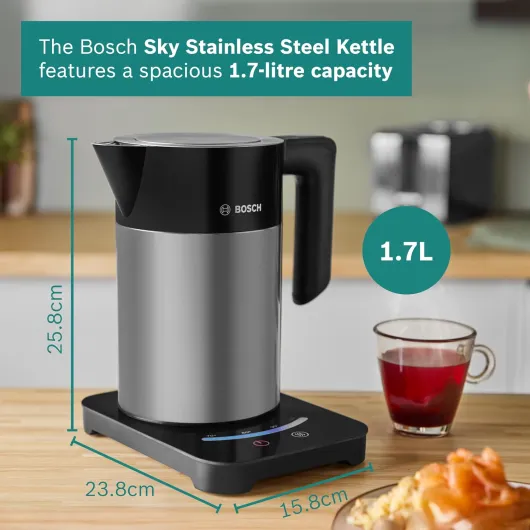
Design-wise, this kettle sits somewhere between basic and high-end. The black and silver look is pretty neutral; it fits in a modern kitchen without shouting for attention. The finish is polished but not mirror-shiny, so it doesn’t show every fingerprint like crazy, which I appreciate. The shape is fairly compact for a 1.7L kettle, and it doesn’t hog too much counter space. The base is round and not huge, and the cord storage underneath is handy if you hate cable spaghetti.
The main thing I noticed is that the handle and overall balance feel solid. When it’s full, it’s not feather-light, but the grip is comfortable and you don’t feel like it’s going to twist in your hand. The flip-top lid is spring loaded, so you press a button and it pops open cleanly. I prefer that over kettles where you have to yank the whole lid off every time. It’s easier to fill under the tap and you’re not juggling parts.
The touch controls on the base are a bit of a mixed bag. On the positive side, they look tidy and are easy to wipe clean. There are no physical buttons that can get gunked up with limescale or splashes. You basically slide your finger to pick a temperature and tap to confirm. That said, if you’re used to a simple on/off switch, it does feel slightly overcomplicated for the first few days. Also, if your fingers are wet, the touch sensitivity is a bit less responsive, so sometimes you have to wipe your hand quickly and try again.
In terms of noise and general presence, it’s quieter than the cheap kettles I’ve used before. You can still hear it, but it doesn’t dominate the room. The beep when it reaches temperature is short and not too loud, which is good if people are sleeping. Overall, the design is practical: it’s not trying to be artsy, it just focuses on being easy to grip, easy to pour, and easy to keep clean. I wouldn’t buy it just for the looks, but I also don’t mind seeing it on the worktop every day.
Materials and build: feels solid, but not luxury
The kettle body is double-walled with a stainless steel inner layer, which is one of the main reasons I went for this model instead of another plastic one. Inside, it looks and feels like proper metal, not coated plastic trying to pass for metal. In a hard water area, that matters, because plastic kettles tend to pick up stains and smells faster. The enclosed heating element also means limescale builds up on a flat surface instead of a visible coil, which is easier to descale with vinegar or a descaler tab.
On the outside, the plastic feels reasonably thick and not flimsy. It’s not the heaviest-duty thing I’ve ever held, but compared to budget kettles, there’s a clear difference when you tap it or squeeze the handle. The cool-touch effect of the double wall is pretty noticeable: even right after boiling, the outside is warm but not “ouch” hot, except near the spout area which is obviously hotter. If you have kids or you’re clumsy, that’s a real plus.
The base is mostly plastic with the touch panel integrated under a smooth surface. Again, it feels decent, not toy-like. I wouldn’t slam heavy pans on it, but for normal kitchen use it seems up to the job. The connection between base and kettle is solid; you don’t need to fiddle to get it to sit properly, it just drops into place. The limescale filter at the spout is removable and feels like it will survive regular cleaning without breaking after a few months.
Is it premium? Not really in the sense of thick brushed metal everywhere, but it’s definitely a step above basic £20 kettles. There are no weird rattles, no loose bits, and after repeated use the lid mechanism still pops open smoothly. Given it’s made in China, like most appliances now, the build quality is actually pretty reassuring. I’d still descale and treat it decently, but nothing about the materials makes me think it’s going to fall apart quickly.
Durability and maintenance: solid so far, but needs regular descaling
On durability, I obviously can’t simulate five years in a week, but I can say how it feels and what I’ve seen so far. The general build feels solid: no creaks, no loose lid, no weird noises from the base. The hinge on the flip-top lid still works smoothly after frequent use, and the handle doesn’t flex even when the kettle is full. Bosch gives a 2-year manufacturer warranty, which is pretty standard but at least shows they’re not expecting it to fail in six months.
We’re in a hard water area, and that’s usually where kettles start to suffer. With this model, the enclosed heating element and stainless steel interior mean limescale builds up as a layer on the bottom rather than around a visible coil. After some use, I could see a light limescale film starting to appear, which is normal here. A standard descaling cycle (white vinegar or a descaler sachet) cleaned it up without any trouble. The limescale filter at the spout also traps some of the flakes, and it’s easy to pop out and rinse.
The double-wall design should, in theory, protect the inner metal from some temperature shock and help with long-term stability. I haven’t seen any discoloration, weird smells, or taste issues even after several boils in a row. The exterior plastic hasn’t warped or faded, and the base still reads inputs correctly. Touch panels can sometimes be a weak point over time, but so far no ghost touches or dead zones.
I’ve seen enough cheap kettles die from cracked lids, broken switches, or corroded contacts to say this feels a step up. It’s not indestructible – if you slam it around or let limescale build up for years, it’ll suffer like any other appliance. But with basic care (descaling every month or two in hard water, not dropping it, not sloshing water all over the base), I’d expect it to last several years. The Amazon reviews mentioning previous Bosch kettles lasting 5+ years line up with what I’d expect from the feel of this one.
Performance and daily use: where the tech actually helps
In daily use, the boiling speed is decent. With 3000W, it’s in the normal range for UK kettles. A full 1.7L takes a bit longer than a “rapid boil” style kettle, but we’re talking a small difference, not minutes. For one or two mugs, it’s quick enough that I don’t stand there getting impatient. Compared to my old cheap kettle, this Bosch feels slightly quieter but roughly similar in speed, which matches what some Amazon reviewers said about it not being the very fastest but still fine.
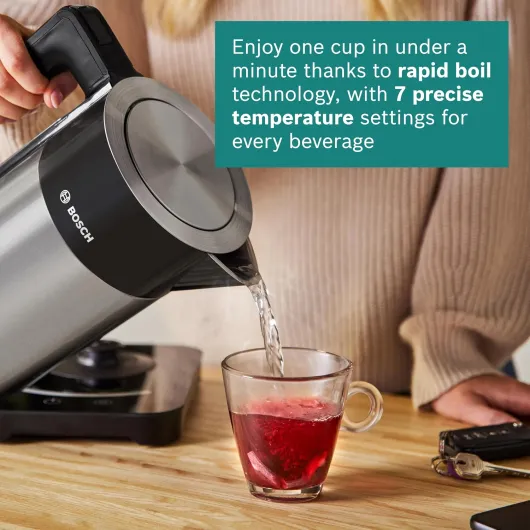
The temperature control is the main reason to buy this model. The 7 settings from 70°C to 100°C are handy if you actually use them. In practice, I use:
- 70–80°C for green tea so it doesn’t taste bitter
- 90°C for coffee (French press and pour-over)
- 100°C for black tea, instant noodles, general cooking
The keep warm function holds the water at your chosen temperature for up to 30 minutes. This sounded like a gimmick to me at first, but when you’re making multiple drinks or cooking, it’s handy. For example, I’ll set it to 90°C when making several coffees in a row, or keep it hot while I’m juggling pans. One thing to know: it doesn’t keep it perfectly flat at that temperature; it reheats as needed, so you may hear it kick in again briefly. You also sometimes need to tap the control again to bring it back to temp if it’s been sitting for a bit.
Pouring performance is genuinely good. The spout gives a steady stream without dribbling, which is more than I can say for some fancy-looking kettles I’ve used. Filling narrow containers is easy, and I haven’t had issues with splashing unless I overfill or pour like a maniac. Overall, in performance terms, it’s not flashy, but the combination of accurate temperatures, decent boil time, and clean pouring makes it a very practical daily kettle, especially if you drink different types of hot drinks.
What this Bosch Sky kettle actually offers in real life
On paper, the Bosch Sky Variable Temperature Kettle is a 1.7L, 3000W cordless kettle with a stainless steel double-walled jug and a separate base with a touch display. You get 7 temperature settings from 70°C up to 100°C, plus a keep-warm function that can hold the chosen temperature for up to 30 minutes. It’s rated at 3000W, so it’s in the normal range for a UK fast-boil kettle, and the weight is around 1.8 kg empty, which you do feel a bit when it’s full.
The inside is stainless steel with an enclosed heating element, and there’s a limescale filter at the spout. The double wall means it’s meant to keep water hotter for longer and stay cooler on the outside, which is a nice safety point if you’ve got kids around or you tend to grab things absentmindedly. The colour options are pretty basic – just black or white – and mine is the black/silver version. It looks modern enough, but it’s not trying to be some design sculpture. It’s more “neat appliance” than “showpiece”.
The base is where the “smart” part lives. You don’t set the temperature on the kettle itself, you do it via a touch slider and buttons on the base. You can:
- Set the temperature between 70°C and 100°C
- Activate the keep warm mode
- Start/stop heating
In daily use, the capacity is enough for a family or for making a round of drinks. A full 1.7L boil isn’t instant, but it’s in line with other 3000W kettles I’ve used. If you only fill what you need (e.g. a mug or two), it’s pretty fast. Overall, the product is basically a normal kettle with a few extra control options and slightly better build than cheap plastic models, rather than some totally new category of gadget.
Does it actually make a difference versus a normal kettle?
If you only ever boil water to 100°C for tea bags and instant coffee, this kettle will feel like a slightly nicer, slightly more expensive version of what you already have. It boils, it pours well, and it keeps the outside cooler. In that case, yes, it works, but you’re paying a premium mainly for build quality and the double wall rather than a completely different experience. It still gets the job done, but you won’t feel a big change beyond it being quieter and nicer to handle.
Where it becomes more effective than a basic kettle is when you actually use the temperature settings regularly. For green tea, being able to pick 70–80°C consistently does make the taste more pleasant and less harsh. For coffee, hitting around 90°C instead of full boil gives you more repeatable results, especially with pour-over or French press. You don’t have to faff around with thermometers or waiting a random amount of time after boiling. That makes your morning routine smoother and more predictable.
The keep warm function also adds real-world usefulness. For example, on weekends when I’m making multiple cups over half an hour, I’ll leave it at 90 or 100°C and just pour as needed. No repeated full boils, no waiting. Same thing when cooking pasta or couscous: I’ll have hot water ready without starting from cold every time. It’s a small time saver, but over a week you feel it. The double wall also means water doesn’t lose heat as fast, so even without keep warm, it stays hot for a while.
In terms of energy use, it’s hard to measure without proper tools, but in theory, only heating to 80–90°C instead of boiling every time should save a bit of electricity. I wouldn’t buy it purely for that reason, but it’s a small bonus. So overall, yes, it’s more effective than a standard kettle if you use the features. If you don’t, it’s basically a well-built kettle with a higher price tag that you’re not fully exploiting.
Pros
- Accurate 7-step temperature control is genuinely useful for tea, coffee, and baby bottles
- Double-walled body keeps exterior cooler and water hotter for longer
- Good build quality with clean, non-dribbling pour and quiet operation
Cons
- Higher price than basic kettles, so not great if you never use the extra features
- Touch controls can feel a bit fussy at first, especially with wet hands
Conclusion
Editor's rating
Overall, the Bosch Sky Variable Temperature Cordless Kettle is a good fit for people who actually care about how hot their water is and use a kettle constantly. The 7 temperature settings, keep warm function, and double-wall design aren’t just for show – they do bring small but real improvements in everyday use, especially if you drink green tea, make proper coffee, or need specific temperatures for baby formula. The build feels solid, the pour is clean, and the cooler exterior is reassuring if you’ve got kids around or you’re just a bit clumsy.
It’s not perfect. The touch controls take a few days to get used to, it’s not the very fastest boiler out there, and the price is clearly higher than a basic on/off kettle. If you only ever slam it to 100°C and don’t care about any of the extra features, then you’re overpaying for what you’ll actually use. But if you want more control, quieter operation, and something that feels like it will last a while with regular descaling, it’s a pretty solid choice. I’d recommend it to tea and coffee fans, parents dealing with bottles, and anyone who wants a slightly more serious kettle without going into silly luxury territory. Budget buyers and people who just want the cheapest thing that boils water should probably look elsewhere.