Summary
Editor's rating
Value for money: you’re paying for the look, not the features
Design: nice to look at, but not all choices are smart
Materials and build: decent, but not at the level of the price
Durability and reliability: some worrying signals
Boiling performance: does the job, nothing more
What you actually get with the EM77 kettle
Pros
- Clean, minimalist EM77 design that looks good on a modern counter
- Boils 1.5 L of water at a normal speed with standard noise levels
- Removable limescale filter and boil‑dry protection for basic safety and maintenance
Cons
- Base only allows one orientation, making everyday use less convenient
- Plastic build and thin spout feel fragile for the price and raise durability concerns
- Limited features compared to cheaper competitors; you mainly pay for the design

Specifications
View full product page →| Brand | Stelton |
Design icon or overpriced kettle?
I’ve been using the Stelton EM77 electric kettle in white for a few weeks now, and I’ll be blunt: you’re clearly paying for the look more than for the pure function. I bought it because I already knew the classic EM77 vacuum jug and liked that simple cylinder style. On the counter, this kettle looks very clean and minimal, and if you care about matching a modern kitchen, it fits right in. But once you get past the nice silhouette, you start noticing little things that feel less thought through.
From day one, what struck me most is that it behaves like a normal kettle in terms of boiling speed and noise. With 2400 W and a 1.5 L capacity, it gets the job done quickly enough. So if you just want hot water for tea or coffee, it works, no surprise there. The dry boil safety and removable limescale filter are basic features you find on many mid‑range kettles now, so nothing special, just standard safety and maintenance stuff.
Where it gets annoying is when you start using it several times a day. The base only lets you position the kettle in one direction because of a notch, so the handle ends up aligned with the cable. This sounds like a small thing, but in practice it’s just awkward on the counter. I kept having to twist either the base or the cable to get a comfortable grip when lifting it, which kind of defeats the point of a cableless design that’s supposed to be convenient from any angle.
Overall, my first impression is: nice object, but a bit style over substance. It’s not a bad kettle, it boils water and looks good, but for the price and for a brand like Stelton, I expected a more robust build and a more practical base design. If you mainly want something that looks good next to your other Stelton gear, you’ll probably be happy. If you just want a reliable daily workhorse, there are simpler and cheaper options that feel more solid and less fussy.
Value for money: you’re paying for the look, not the features
On value, this is where the Stelton EM77 is hardest to justify. Functionally, it’s a basic electric kettle with standard features: 1.5 L capacity, 2400 W, boil‑dry protection, removable filter. Nothing advanced like variable temperature, keep‑warm mode, or double walls for better insulation. Meanwhile, there are plenty of cheaper kettles from big brands that offer the same or more in terms of features and often feel sturdier, especially the stainless steel ones.
So what are you paying for? Mainly the iconic design and the Stelton name. If you already own the EM77 vacuum jug or other Stelton pieces, this kettle fits nicely in that family and looks good on the counter. If design matters a lot to you and you see it as part of your kitchen decor, then it might feel worth it. For someone who just wants hot water quickly and reliably, it’s harder to recommend at this price, especially with the durability concerns mentioned in user reviews.
The Amazon rating of 3.9/5 reflects this mix: some people are happy and praise the look and quietness, others are disappointed by build quality and lifespan. It’s not a disaster product, but it’s also not a clear win. For the money, I’d expect either more robust construction or extra functions, and here you get neither. It’s basically paying a design tax to have a cleaner silhouette on your counter.
If I had to sum up the value: good if you’re a design fan and you really want that EM77 look in electric kettle form; pretty weak if you’re just looking at performance per pound. Personally, after using it, I feel like I spent more than I should have for what is, in daily life, just a decent but quite ordinary kettle with some quirks.
Design: nice to look at, but not all choices are smart
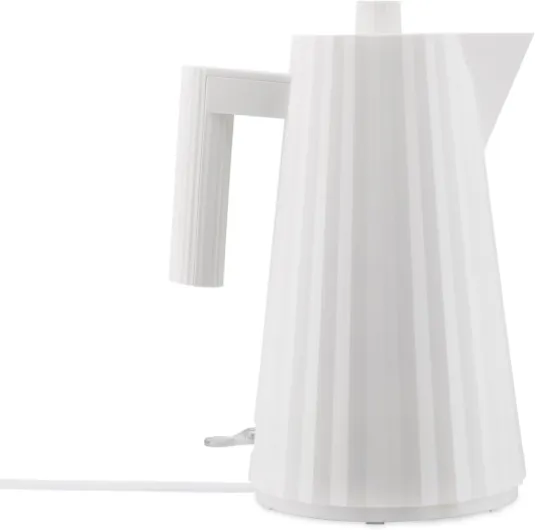
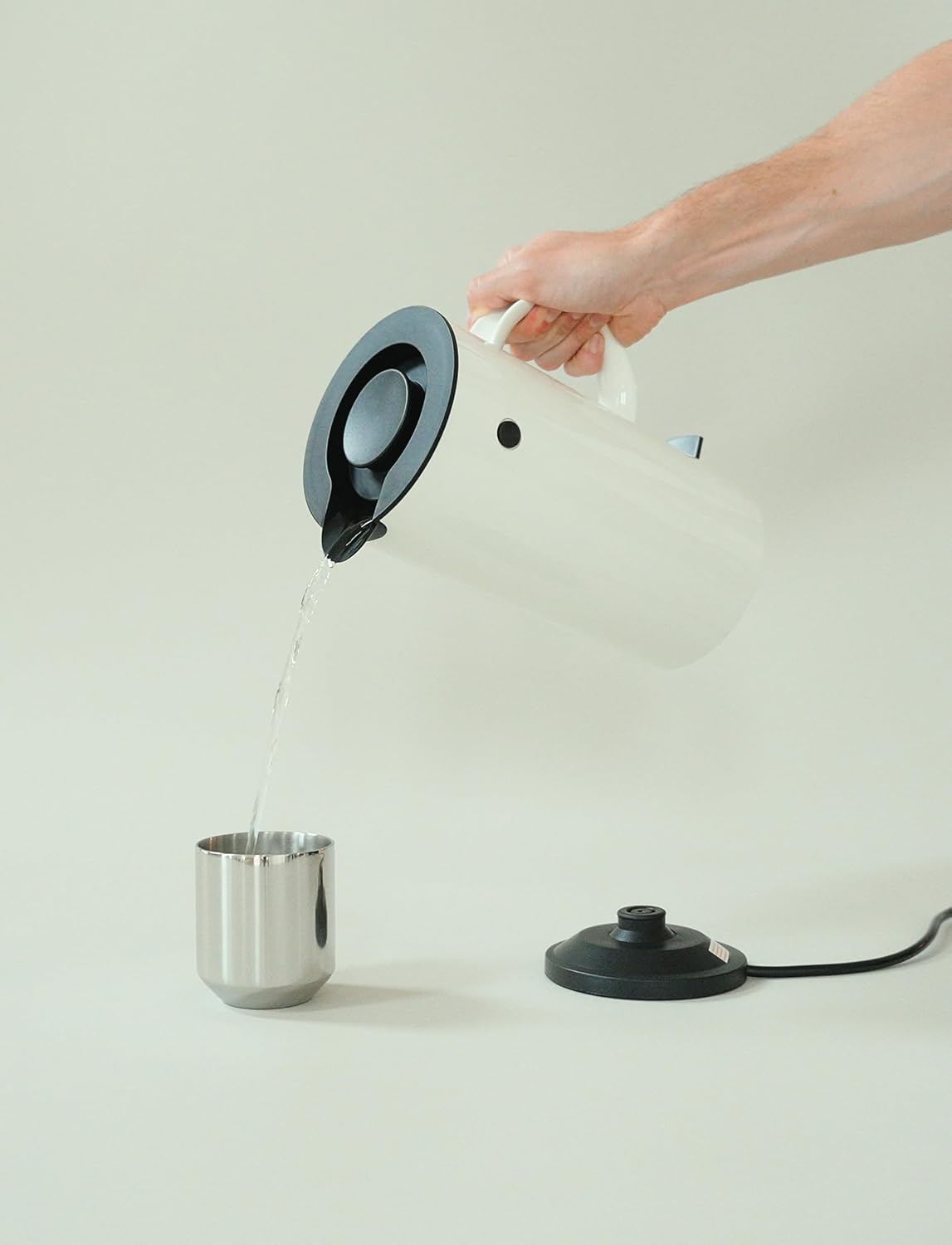
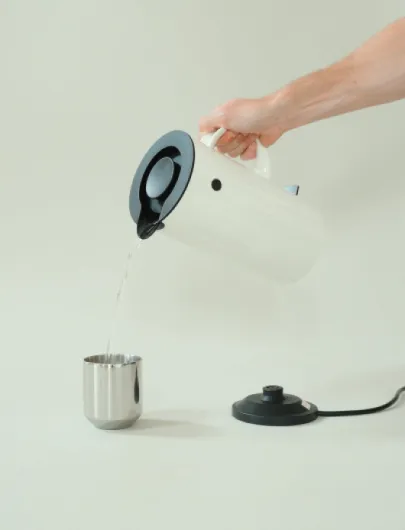
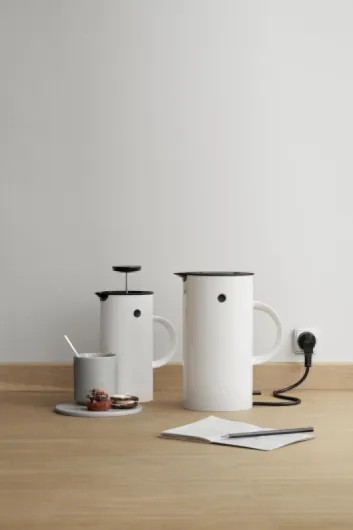
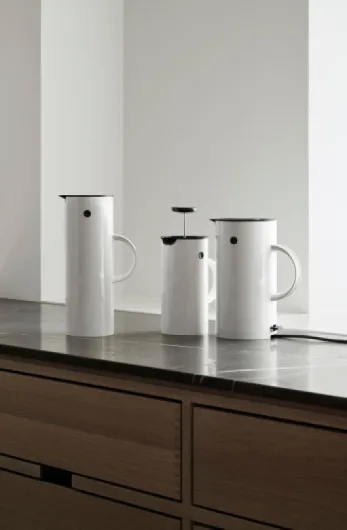
The design is clearly the main selling point. The EM77 kettle looks like a taller, electric version of the classic Stelton vacuum jug: clean cylinder, simple handle, minimal spout. On my counter, it looks tidy and matches a modern or Scandinavian style kitchen really well. If you’re into minimalist gear, you’ll probably like the silhouette. The white painted finish is uniform and the shiny look is quite clean when it’s freshly wiped. It definitely doesn’t scream “cheap plastic kettle” from a distance.
But once you start using it, some design choices get in the way. The biggest one for me is the base orientation. There’s a notch that forces the kettle to sit in one fixed direction, so the handle lines up with the cable. That means if your plug is behind the kettle, the handle often ends up pointing away from you or at an odd angle. I found myself either twisting the base or letting the cable bend around, which isn’t ideal and slightly annoying when you’re half asleep making tea in the morning. A 360° base, like you get on most kettles now, would have been much more practical.
The spout is another weak point. It’s quite thin and narrow, clearly trying to copy the vacuum jug’s look. It pours in a controlled way when you go slow, but it doesn’t feel very robust. One Amazon reviewer even mentioned the spout breaking within a week, and I can see how that could happen if it’s knocked or if you’re not gentle when cleaning. Personally, I’ve been careful and haven’t broken anything, but I do feel like I have to treat it more delicately than my previous metal kettle, which I could almost throw in the sink without worrying.
Overall, I’d say the design is nice for the eyes but not always for the hands. It looks good in photos and on the counter, but the base orientation and fragile‑feeling spout are clear trade‑offs. If you prioritise aesthetics and already love the EM77 line, you’ll probably accept these flaws. If you just want something practical that you can grab from any angle and use without thinking, this design will feel a bit forced and slightly over‑engineered in the wrong places.
Materials and build: decent, but not at the level of the price
The kettle is mainly made from PP plastic with some stainless steel parts inside. The outside has a painted, shiny finish. In the hand, the plastic doesn’t feel super cheap, but it also doesn’t feel particularly premium. It’s somewhere in the middle: solid enough, no obvious flex when you squeeze the body lightly, but it doesn’t give that heavy, durable impression that some stainless steel kettles do. For the price range this sits in, I expected a bit more weight and a more solid feel, to be honest.
The handle is comfortable enough, not slippery, and doesn’t heat up during use, which is the minimum you’d expect. The lid mechanism on mine works fine, no wobbling or weird play, but I’m always cautious when opening and closing because of how plasticky it all feels. Reading the Amazon reviews, a few people mention durability issues after about a year, including one user whose kettle stopped boiling and whose switch light died after six months. I obviously can’t confirm the long‑term electronics from just a few weeks of use, but it doesn’t give huge confidence when you see several comments about failures around the one‑year mark.
Inside, the stainless steel and the removable limescale filter are fairly standard. The filter pops out easily so you can rinse off scale, which is handy if you live in a hard‑water area. It’s not a fancy multi‑layer filter or anything, just a basic mesh that stops bits getting into your cup. After a couple of weeks, mine already had some white deposits, which is normal here, and it cleaned off without any drama. The inner walls also wipe down fine once in a while.
Where I think Stelton could have done better is the base and spout robustness. The base is light, and the plastic doesn’t grip the counter that well, so the whole thing feels a bit too easy to move. The thin spout, as mentioned earlier, doesn’t inspire much confidence if you’re not gentle. For a design kettle that costs more than your average supermarket model, I was hoping for a more reassuring build. It’s not falling apart in my hands, but it doesn’t feel like something that will survive 5–7 years of heavy daily use without a hitch.
Durability and reliability: some worrying signals
On the durability side, I’ll be honest: I’m not fully convinced this kettle is built for the long haul, especially given the price. In my few weeks of use, it hasn’t failed or done anything strange, but the overall feel is more “careful with it” than “throw it around and it will survive for years.” The plastic, the thin spout, and the light base don’t scream long‑term tank. You can absolutely use it daily, but I found myself handling it more gently than I ever did with cheaper metal kettles.
The Amazon reviews back this up a bit. There’s at least one 1‑star review from someone saying their kettle basically died after 12 months: it stopped boiling and the switch light had already failed around the six‑month mark. Another user mentioned the spout breaking within a week, which is pretty bad for such a simple object. When you see several people complaining about breakdowns around the one‑year mark, it does raise questions about component quality and quality control.
From a practical point of view, the glossy painted finish will also show scratches and marks more than a brushed steel kettle. After some time, I’d expect light scuffs from contact with other appliances or from cleaning. It’s easy to wipe down with a damp cloth, but if you’re rough with sponges or bump it often, it’ll probably start to look tired. The inside is easier: stainless steel is resistant enough, and limescale can be handled with standard descaler, nothing unusual there.
So in terms of durability, my feeling is: it’s okay if you’re careful and don’t abuse it, but it doesn’t feel like a 5–10 year workhorse. The brand name and design might suggest something premium, but the reality is more like a mid‑range plastic kettle wearing a nicer coat. If you tend to replace kettles every few years anyway, that might not bother you. If you were hoping to buy this once and forget about kettles for a long time, I’d manage expectations and maybe consider something more robust for heavy daily use.
Boiling performance: does the job, nothing more
In terms of pure performance, the EM77 is pretty standard. With 2400 W and a 1.5 L capacity, it boils water at about the same speed as most mid‑range UK kettles I’ve used. From cold tap water to full boil for around 1 L, you’re looking at a couple of minutes. It’s not especially fast, but it’s not slow either. For everyday tea, coffee, or instant noodles, it’s totally fine. If you’re expecting it to be noticeably quicker than a basic kettle, that’s not the case.
Noise level is also average. It’s not whisper quiet, but it’s not crazy loud. You get the usual humming and bubbling; you can still have a conversation in the kitchen while it boils. Compared to my previous stainless steel kettle, I’d say this one might be slightly quieter, probably because of the plastic body, but it’s not a huge difference. The switch clicks off reliably when it reaches boiling, and I haven’t had any times where it kept going or stopped too early during my testing.
The pouring is where the design affects performance a bit. The narrow spout gives a more controlled stream when you pour slowly, which is nice for filling smaller cups or a French press without splashing. But if you tilt it too quickly, it can feel a bit hesitant at first and then suddenly rush out. You get used to the angle pretty fast, but it’s not as forgiving as a wider, more traditional kettle spout. Also, you have to be a little careful not to bang the spout against the sink or tap when filling or cleaning because it doesn’t feel super sturdy.
Safety‑wise, the boil‑dry protection is reassuring. I tried once with a very small amount of water, and it shut off as expected without any weird smells or overheating of the body. So that part works as advertised. Overall, I’d rate the performance as: it boils water reliably, at a normal speed, with standard noise and decent pouring once you get the hang of it. Nothing special, nothing disastrous, just a regular kettle wearing a designer outfit.
What you actually get with the EM77 kettle
On paper, the Stelton EM77 electric kettle is pretty straightforward: 1.5 L capacity, 2400 W power, boil‑dry protection, removable limescale filter, and a base with cord storage. It’s made from PP plastic with some stainless steel inside, and the finish on this white version is painted and shiny. The product page really leans on the iconic Erik Magnussen EM77 design, clearly trying to attract people who already like the thermos version. So you’re not buying a feature monster here; you’re basically buying a simple kettle dressed up in a design classic shape.
In the box, it’s basic: the kettle, the base, and the limescale filter already in place. No fancy extras, no descaler sachets, no manual with tips beyond the usual safety warnings. The cable length is decent, and the base has a groove underneath to wrap the cord, which helps if your socket is close. But the base itself is pretty light and doesn’t feel as premium as the price level suggests. When you lift the kettle, the base can shift a bit if your countertop is smooth, so you often need to reposition it with your other hand.
In day‑to‑day use, you fill it through the lid like any normal kettle. The water level markings are there but not super bold, so you sometimes have to tilt it or get closer to see how much you’ve filled, especially in low light. Maximum 1.5 L is enough for a couple of big mugs or a small family, so capacity is fine for normal home use. It boils a full load in a few minutes, about the same as most 220–240 V kettles I’ve used in the UK.
So in terms of pure specs and features, it’s honestly quite average. It boils water, it has basic safety features, it’s easy to wipe clean from the outside, and the filter can be removed to rinse off limescale. If you were hoping for something that stands out with smart features, temperature control, or extra insulation, that’s not what this is. It’s basically a standard electric kettle wrapped in a design object shell, and you’re paying quite a bit for that shell.
Pros
- Clean, minimalist EM77 design that looks good on a modern counter
- Boils 1.5 L of water at a normal speed with standard noise levels
- Removable limescale filter and boil‑dry protection for basic safety and maintenance
Cons
- Base only allows one orientation, making everyday use less convenient
- Plastic build and thin spout feel fragile for the price and raise durability concerns
- Limited features compared to cheaper competitors; you mainly pay for the design
Conclusion
Editor's rating
The Stelton EM77 electric kettle is basically a design object that also boils water. It looks clean, minimal, and fits very well in a modern or Scandinavian‑style kitchen, especially if you already own the classic EM77 thermos. In everyday use, it performs fine: 1.5 L capacity, normal boiling speed, standard noise level, and basic safety with boil‑dry protection. The removable limescale filter makes cleaning easy enough, and the outside is simple to wipe down. So as a kettle, it works and gets the job done without drama.
Where it loses points is on practicality and value. The base only lets you place the kettle in one orientation, which is annoying and not as user‑friendly as a 360° base. The spout feels fragile, and several user reviews mention early failures or breakages, plus electronics issues around the one‑year mark. For the price, the plastic body and light base don’t feel as solid as they should. You’re clearly paying a premium for the design and the Stelton badge rather than for extra features or heavy‑duty build.
So who is it for? If you’re a design‑focused buyer, already into Stelton, and you want a kettle that visually matches your kitchen and you don’t mind handling it a bit more carefully, you’ll probably be satisfied. If you just want a robust, long‑lasting, no‑nonsense kettle for daily heavy use, I’d look elsewhere. There are cheaper models that feel tougher and offer similar or better functionality without the design tax.