Summary
Editor's rating
Is it worth the price?
Design: clearly the main reason to buy it
Materials: thermoplastic resin, not metal
Build quality and reliability concerns
Boiling performance and day-to-day use
What you actually get out of the box
Pros
- Very distinctive design that looks good on the countertop
- Boils water fairly quickly thanks to 2400W power
- Good pouring performance with minimal drips
Cons
- High price for what is basically a standard plastic kettle
- Some concerns about build quality and long-term durability
- Ships with a European plug, which is inconvenient in some countries

Specifications
View full product page →| Brand | Alessi |
A designer kettle for people who care about looks first
I’ve been using the Alessi Plissé MDL06 W kettle for a few weeks now, and I’ll be honest: I bought it mainly because of how it looks, not because I thought it would be the most practical kettle on earth. I already had a basic stainless steel kettle that worked fine, but my countertop looked a bit messy and I wanted something that didn’t scream “office kitchen”. This one clearly targets people who care about design and are ready to pay extra for it.
From day one, what stands out is the shape. It really looks more like a decorative object than a basic appliance. Friends who came over noticed it straight away and asked what brand it was, which almost never happens with a kettle. So if you want something that blends in and disappears, this is not it. It’s more like a small sculpture parked next to your toaster.
But once the initial “oh, that’s pretty” moment passes, you start judging it like any normal kettle: how fast it boils, how easy it is to fill and pour, if the handle gets hot, if it feels cheap or solid, that kind of stuff. I also paid attention to the usual annoyances: cable length, noise, limescale, and whether the plastic smell disappears or not after a few boils. For a kettle at this price, I’m a bit less forgiving than with a 20€ supermarket model.
So if you’re hesitating between this and a more standard metal kettle, I’ll walk you through what it does well and where it’s just average. It’s not perfect, it’s not total trash either; it sits somewhere in between. It mostly comes down to what you value more: looks or pure practicality.
Is it worth the price?
Value-wise, this kettle sits in a weird spot. Functionally, it’s basically a standard 1.7L, 2400W electric kettle with no special features beyond automatic shutoff. If you ignore the design, you can get something that boils just as fast, maybe with a metal body and sometimes even variable temperature, for less money from brands like Philips, Bosch, or Russell Hobbs. So if you’re just after hot water, you’re paying extra for nothing you’ll actually feel in the cup.
Where the money goes is clearly the design and the Alessi name. If you’re into design objects and you like having something that looks a bit different on your countertop, then the higher price is easier to swallow. It becomes more of a decor choice than a pure appliance choice. In that case, you might see it as “good enough value” because it replaces both a kettle and a decorative object. But if you’re more practical and don’t care what your kettle looks like as long as it works, this will feel overpriced.
There’s also the plug issue. It ships with a European plug, and while some versions include an adaptor for UK users, others don’t. Having to mess around with adaptors or rewiring the plug on a not-cheap product is pretty annoying. That kind of detail kills the feeling of paying for a premium experience. At this price level, I’d expect a version with the right plug for each market, not a workaround.
So in terms of value for money, I’d rate it as average. You’re not getting ripped off completely, but you’re definitely not buying the most efficient or feature-packed kettle for the price. You’re mainly paying for looks and the Alessi badge. If that matters to you, you’ll probably be happy enough. If not, your money will go further with a more basic, metal kettle from a mainstream brand.
Design: clearly the main reason to buy it
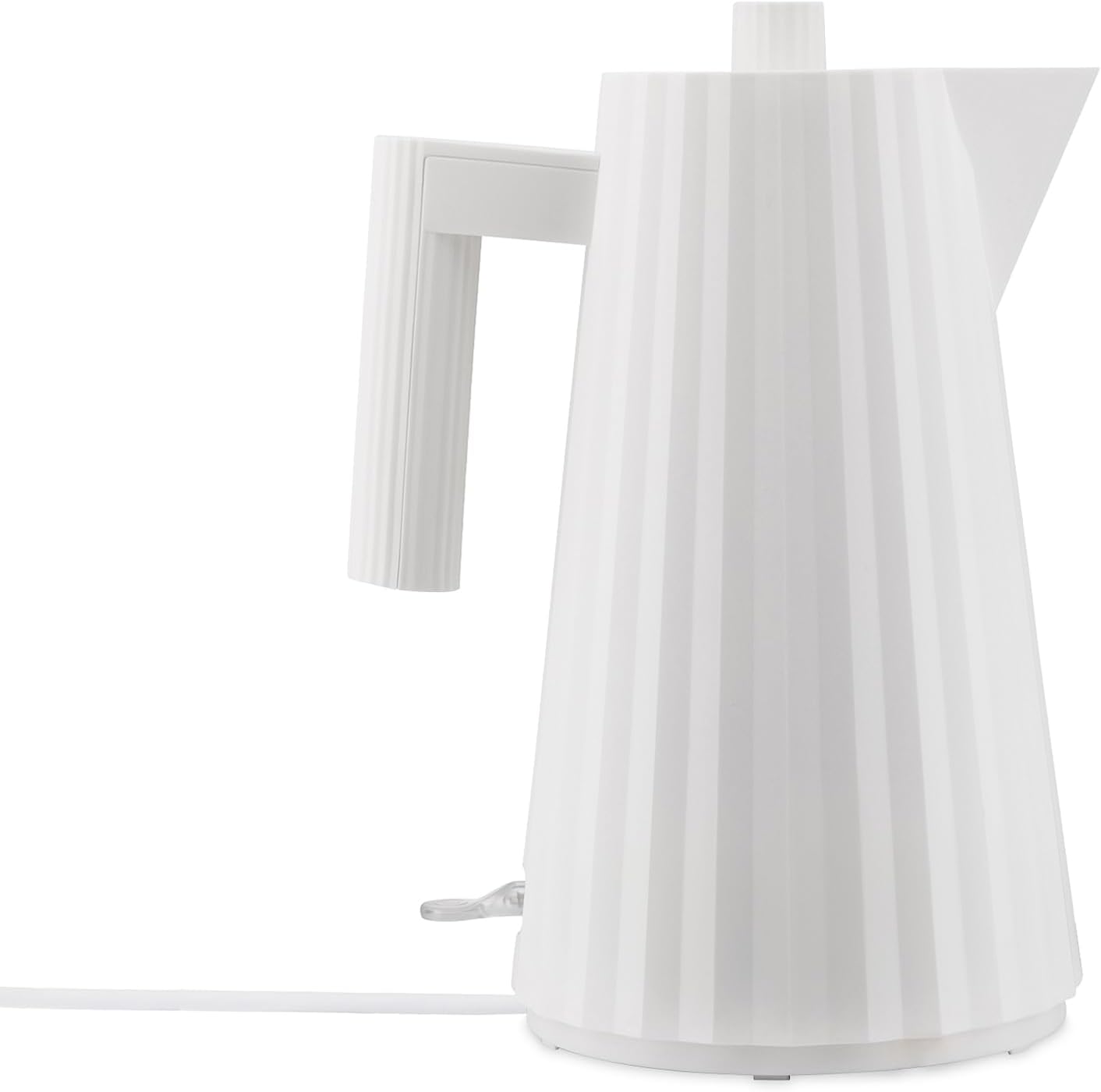
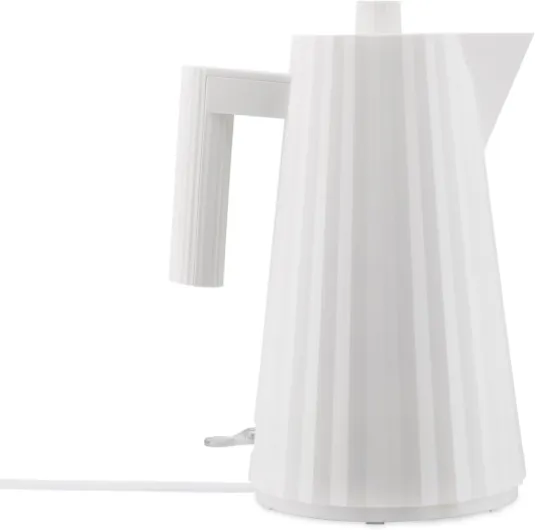
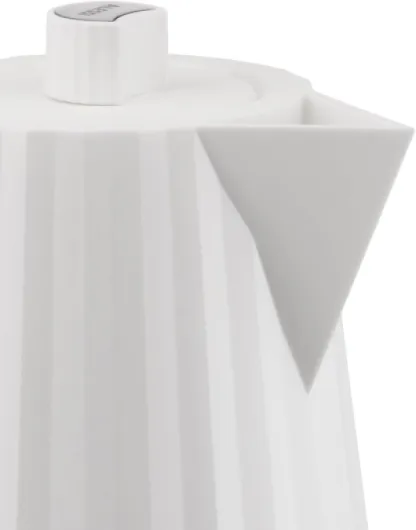
The design is the whole point of this kettle. The pleated look actually stands out a lot more in real life than in photos. It looks like folded fabric wrapped around a cone, which sounds a bit weird, but on the counter it works. In white, it looks clean and kind of “architect” style. If your kitchen is fairly minimal, it fits right in. If your kitchen is already visually busy, it might look a bit over the top. But one thing is clear: it doesn’t look like a cheap appliance.
The shape isn’t just for looks though. The base is relatively stable and the handle is well separated from the body, which is useful when the kettle is full. The lid has that same pleated pattern, so the whole thing looks consistent instead of mixing styles. The only thing that breaks the look a bit is the power base, which is just a round plastic disc. It doesn’t look bad, but you can tell all the effort went into the kettle body and not the base.
In day-to-day use, the design is mostly a plus, but it does have a few practical downsides. The pleats collect dust and small splashes, especially around the lower area near the handle and spout. So you end up wiping more than you would with a smooth stainless steel kettle. It’s not dramatic, but if you’re picky about cleanliness, expect to run a cloth over it fairly often. Also, the water level indicator isn’t the most visible, which is a bit annoying if you’re trying not to overfill it.
Overall, if you’re buying this kettle, it’s probably because you like how it looks and you want it on display. On that front, it delivers: it’s eye-catching and doesn’t feel cheap visually. Just don’t expect the design to be super practical in every detail. It’s more about style than pure ergonomics.
Materials: thermoplastic resin, not metal
The whole body of the kettle is made from thermoplastic resin, basically a rigid plastic that’s been shaped and painted to look a bit more premium. If you’re used to stainless steel kettles, you’ll notice the difference immediately when you touch it. It’s lighter, less cold to the touch, and it doesn’t give that metal “solid block” feeling. Whether that’s good or bad depends on what you like. Personally, I don’t mind plastic as long as it doesn’t feel flimsy or smell weird for ages.
On first use, there was a slight plastic smell when boiling, which is pretty common with plastic kettles. After a couple of full boils and rinses, it mostly went away. I’d still recommend doing two or three boils and throwing the water out before actually drinking anything. Once that’s done, I didn’t notice any plastic taste in my tea or coffee. If you’re super sensitive to that, a full metal kettle will always be safer, but for regular use this one seemed fine to me.
The finish is painted and polished, which looks nice but also means you probably don’t want to bash it around. I wouldn’t put it right next to sharp objects or under cabinets where it can get scratched easily. It’s not ultra-fragile, but it doesn’t feel like something you can abuse. The base and handle feel decent enough, nothing squeaky or loose. The lid opens and closes without drama, but again, you can tell it’s plastic and not some heavy-duty mechanism.
One thing to keep in mind: plastic will usually age differently than metal. Over time, if you leave it next to the stove or under harsh light, it might yellow a bit or lose some of its shine. I haven’t had it long enough to see that, but based on other plastic appliances I own, it’s a fair guess. So if durability and “aging gracefully” are your priorities, a brushed stainless steel kettle might be a better long-term bet. Here, the choice of material is clearly in service of the design and light weight rather than maximum robustness.
Build quality and reliability concerns
Durability is where I’m a bit more cautious. My unit hasn’t failed, but when you read through some of the user reviews, there are a few worrying comments, especially the one about an earth leak tripping the electrics after three weeks. That kind of fault is serious, even if it’s probably not super common. When you pay for a designer brand like Alessi, you kind of expect at least average reliability, and these stories don’t inspire total confidence.
Physically, the kettle doesn’t feel flimsy, but it also doesn’t scream “tank”. The plastic body is rigid enough, but if you squeeze it or knock it against something hard, you can tell it’s not in the same league as a full metal kettle. The handle seems well anchored, and the lid mechanism hasn’t given me any trouble so far. The base contact is also okay, no sign of overheating or weird smells after repeated use. Still, I’d handle it with a bit more care than a 20€ supermarket kettle you don’t care about.
Another thing: some customers clearly expected this to be made in Italy, and then discovered it’s actually made in China, even if it’s an Alessi product. That doesn’t automatically mean it’s bad, but it does show that the brand image is a bit ahead of the actual manufacturing reality. If you’re specifically trying to avoid products made in China, this is not the safe bet some people thought it was. Also, if something goes wrong after the return window, replacement parts and service might not be as easy to deal with as with more mainstream appliance brands.
Long term, I’d say this kettle will probably last if you treat it gently and don’t toss it around. But if you have a very busy kitchen, kids, or you’re rough on gear, I’d lean towards a more robust metal model. For the price, I would have liked a bit more confidence on the quality side. As it is, I’d call the durability acceptable but not impressive, especially considering the brand and the cost.
Boiling performance and day-to-day use
On the performance side, the kettle is pretty solid overall. With 2400W, it boils a full 1.7L faster than the older 2000W kettle I had before. You’re not saving minutes and minutes, but you do notice that it reaches boiling a bit quicker, especially when you’re just heating water for one or two mugs. For a full load, it’s roughly in line with other mid to high power kettles I’ve used. Nothing mind-blowing, but it does what it’s supposed to do.
The noise level is average. It’s not whisper quiet, but it’s not a jet engine either. You can still talk next to it without shouting, but if you’re in a tiny kitchen, you’ll notice it humming away. The automatic shutoff works reliably: once it boils, it clicks off and there’s no weird half-boiling situation. I also tested it with a very low water level (still above the minimum mark), and it boiled fine and switched off correctly. The base connection is standard: you place the kettle on it from any angle, and it slots in without much fiddling.
Pouring is actually one of the strong points. The spout is well designed and doesn’t dribble much, even when you pour slowly into a narrow mug or teapot. With my previous cheap kettle, I always had a few drops running down the side; with this one, that barely happens. The handle position is also comfortable for pouring a full kettle without feeling like you’re going to twist your wrist. The only minor annoyance is that the lid doesn’t open super wide, so filling it directly under a low tap can be a bit awkward depending on your sink layout.
Daily, it works like any normal kettle: flip the switch, wait, pour. No special tricks. If you were expecting extra features like variable temperature or a keep-warm function at this price, you’ll be disappointed because they’re just not there. But if all you need is boiling water, it delivers reliably. So in terms of pure performance, I’d call it decent to good, but not standout compared to similar power kettles made of metal.
What you actually get out of the box
Out of the box, the Alessi Plissé MDL06 W is pretty straightforward: you get the kettle, its base, and that’s it. No fancy accessories, no filters or extra stuff. Mine came with decent packaging: thick cardboard, molded inserts to keep the kettle from moving, and some basic documentation that explains how to descale and clean it. Nothing premium-feeling, but it’s tidy and functional. If you like unboxing rituals, there’s nothing special here, it’s just a kettle in a box.
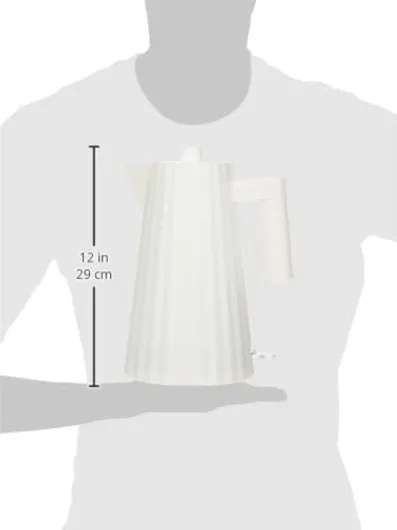
The capacity is 1.7 litres (170 cl), which is standard. For a couple or a small family, that’s plenty: enough for several mugs of tea or a big batch of pasta water. The power is 2400W, which on paper means it should boil water fairly quickly compared to weaker kettles. It runs on 230V and comes with a European plug, which is clearly mentioned but still manages to surprise people, judging from the reviews. In my case, I’m in Europe so it’s fine, but if you’re in the UK you’ll either need the included adaptor (when supplied) or swap the plug yourself, which is annoying for this price range.
There’s a basic on/off switch, an automatic shutoff when it boils, and it stops if there’s not enough water inside. So nothing revolutionary, just the usual safety features. No temperature settings, no keep-warm mode, no app, no smart nonsense. If you’re used to kettles where you can pick 80°C, 90°C, etc., this one will feel a bit basic. But if you just want boiling water, it gets the job done without extra buttons.
In short, in terms of pure features, it’s a pretty standard kettle with a designer shell. You’re paying for the brand and the look way more than for advanced functions. If you need a gadget packed with settings, you’ll be disappointed. If you just want a decent kettle that looks nicer than average, then this is more in your lane.
Pros
- Very distinctive design that looks good on the countertop
- Boils water fairly quickly thanks to 2400W power
- Good pouring performance with minimal drips
Cons
- High price for what is basically a standard plastic kettle
- Some concerns about build quality and long-term durability
- Ships with a European plug, which is inconvenient in some countries
Conclusion
Editor's rating
In the end, the Alessi Plissé MDL06 W is a kettle for people who care more about how their kitchen looks than squeezing every bit of performance and value out of an appliance. It boils water quickly enough, pours well, and does its basic job without any big day-to-day headaches. The design is the main attraction: it genuinely looks nice on the counter and doesn’t feel like a boring plastic lump. If you want your kettle to be part of the decor, this one fits that role pretty well.
On the flip side, you’re paying a clear premium for that design. The materials are plastic, not metal, there are no advanced features like temperature control, and durability doesn’t seem to be flawless based on some user reviews. The European plug situation is another practical annoyance if you live in the UK or a country with a different socket standard. For the same money, you can get a tougher, more feature-rich kettle from less “design-focused” brands.
So, who is it for? It’s for someone who has a fairly styled kitchen, likes designer objects, and wants a kettle that looks good on the worktop while still doing the basic job. Who should skip it? Anyone who prioritises long-term robustness, extra features, or pure value for money. If you just want a reliable workhorse and don’t care about looks, there are better options out there for less.