Summary
Editor's rating
Value for money: paying mostly for the look
Retro look: the main selling point
Materials and build: solid feel, hot exterior
How it holds up over time
Boiling speed, noise and daily use
What you actually get with this kettle
Pros
- Attractive retro design that looks good on the counter
- Stainless steel body feels solid and durable
- Large 1.7 L capacity with reliable auto shut-off and removable limescale filter
Cons
- More expensive than similar-performing kettles; you pay mainly for the design
- Exterior gets very hot when boiling, not ideal around children
- Some units ship with an EU plug, requiring an adaptor in the UK

Specifications
View full product page →| Brand | De'Longhi |
Nice-looking kettle, a bit overhyped
I’ve been using the DeLonghi KBOV 2001.BG for a while now, and I’ll be straight: I mainly bought it for the look. My old plastic kettle was ugly, this one has that retro vibe with chrome bits that fits better on the counter. If you’re like me and you care about what’s sitting out in the kitchen, this one catches the eye more than the usual cheap stainless bricks.
Once you get past the design, though, it’s just a kettle. It boils water, sometimes a bit slower than I’d like, and it’s not exactly quiet. The 1.7 L capacity is handy for several cups of tea or filling a French press, but you pay a premium for something that basically does what a £20 kettle also does. That’s the trade-off: looks and brand name versus pure practicality.
In daily use, it’s been pretty straightforward. You fill it, you flip the switch, it boils, it clicks off. No fancy temperature settings, no smart features, nothing like that. It’s more old-school than high-tech. The filter against limescale is a nice touch, especially if you’re in a hard water area, but again, a lot of kettles have that now. So it’s not some special innovation, just a basic feature done decently well.
If you’re expecting something that changes how you make tea or coffee, this isn’t it. It’s more about having a good-looking appliance that does the standard job. For me, it’s a mix: I like seeing it on the counter, I’m okay with how it performs, but I’m also very aware I paid more for the design than for any real performance jump.
Value for money: paying mostly for the look
Let’s be honest: this kettle is not cheap for what it does. Functionally, it boils water like any other mid-range kettle. You don’t get temperature presets, you don’t get double-wall insulation, you don’t get fancy smart features. You’re paying extra for the retro design, the DeLonghi badge, and the fact that it looks nicer on the countertop than most generic kettles. If you don’t care about aesthetics, there are cheaper models that will boil water just as well, sometimes faster and quieter.
On the other hand, if you’re into having a coordinated kitchen setup with matching toaster and kettle, the price makes a bit more sense. It’s like paying a bit more for furniture that looks better, even though a cheaper piece would technically do the job. I’ve owned very cheap kettles that felt flimsy and ended up in the bin after a year. This one feels more solid, and that does partly justify the price if you see it as a longer-term buy rather than something disposable.
The EU plug issue for UK buyers is a real downside in terms of perceived value. Buying a kettle and then having to add an adaptor or change the plug yourself is annoying, especially when you’re already paying a premium. Some people are happy to do it because they want this exact model and colour, but if you just want a plug-and-play experience, that’s a knock against it. At this price, you’d expect it to be ready to go out of the box in the market you’re buying from.
So in terms of value, I’d call it decent but not great. If you really like the design and plan to keep it for several years, the cost spreads out and feels more acceptable. If you’re on a tight budget or don’t care about how your kettle looks, then no, it’s not the smartest buy. You’re clearly paying a design tax here, and only you can decide if that’s worth it in your kitchen.
Retro look: the main selling point
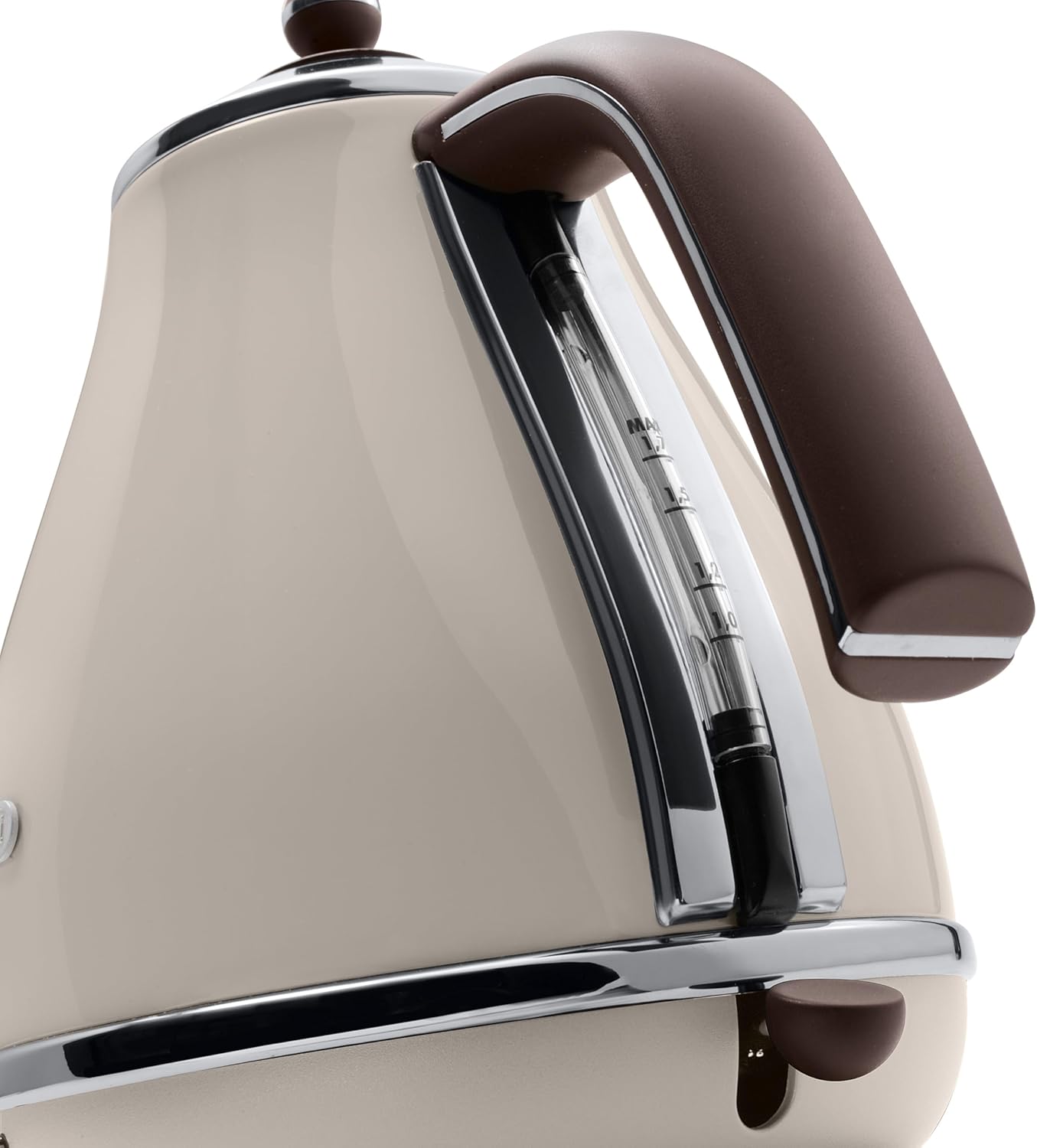
The design is clearly the big argument for this kettle. The beige colour with chrome details is pretty distinctive compared to the usual black or brushed steel kettles. On my counter, it actually looks more like a decor piece than a basic appliance. If you already have other DeLonghi Icona Vintage gear, like the matching toaster, this kettle blends in nicely and gives the kitchen a coherent style.
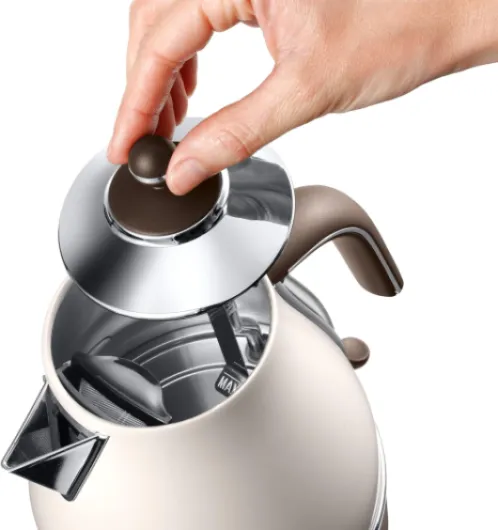
The shape is more rounded and almost teapot-like, not the usual straight cylinder. The handle has a nice curve and the lid has that metal knob on top. It definitely looks more premium than a supermarket kettle. The branding is discreet, which I like. No huge screaming logo, just a small DeLonghi badge that doesn’t dominate the look. For someone who hates big shiny logos, that’s a plus.
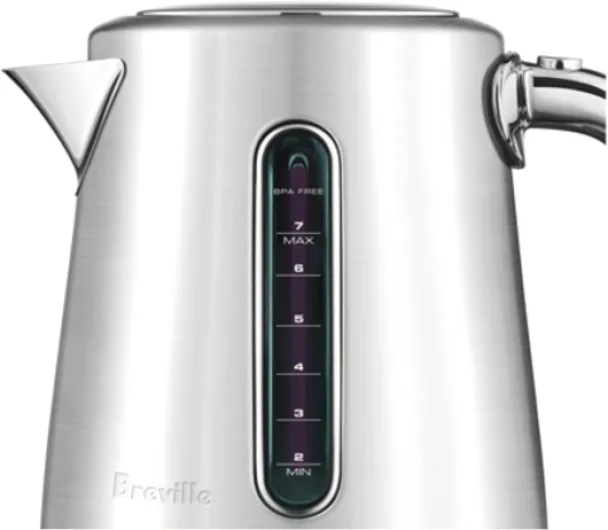
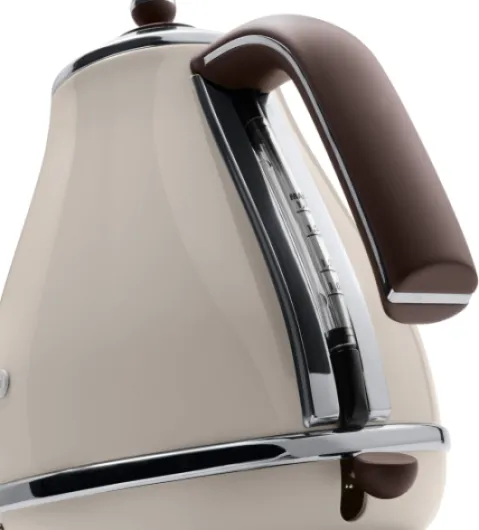
On the practical side, some choices are more style than function. The water level indicator is at the back, and while you can see it from both sides, it’s not the biggest window out there. Also, the chrome details look nice, but they show fingerprints pretty easily and need regular wiping if you care about it looking clean. It’s one of those products where you end up cleaning it a bit more just because you notice every mark on it.
In short, the design is the main reason to buy this kettle. It looks good, feels coherent with the Icona Vintage line, and dresses up the counter a bit. But if you’re someone who doesn’t care how a kettle looks and just wants hot water fast and cheap, this design won’t justify the extra money. It’s form first, function second, even if the function is still acceptable.
Materials and build: solid feel, hot exterior
The kettle is made of stainless steel with a chrome finish on some parts, and you can feel it as soon as you grab it. It doesn’t feel flimsy or hollow like some cheaper plastic kettles. The body feels quite sturdy and gives the impression it will survive a few bumps on the counter without drama. The stated features mention corrosion resistance and durability, and honestly, that checks out so far. No rust spots, no weird discolouration, even after repeated boiling and a few minor splashes.
But there’s a flip side to the metal build: the outside gets really hot when it’s boiling. This is not one of those insulated kettles where you can still grab the body. Here, you need to stick to the handle and stay away from the sides, especially if you’ve got kids around. After boiling a full 1.7 L, the metal is basically something you don’t want to touch. It cools down eventually, but for a good while it’s a bit of a hazard if you’re not paying attention.
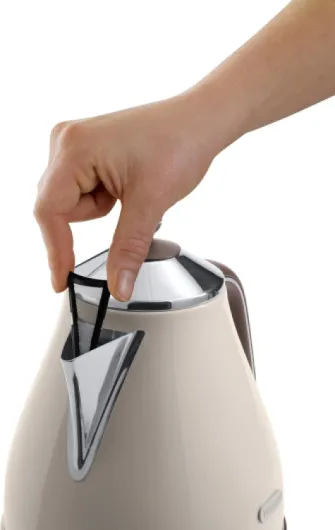
The handle itself feels solid and doesn’t flex, which is reassuring when the kettle is full. The lid mechanism is basic but works; it doesn’t feel like it’s going to snap off, and the hinge feels okay. The anti-limescale filter is a simple mesh piece that slots into the spout. It’s easy to pull out and rinse under the tap. It’s not some high-tech filter, just a standard mesh, but it helps reduce bits in your drink if your water is hard.
Overall, materials are pretty solid for a home kettle. You’re getting proper metal, not lightweight plastic, and it shows in the feel. Just keep in mind that “metal and solid” also means “hot and not very forgiving” if you or someone else brushes against it right after boiling. If safety with kids or elderly people is a big concern, that’s something to take seriously.
How it holds up over time
Build-wise, the DeLonghi KBOV 2001.BG feels like it’s meant to last a few years, not a few months. The stainless steel body doesn’t flex or creak, and after regular use, I haven’t seen any cracks, loose parts or peeling finishes. The chrome bits still look good, even though they do need wiping to keep fingerprints and water marks under control. The fact that some people on Amazon are buying this as a direct replacement for an older DeLonghi kettle of the same style says a lot: they got used to the thing and trust it enough to buy it again.
The anti-limescale filter is probably the part you’ll handle the most besides the lid and handle. It pops out easily, and if you rinse it regularly, it doesn’t clog. In a hard water area, you’ll still need to descale the kettle itself from time to time, but that’s true for pretty much any kettle. I’ve done a couple of descaling cycles with standard descaler, and the inside stainless steel cleaned up well without stains or damage.
One thing that can affect durability in the UK specifically is the EU plug issue. Some units come with an EU plug, which means you either use an adaptor or replace the plug yourself. Using a decent quality adaptor is fine, but a cheap one can feel wobbly and that’s not great for long-term reliability or safety. If you buy this in a country where the plug matches your sockets, this is obviously not a problem, but it’s worth mentioning for UK buyers.
Overall, I’d say durability is pretty solid for a home kettle. No obvious weak points so far, and the materials feel like they can take daily use. It’s not indestructible, but compared to budget kettles I’ve owned that started leaking or cracking after a year, this one gives more confidence. Just keep up basic maintenance: rinse the filter, descale now and then, and don’t bash it around, and it should keep going without drama.
Boiling speed, noise and daily use
On paper, 2000 W for a 1.7 L kettle is fairly standard, and in practice that’s exactly how it behaves. If you fill it to the max, you’re looking at roughly 4–5 minutes to get a full boil, which matches what one Amazon reviewer mentioned. If you’re just doing one mug or two, obviously it’s faster, but it’s not the quickest kettle I’ve used. My previous 3000 W UK kettle was a bit faster, so if you’re used to those, this one can feel a touch slow.
Noise-wise, it’s on the louder side. Nothing crazy, but it’s not discreet. When it’s boiling, you clearly hear that typical roaring kettle sound. If your kitchen is open to your living room, you’ll notice it during a quiet TV moment. There’s no gentle “low noise” trick here; it’s just a standard heating element doing its thing. Once it reaches boiling, it clicks off cleanly, and it doesn’t beep or make extra sounds, which I actually prefer.
The auto shut-off works well. I’ve never had it keep running or fail to stop. There’s also the usual safety cut-out if you accidentally switch it on with too little water, though I try not to test that on purpose. The water level indicator is useful, but not hyper precise. You can see rough levels (0.5 L, 1 L, etc.), enough for daily use, but if you like to be super exact, you’ll still end up eyeballing it or using a measuring jug.
In day-to-day life, it does the job: it boils water reliably, doesn’t leak, and the lid and spout pour cleanly without splashing everywhere. It’s not a performance beast and it’s not quiet, but it’s consistent. If you’re expecting ultra-fast boiling and whisper-quiet operation, you’ll be underwhelmed. If “normal kettle speed and noise” is fine for you, then performance is acceptable, just not something that stands out.
What you actually get with this kettle
Out of the box, the DeLonghi KBOV 2001.BG is pretty simple. You get the kettle, the base, and a removable anti-limescale filter in the spout. That’s it. No accessories, no extra jug, no fancy manual. It’s a 1.7 L stainless steel kettle rated at 2000 W, running on 220–240 V, with a 50/60 Hz input frequency. So it’s made for European mains, not for the US, and in the UK you often get it with an EU plug, which is annoying if you weren’t expecting that.
The base is the usual 360° rotating type, so you can drop the kettle on from any angle. The cable is about 26.5 cm coming out of the base, which is actually on the short side. In practice, it means you pretty much have to keep it close to a socket or use an extension. There’s a bit of cable storage under the base, but it’s not like you’re hiding loads of extra cord there. It’s just enough to tidy things up slightly.
Weight-wise, the kettle is around 1.15 kg empty. Once you fill it close to 1.7 L, it gets noticeably heavier, but still manageable for most people. If you have wrist problems or arthritis, you might feel the strain when it’s full. The water level indicator is at the back, which you can see from both sides, but it’s not super bold. It’s readable, just not ultra clear if your kitchen lighting is a bit dim.
Overall, the presentation is clean and simple: one main unit, one base, one filter. Nothing overcomplicated. It feels like DeLonghi relies heavily on the design and brand recognition here, rather than trying to pack in loads of features. If you expect a basic kettle with a retro look, that’s exactly what you’re getting. If you expect extras for the price, you’ll probably feel a bit short-changed.
Pros
- Attractive retro design that looks good on the counter
- Stainless steel body feels solid and durable
- Large 1.7 L capacity with reliable auto shut-off and removable limescale filter
Cons
- More expensive than similar-performing kettles; you pay mainly for the design
- Exterior gets very hot when boiling, not ideal around children
- Some units ship with an EU plug, requiring an adaptor in the UK
Conclusion
Editor's rating
The DeLonghi KBOV 2001.BG is basically a good-looking, solidly built kettle that does a standard job. It boils water reliably, the capacity is enough for a family, and the metal build feels sturdy. The anti-limescale filter is easy to clean, and the 360° base makes it simple to use whether you’re left or right handed. If you care about how your kitchen looks and like the retro vibe, this kettle fits nicely and feels more like a piece of decor than a random appliance.
On the downside, you’re paying extra mainly for the design. It’s not the fastest or quietest kettle, and there are cheaper options that match or beat it on pure performance. The exterior gets very hot when boiling, which is something to watch out for if you have kids or tend to touch the body absent-mindedly. For UK buyers, the EU plug issue is a genuine annoyance and something you need to solve with an adaptor or a plug change. So, who is it for? People who want a stylish, metal kettle that feels solid and are okay with standard performance and a higher price. Who should skip it? Anyone who just wants a cheap, fast, quiet kettle and doesn’t care what it looks like.