Summary
Editor's rating
Is it worth the price or just a fancy toy?
Retro design that actually feels thought-out
Daily usability: weight, grip, and small annoyances
Build quality, weight, and that slight plastic smell
Feeling of longevity and long-term expectations
Boiling speed, temperature control, and noise
What you actually get out of the box
Pros
- Solid stainless steel build with a quality feel and retro design
- Useful variable temperature settings from 50°C to 100°C plus keep-warm
- Quieter than many high-wattage kettles and easy 360° base handling
Cons
- High price compared to basic kettles with similar boiling function
- Heavy when full and awkward water level gauge behind the handle
- Annoying beeps/melody with no obvious mute option

Specifications
View full product page →| Brand | Smeg |
A fancy kettle for everyday tea: worth it or just decor?
I’ve been using the Smeg KLF04BLUK variable temperature kettle in black for a few weeks now, and I’ll be honest: I didn’t buy it because I desperately needed a new kettle. I bought it because it looks good on the counter and I was curious if a pricey kettle actually feels different in daily use. I’ve mostly used cheap supermarket kettles before, so this is a big jump in price for me.
From day one, you can tell this isn’t a basic plastic jug. It’s heavier, it feels more solid, and there are actual buttons and temperature settings instead of just an on/off switch. I mainly drink tea and my partner drinks coffee, so the variable temperature from 50°C to 100°C sounded useful rather than just a gimmick. I wanted to see if we’d really use that, or if we’d just end up boiling everything like usual.
In everyday use, I’ve boiled water several times a day: morning coffee, afternoon tea, and random cups in between. I’ve also tried the lower temperature settings for green tea and instant coffee, and tested the keep-warm function when we had people over. I’m judging it on three things: how fast and quiet it is, how easy it is to live with, and whether the build quality matches the price.
So far, my feeling is: it’s a very nice kettle to use, but you’re clearly paying extra for the design and the Smeg name. It does the job well and feels high quality, but in terms of pure function, a cheaper kettle could handle the basics. The question is whether the extra features and the look matter enough to you to justify the cost.
Is it worth the price or just a fancy toy?
This is where things get real: the Smeg KLF04BLUK is not cheap. You can easily find kettles that boil water just fine for a fraction of the price. So the question is, are you paying only for the logo and the retro look, or does it bring enough extra to justify the cost? After using it daily, I’d say you’re paying for three things: the design, the build quality, and the variable temperature/keep-warm features.
If you only care about boiling water as fast as possible, then no, it’s not great value compared to a basic 2000–3000W kettle. A budget model will do the same basic job for much less money. But if you drink a lot of tea and coffee and actually use different temperatures, the extra control is genuinely useful. I’ve noticed my coffee tastes better with 90–95°C water instead of full boiling, and green tea is less bitter when I use the lower settings. So the feature isn’t just a gadget, as long as you actually use it.
On top of that, the solid stainless steel body and the general feel of the buttons, lid, and handle do give a sense of durability. It doesn’t feel like something that will fall apart in a year. The Amazon rating (around 4.4/5 from hundreds of reviews) also suggests most people are happy with it.
Overall, in terms of value, I’d call it: good if you care about design and temperature control, average if you only want a simple kettle. You’re definitely paying a premium. If your budget is tight or you don’t care how your kettle looks, there are cheaper options that will be perfectly fine. If you enjoy nice-looking appliances and actually use the extra features, you’ll probably feel that the money wasn’t wasted, even if it’s not the most rational purchase.
Retro design that actually feels thought-out
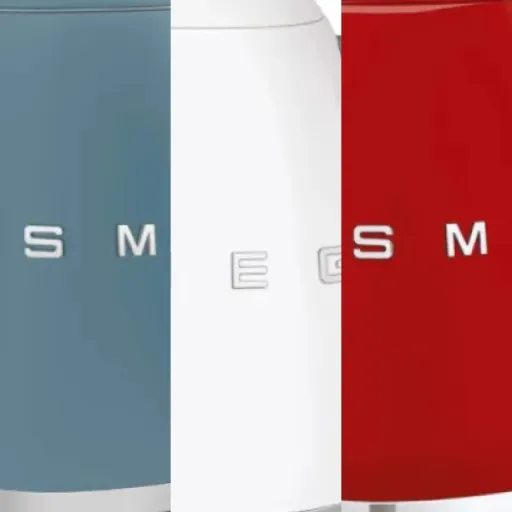
The design is clearly the main selling point here. It has that 50s-style rounded shape, the big Smeg logo in 3D on the side, and a glossy black finish. On the counter, it definitely stands out compared to a plain white plastic kettle. If you like that retro kitchen look, it fits right in. If you prefer minimal, super-modern gear, you might find it a bit chunky and loud visually.
From a practical point of view, there are a few things I liked and a few that bugged me. The handle is comfortable and feels secure, but the kettle is quite heavy, especially when it’s full. The lid opens with a soft, damped movement when you press the button, which feels very controlled and gives a sense of quality. It doesn’t snap open or slam shut, and that’s the kind of small detail you notice after using cheap kettles for years.
On the downside, the water level gauge is placed behind the handle. That means when you’re filling it directly under the tap, you can’t really see the water level clearly unless you tilt it or move your head. After a while you learn to judge by weight, but it’s still a questionable design choice. A side window would have been more practical. Also, the beeps and sounds when you set the temperature and start it can be annoying if you’re sensitive to that kind of thing. It’s not super loud, but it’s not silent either.
Still, in daily life, the design is mostly a plus. It looks good, the controls feel solid, and the 360° rotating base makes it easy to grab from any angle. I’d say the design is clearly aimed at people who care how their kitchen looks, not just how fast they can make tea. If you’re in that group, you’ll probably be happy with it, as long as you accept a few small compromises in practicality.
Daily usability: weight, grip, and small annoyances
Using this kettle every day, the main thing you feel is the weight. When it’s full, it’s not exactly light. The handle shape helps a lot though: it’s thick enough, doesn’t dig into your hand, and the grip feels secure when you pour. If you’re used to very light plastic kettles, you’ll need a few days to adjust. My partner mentioned that for quick single cups, they prefer not to fill it too much just to avoid lifting a heavy, full kettle.
The lid and spout work well. The lid opens smoothly with a button and doesn’t slam, which is nice if you’re refilling several times in a row. Pouring is controlled; I didn’t have random splashes or drips all over the place. The 360° base makes it easy to put it back down without looking too much, which sounds like a small thing, but when you’re half-awake in the morning, it’s actually quite useful. It’s also convenient for left-handed users since you can place it in any direction.
One thing that’s less comfortable is the water level window hidden behind the handle. To see how much water is inside, you basically have to move your head to the side or lift the kettle away from the tap. It’s not the end of the world, but it’s a bit annoying when you’re used to kettles with a big side window. After a couple of weeks, I mostly go by feel and sound when filling it, but it’s still a design decision that hurts usability a bit.
On the control side, the buttons and lever are clear, but the sound feedback when you change temperatures or start it can get old fast. The melody when the water is ready is fun the first few times, then you start thinking about how to shut it up. If you live in a small flat or share a space, that little tune can be more irritating than helpful. Overall, comfort is good in terms of handling and pouring, but the weight and the sound effects might bother some people.
Build quality, weight, and that slight plastic smell
The body is stainless steel, and you can feel it as soon as you pick it up. It’s solid and heavier than a typical plastic kettle. Empty, it already has a bit of weight, and full at 1.7 litres, it’s not the lightest thing to handle. If you have wrist issues or just prefer something very light, this is worth keeping in mind. The handle itself feels sturdy, with no flex, and the lid mechanism is well built with that soft opening mentioned in the reviews.
Inside, the finish looks clean, and the removable water filter is a nice touch for hard water areas. It’s not some fancy high-tech filter, but it helps catch limescale bits. Cleaning-wise, it’s pretty straightforward: you’re supposed to hand wash and wipe clean, no dishwasher. The outside stainless steel surface will show fingerprints a bit, especially in black, so you’ll probably end up wiping it regularly if you like your appliances looking tidy.
One thing that matches what another user said: there is a faint plastic smell when it’s brand new. I noticed a slight smell on the first couple of boils. I always boil and throw away the first few loads of water with any new kettle, and here it took about 3–4 boils before the smell faded to almost nothing. After a week of daily use, I didn’t notice it anymore. So it’s there at the start, but it doesn’t seem to last.
Overall, the materials feel pretty solid and more premium than budget kettles. You do get that sense of durability from the stainless steel body and the weight. It’s not perfect—fingerprints, initial smell—but I’d rather have this than thin, rattly plastic. For the price, you kind of expect this level of construction, and in that sense, it delivers.
Feeling of longevity and long-term expectations
I haven’t owned this kettle for years, so I can’t pretend to know exactly how it will age, but based on the materials and how it feels in the hand, I can make some reasonable guesses. The stainless steel body and the solid handle give a good impression. Nothing rattles, the lid mechanism is smooth, and the base doesn’t feel flimsy. It weighs about 2.6 kg, which partly comes from the metal construction, and that usually means better durability than thin plastic shells.
The main wear points on kettles are usually the lid hinge, the switch, and limescale buildup around the heating element. Here, the lid has that soft opening and doesn’t slam, so I’d expect less stress on the hinge over time. The on/off lever and buttons feel firm and not wobbly, which is reassuring. The removable water filter is also helpful in hard water areas, though you’ll still need to descale the kettle regularly if your water is very hard. Product care instructions say hand wash and wipe, so no dishwasher shortcuts, but that’s pretty standard for electric kettles anyway.
Another good sign is the number of positive reviews over time. With more than 700 ratings and a 4.4/5 average, if there were massive durability issues, they’d probably show up more clearly in the comments. Of course, things can still go wrong—heating elements can fail, electronics for the temperature control can act up—but nothing about the build screams “cheap” or “fragile”. It feels like something designed to last several years of daily use.
So, my feeling on durability is cautiously optimistic: the construction and materials justify the higher price more than the raw performance does. You’re not just paying for a pretty shell; it does seem to be built to handle regular use for the long run, as long as you take basic care of it and descale it from time to time.
Boiling speed, temperature control, and noise
In terms of pure performance, the Smeg KLF04BLUK does what it’s supposed to do: it boils water and lets you choose the temperature between 50°C and 100°C. I’ve used 100°C for black tea and cooking, 90–95°C for coffee, and around 70–80°C for green tea. The temperature presets are easy to cycle through, and the kettle hits the set temperature reliably from what I can tell. I didn’t measure it with a thermometer, but in practice, the results match what I expect: coffee isn’t scalding, green tea doesn’t taste burnt.
Boiling speed is decent, not lightning fast. With a full 1.7L, it takes a bit longer than my previous high-wattage kettle, which was around 3000W. We’re talking maybe an extra 20–40 seconds, nothing dramatic, but if you’re impatient, you’ll notice. For smaller amounts (one or two mugs), it’s quick enough and never felt slow to the point of being annoying. The advantage of the lower power is that it’s quieter. Several people mention it being quiet, and I agree: it’s noticeably less noisy than some kettles that sound like a small jet engine.
The keep-warm feature is handy when you’re making several drinks in a row or during a long breakfast. It keeps the water at the chosen temperature for a while without having to re-boil. That’s one of those things you don’t think you need until you use it a few times. For example, when we had guests, we could make tea round after round without waiting for a full re-boil each time.
Noise-wise, apart from the boiling sound being fairly soft, there are the beeps and the little melody when it’s done. Personally, I’d prefer an option to turn those off or at least make them quieter. Early in the morning or late at night, it’s not exactly discreet. But aside from that, the performance is pretty solid: reliable temperature control, quiet operation, and enough power for daily use without feeling sluggish.
What you actually get out of the box
Out of the box, the Smeg KLF04BLUK is basically: the kettle, the 360° rotating base, and a built-in removable water filter. No fancy accessories, no jug or cups, just the core unit. The base connects to the mains (230V) and the kettle sits on top and can rotate freely, which is handy if more than one person uses it or if you’re left-handed. The capacity is 1.7 litres, which is standard and enough for several mugs at a time.
The controls are all on the kettle itself. You’ve got a lever to start boiling and buttons to change the temperature in steps from 50°C to 100°C. There’s also a keep-warm option. The display and LEDs are clear enough, even early in the morning when you’re half-awake. There’s also that little melody when it finishes boiling, which some people like and others will find annoying. Personally, it’s kind of cute for the first week, then you start wondering how to mute it.
In terms of power, the spec sheet says 1000 watts, which honestly seems low compared to many kettles that are 2000–3000W. In practice, though, it still heats reasonably quickly, but don’t expect it to be the fastest kettle you’ve ever used. If you’re used to very powerful kettles, you might notice the difference by 20–30 seconds with a full load. For me, it’s not a big deal, but speed freaks should know this beforehand.
Overall, the presentation is simple and practical: no useless extras, just a solid stainless-steel kettle with temperature control and a base that does its job. The first impression is that it’s built for everyday use, but clearly dressed up to look nicer than the average appliance. It feels more like a small piece of decor that also boils water, rather than a purely functional tool.
Pros
- Solid stainless steel build with a quality feel and retro design
- Useful variable temperature settings from 50°C to 100°C plus keep-warm
- Quieter than many high-wattage kettles and easy 360° base handling
Cons
- High price compared to basic kettles with similar boiling function
- Heavy when full and awkward water level gauge behind the handle
- Annoying beeps/melody with no obvious mute option
Conclusion
Editor's rating
The Smeg KLF04BLUK variable temperature kettle is basically a stylish, well-built kettle with some genuinely useful features, wrapped in a retro design and sold at a premium price. It boils water reliably, the temperature control from 50°C to 100°C actually makes a difference for coffee and different teas, and the keep-warm function is handy when you’re making several drinks in a row. The stainless steel body, solid handle, and smooth lid mechanism give a good feeling of quality, and it’s quieter than many high-wattage kettles.
On the downside, it’s heavier than average, the water level window hidden behind the handle is not very practical, and the beeps/melody can get annoying. It’s also simply expensive for what is, at the end of the day, a kettle. If you only care about boiling water as cheaply as possible, there are better value options. But if you like nice-looking appliances, drink a lot of tea and coffee, and will actually use the different temperature settings, this model makes daily use a bit more pleasant and feels built to last.
So, who is it for? People who care about design, want variable temperature, and are okay paying extra for that combination. Who should skip it? Anyone on a tight budget, anyone who doesn’t care about looks, or those who just want the fastest, cheapest way to boil water. For me, it’s a solid product with a price that’s a bit high but not totally unreasonable given the build and features.