Summary
Editor's rating
Value for money: worth it if you actually use the features
Design: compact, nice-looking, but a bit plasticky at the base
Build and durability: feels decent, but not bulletproof
Performance: fast enough, very precise, but not a rocket
What you actually get out of the box
Effectiveness for coffee and tea: does the fancy spout actually matter?
Pros
- Very precise temperature control with 1°C steps and a useful hold function
- Gooseneck spout gives controlled, mostly non-drip pouring for coffee and tea
- Compact, relatively quiet, and has a mute mode for key tones
Cons
- Small 0.8L capacity is limiting for households or larger tea pots
- Slower to boil than standard high-wattage jug kettles and base feels a bit plasticky

Specifications
View full product page →| Brand | Dualit |
A small kettle built for coffee nerds
I’ve been using the Dualit Pour Over Fast Boil Electric Kettle (the matt black, 0.8L, gooseneck one) for a few weeks, mainly for V60 and Aeropress. Before this I had a basic 1.7L jug kettle and a cheap stovetop gooseneck, so I was curious to see if paying more for a temperature-controlled electric gooseneck actually changes anything in daily use. Short answer: yes, but not on every point, and not for everyone.
The first thing that hit me is the size. 0.8L feels tiny if you’re used to family kettles. For a single person or a couple who mostly make coffee or one or two mugs of tea, it’s fine. If you often fill a teapot for four people, you’ll be refilling it a lot. That’s something you really feel after a few days, not just from reading the specs.
The second strong point is the level of control. You can set the temperature degree by degree, in °C or °F, and there’s a hold function for a few minutes. For pour-over coffee it’s actually handy, not just a gadget. I stopped guessing “wait 30 seconds after boiling” and just hit 94°C or 96°C depending on the beans. It’s not life-changing, but it’s consistent, and that’s nice when you brew every morning half-asleep.
But it’s not perfect. It’s slower than a big 3kW jug kettle, the base feels a bit plasticky for the price, and the capacity will annoy some people. Overall though, for coffee-focused use, it gets the job done well and feels like a decent step up from the cheap options, as long as you know what you’re getting into.
Value for money: worth it if you actually use the features
Price-wise, this Dualit kettle sits well above a basic supermarket jug kettle and also above some cheaper gooseneck kettles without temperature control. You’re paying for the brand, the digital temperature control, the hold function, and the gooseneck design. If you just need hot water and don’t care about precision, then honestly, it’s overkill and not great value. A standard 1.7L kettle will be cheaper, faster, and more practical for big volumes.
Where the value starts to make sense is if you’re into manual coffee or careful tea brewing and you’ll actually use the degree-by-degree control and the spout every day. In that case, you’re effectively paying for consistency and convenience. Compared to some high-end barista kettles from more specialist brands, this Dualit can actually be slightly cheaper while offering similar core features: gooseneck, temp control, hold mode. It’s not the most advanced on the market, but it covers the basics well.
The 0.8L capacity is a double-edged sword for value. On one hand, it heats less water, so it’s a bit more energy-efficient and fine for single or double servings. On the other hand, if you live with several people and keep refilling it, the convenience drops and it starts feeling like a compromise. So the value really depends on your household and habits. Solo coffee nerd? It’s easier to justify. Family of five? It will annoy you.
So in my opinion, the value is good but not outstanding, and very dependent on use case. If you never cared about brew temperatures or pour control before, this kettle won’t magically make you care. But if you’ve been messing around with thermometers, waiting for water to cool, or trying to pour gently from a big jug kettle, this is a clear step up and the price can be defended.
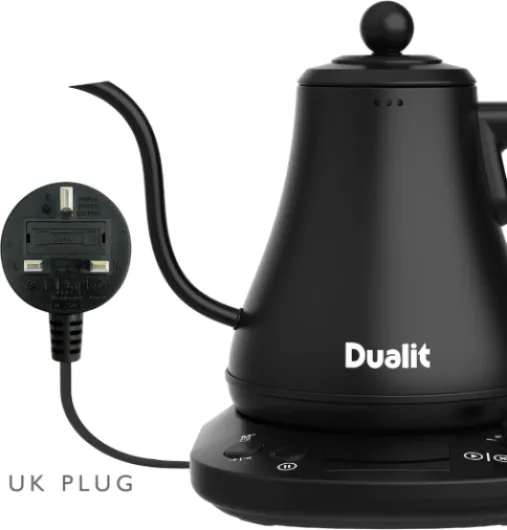
Design: compact, nice-looking, but a bit plasticky at the base
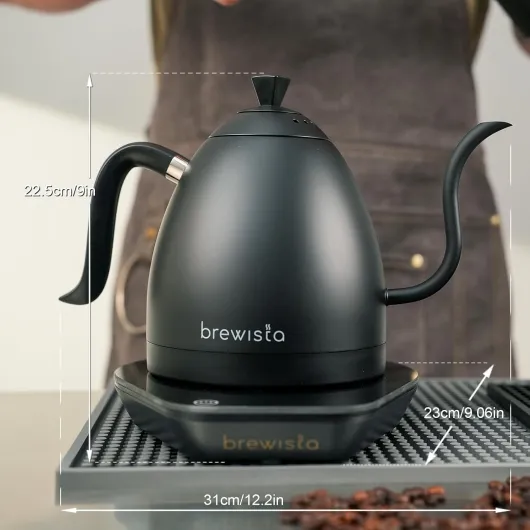
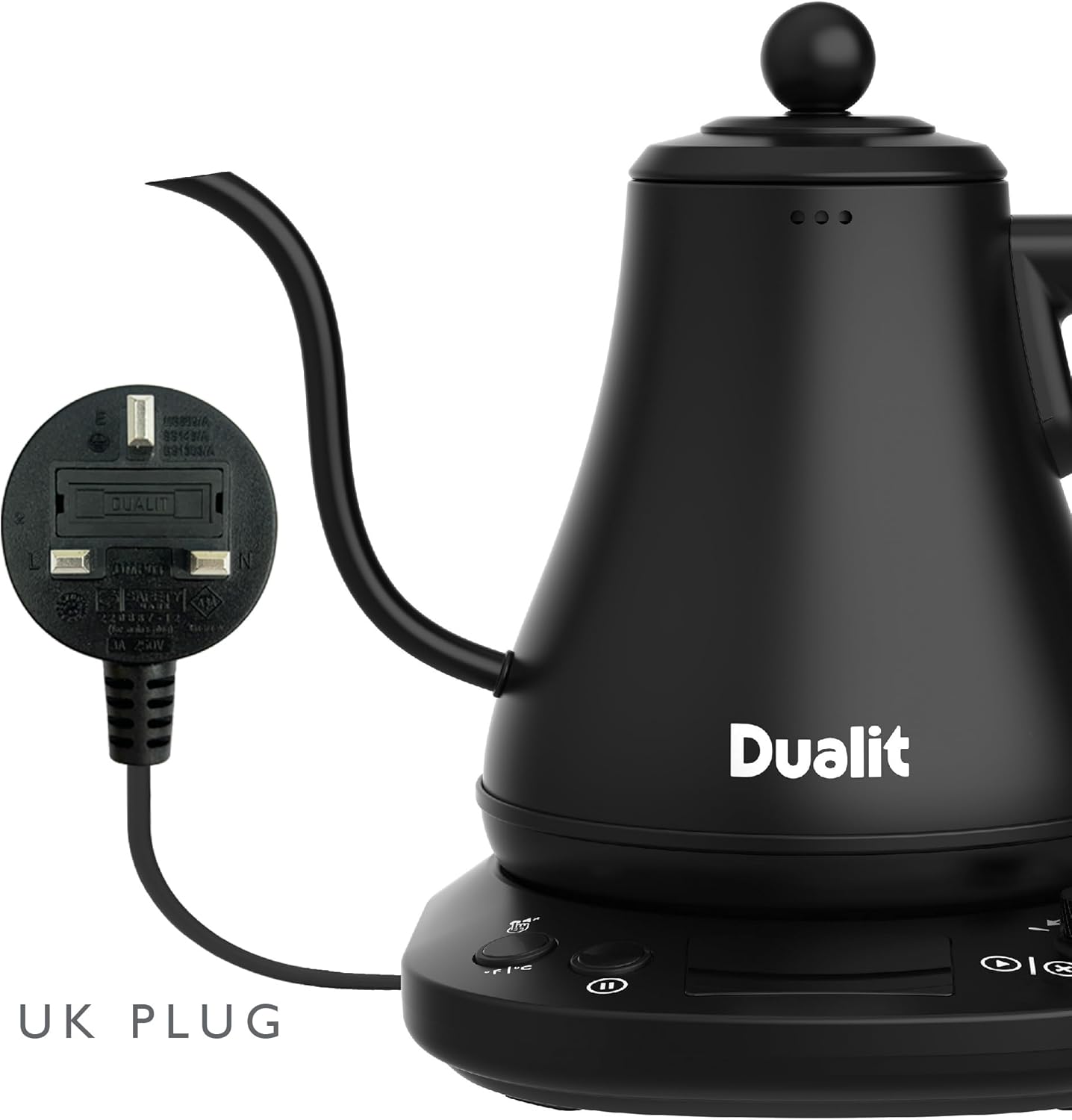
Design-wise, it’s pretty straightforward: a matt black stainless steel body with a long gooseneck and a simple handle. On the counter, it looks clean and modern enough without screaming for attention. The matt finish hides fingerprints much better than shiny stainless steel, which I appreciated after constantly wiping my old chrome kettle. It’s not a showpiece, but it looks neat and fits in with most kitchen setups without clashing.
The handle is reasonably sized and well-angled for pouring. I never felt like I was going to drop it, even when it was full. The weight is about 1 kg empty, and once full it’s still lighter than a big 1.7L kettle, obviously. That makes it easier to control during slow pours. The lid is removable, not hinged, and it sits firmly but comes off easily when you want to fill it. No weird locking mechanism or anything, which I like because it’s simple and easy to clean.
The downside is the base. Functionally it’s fine, but the plastic around the display and buttons doesn’t feel as premium as the metal body. At this price range, I kind of expected something a bit more solid or at least heavier. It doesn’t feel like it will break right away, but it does feel more like a mid-range appliance than something high-end, which is a bit at odds with the brand image they push.
Another small design point: the cable length is just okay. Not super long, not super short. If your plug is right near your worktop area, you’re good. If your socket is awkwardly placed, you might need an extension. No cable tidy built into the base either, which is a bit of a shame. Overall, the design is practical and pretty easy to live with, but not luxurious. It does the job, looks decent, and that’s about it.
Build and durability: feels decent, but not bulletproof
In terms of build, the stainless steel body feels solid enough. The matt coating hasn’t scratched yet for me, even though I’ve banged it lightly against the tap a couple of times while filling. It doesn’t dent easily, and the finish still looks the same after regular daily use. The handle is firmly attached, no wobble, and the lid still fits snugly without getting loose or warped from steam.
The part that worries me long-term is more the base and electronics. The plastic around the display is fine, but not exactly inspiring. The buttons are clicky but feel a bit cheap, like they might wear down faster than the metal parts. Nothing has failed so far, but from handling it, I can tell this isn’t built like a tank. It’s okay for home use, but I wouldn’t put it in a busy office kitchen and expect it to last years under heavy abuse.
Cleaning is pretty straightforward. The inside is stainless steel, so I just rinse and occasionally descale like any other kettle. The manufacturer says hand wash and wipe clean, which is normal. No weird corners inside where limescale builds up massively; it’s a simple shape. As long as you descale regularly in a hard water area, it should be fine. The outside just needs a quick wipe; the matt finish hides most marks.
Overall, I’d say durability feels pretty solid but not outstanding. It doesn’t feel cheap, but it also doesn’t give that tank-like impression you get from some heavier kettles. Given the price, I expected a tiny bit more heft or a more robust base. If you treat it normally and don’t slam it around, I don’t see any obvious weak spot, but I wouldn’t buy it expecting it to last decades either.
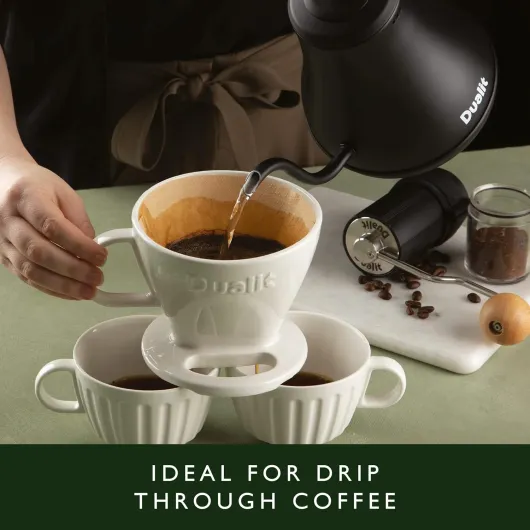
Performance: fast enough, very precise, but not a rocket
On paper, the Dualit kettle runs at 1100W and goes up to 100°C/212°F, with temperature steps of 1 degree. In real life, that means it’s not as fast as the usual 3000W jug kettles you see in the UK, but it’s not painfully slow either. From room temperature water to 92–94°C, I was usually looking at around 3–4 minutes for a full-ish kettle. For small pours (say 300–400 ml for a single V60), it’s quicker and feels perfectly reasonable in a morning routine.
The strength of this kettle is really the precision. Being able to dial in temperatures by 1°C is more than enough for home use. I mostly sit between 90–96°C for coffee and 80–90°C for green teas. The kettle hits the set temperature and stops, and I didn’t notice any wild overshooting. The hold function keeps the water around the target for about 5 minutes (up to 96°C). That’s handy when you’re grinding beans or rinsing filters and don’t want to reheat the water again.
Noise-wise, it’s quieter than my old 3kW jug kettle. It still hums and you hear the usual boiling noise, but it’s not that harsh roaring sound. With the mute mode on, there are no beeps at the start or end, which I really appreciated during early mornings. You still hear the water, obviously, but you don’t get those sharp electronic sounds that wake up the whole flat.
The non-drip claim is mostly true. If you pour at a normal angle and don’t snap it back too fast, it doesn’t dribble or spit. When I rushed and yanked it back too aggressively, I got a tiny drip, but nothing dramatic. Compared to a regular kettle, it’s much cleaner to use. Overall, the performance is solid: not lightning fast, but controlled, consistent, and quiet enough for shared living.
What you actually get out of the box
Out of the box, you get the kettle itself (stainless steel body, matt black finish), the heating base with the digital display, and the usual paperwork. No fancy extras, no filters or cleaning tools. For the price, it’s pretty standard, but I wasn’t expecting more. The stated capacity is 0.8 litres, and in practice you’re not filling it to the absolute brim if you don’t want boiling water near the lid, so think more like 600–700 ml as a comfortable working volume.
The base has the digital display and a few buttons to set temperature, switch between °C/°F, turn on the mute mode, and use the hold function. It’s not a smart kettle: no Bluetooth, no app, no crazy automation. Honestly, I’m fine with that. You just press buttons and it heats water. The display is clear enough to read from a normal counter height, even in a slightly dim kitchen. The UI is basic but logical: temperature up/down, start, and a button to toggle functions.
There’s also the gooseneck spout, which is the whole point of this kettle. It’s thin, long, and curved enough to control the flow. Compared to a normal jug kettle, you immediately feel the difference when you pour. You can go from a thin, slow stream to a slightly stronger one without splashing everywhere. It’s not as ultra-precise as some high-end barista kettles I’ve tried in cafés, but for home use it’s pretty solid.
In everyday use, the kettle is clearly designed for someone who cares about brewing temperature and pouring control more than about boiling huge amounts of water fast. If you just want to make pasta water and big pots of tea all day, this is not the most practical format. But if you’re into manual coffee or picky about tea temperatures, the feature set actually matches what you need rather than being random gimmicks.
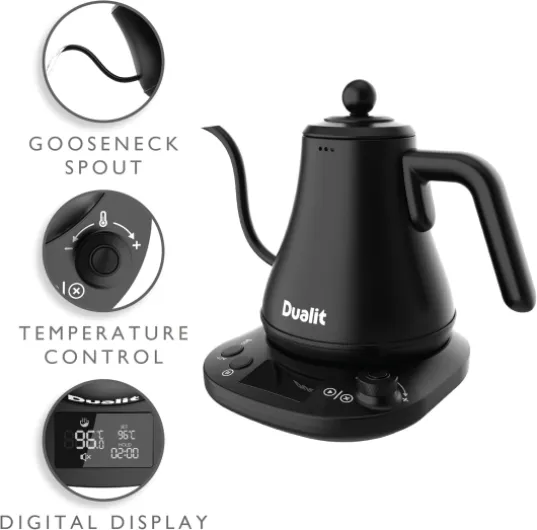
Effectiveness for coffee and tea: does the fancy spout actually matter?
This kettle is clearly aimed at people doing pour-over coffee or more careful tea brewing, so that’s how I used it. For V60 and Aeropress, the gooseneck spout really makes a difference compared to a standard jug kettle. You can control the pour rate much more easily, and you’re not fighting against a huge gush of water. Bloom pours are smoother, and keeping a constant spiral pour over 2–3 minutes is just more comfortable.
After a few days, I realised my brews were more consistent, mainly because the flow and temperature were the same every time. I wouldn’t say the coffee suddenly tasted like a café, but it was easier to reproduce a brew that I liked. Before, with the old jug kettle, I had to be careful not to dump half the water at once and I was guessing temperatures. Here, I just pick 94°C, press start, wait, and that’s it. Less faff, fewer variables.
For tea, the temperature control is also practical. Green tea at 80°C, oolong around 90°C, black tea near boiling – you don’t have to wait around for the kettle to cool down or play the “add a bit of cold water” game. If you drink a lot of different teas, this is where the kettle really earns its keep. If you only drink builder’s tea and always pour boiling water, then the temperature feature is kind of wasted on you.
In short, in terms of effectiveness, it does what it promises: controlled pouring, precise temperature, and a hold mode that is actually useful when you’re brewing more than one cup or doing back-to-back coffees. It doesn’t magically make bad beans good, but it removes some of the annoying parts of manual brewing. If you’re into that stuff, you feel the difference pretty quickly. If you’re not, you might just see it as a slower small kettle.
Pros
- Very precise temperature control with 1°C steps and a useful hold function
- Gooseneck spout gives controlled, mostly non-drip pouring for coffee and tea
- Compact, relatively quiet, and has a mute mode for key tones
Cons
- Small 0.8L capacity is limiting for households or larger tea pots
- Slower to boil than standard high-wattage jug kettles and base feels a bit plasticky
Conclusion
Editor's rating
Overall, the Dualit Pour Over Fast Boil Electric Kettle is a pretty solid small kettle aimed at people who actually care about how they brew coffee and tea. The big positives for me are the precise temperature control, the genuinely useful gooseneck spout, the non-drip pouring, and the option to mute the beeps. Day to day, it made my pour-over routine smoother and more consistent, and it’s definitely nicer to use than a basic jug kettle when you’re doing manual brews.
On the downside, the 0.8L capacity is limiting, the 1100W power means it’s not as fast as a typical 3kW kettle, and the base feels a bit more plasticky than I’d expect at this price. It’s not bad, but it doesn’t scream premium either. If you live alone or with one other person and mainly make coffee and a few cups of tea, it fits the bill. If you’ve got a big household or mostly use a kettle for big pots of tea and cooking water, I’d skip this and get a larger, more powerful model instead.
So, who is this for? It’s for coffee and tea enthusiasts who want more control and don’t mind trading capacity and speed for precision and a better pour. Who should skip it? Anyone who just wants boiling water fast, doesn’t care about exact temperatures, or needs to serve several people at once. In that case, you’ll pay more for features you barely use, and it won’t feel worth it.