Summary
Editor's rating
Value for money: better than entry-level, but you pay for the brand and build
Design: looks good, but it’s a fingerprint magnet
Comfort and daily use: easy to handle, normal noise, no drama
Materials: mostly solid, but still some plastic in the mix
Durability: feels built to last longer than the cheap stuff, but not indestructible
Performance: fast boiling and clean pouring, but not silent
What you actually get out of the box
Pros
- Stainless steel body and generally solid build that feels more durable than cheap plastic kettles
- Fast 3000W boiling with clear dual measuring windows that help avoid overfilling
- Non-drip spout and comfortable handle make pouring clean and easy in daily use
Cons
- Polished stainless finish shows fingerprints and water marks very easily
- Noise level is standard rather than quiet, with no extra features like temperature control

Specifications
View full product page →| Brand | Dualit |
A kettle that feels more like an appliance than a disposable gadget
I’ve been using the Dualit Lite 1.5L Jug Kettle in polished stainless steel with black trim for a few weeks now, basically 5–6 boils a day for tea and coffee. I’m not a collector of fancy kettles, I just want something that boils fast, doesn’t leak, and doesn’t feel like it will crack in a year. I’d had a couple of cheap supermarket kettles before that, both of which died after around 18 months, usually with dodgy lids or flaky plastic.
Going into this, my main questions were simple: does it boil quickly, is it annoying to use, and does it feel like it will last? The Amazon page talks a lot about rapid boil, non-drip spout, and dual measuring windows, which all sound nice, but half the time those are just bullet points that don’t change much in real life. So I tried to ignore the marketing and just use it normally: quick cups of tea, topping up a saucepan, that kind of thing.
In day-to-day use, the first thing that stood out is that it feels more solid than the usual £20–£25 plastic kettles. The body is stainless steel, it has a bit of weight to it, and the lid mechanism is basic but feels less fragile than the flip-top lids I’ve broken in the past. It’s not some fancy design piece, but it definitely doesn’t feel flimsy. That said, it’s still made in China and there is a fair bit of plastic around the handle and base, so don’t expect a tank.
Overall, my first impression was: decent quality, boils fast, and feels like something I might actually keep for several years instead of mentally preparing to replace it in a year. It’s not perfect and I do have a couple of gripes, especially around noise and price, but in daily use it mostly just does its job without drama, which is basically what I want from a kettle.
Value for money: better than entry-level, but you pay for the brand and build
In terms of value, this kettle sits in the mid-range bracket. It’s clearly more expensive than the basic supermarket or own-brand kettles, but cheaper than some of the high-end “design” ones. You’re basically paying for the Dualit name, the stainless steel build, and a few practical features like the non-drip spout and clear windows. The question is whether that price jump over a £20–£25 kettle is worth it for you.
For me, comparing it to my last cheap plastic kettle that died after about 18 months, the extra money makes sense if this one lasts at least 3–4 years. The build definitely feels more solid, and things like the manual hinged lid and metal body suggest fewer obvious failure points. Also, it just feels nicer to use every day: better grip, better pouring, and more stable on the base. If you’re the kind of person who replaces kettles regularly without thinking, this might feel pricey. But if you’re fed up with buying disposable-feeling appliances, it’s a reasonable step up.
On the other hand, it’s not perfect. There’s still a fair amount of plastic, it’s not especially quiet, and it doesn’t have any special features like temperature control or keep-warm. If you want those extras, you’ll find other brands at a similar price that offer more tech. So in that sense, you’re paying mainly for solid basics and a known brand, not for fancy options. I think that’s fine as long as you’re clear on what you’re getting.
Overall, I’d call the value good but not spectacular. If you just want the cheapest way to boil water, this is overkill. If you want something that feels better built, boils fast, and should last a decent number of years, the price is fair. Personally, I’m okay with the cost because I’m tired of throwing away flimsy kettles, but if your budget is tight, there are definitely cheaper options that will still boil water just fine, just with a more “meh” feel and likely shorter lifespan.
Design: looks good, but it’s a fingerprint magnet
Design-wise, the Dualit Lite kettle goes for the classic stainless steel and black combo. It’s not flashy, but it does look a bit more “grown-up” than the all-plastic budget kettles. On my counter next to a black toaster and a stainless steel coffee machine, it blends in nicely. I wouldn’t call it stylish in a fancy way, but it looks clean and fairly modern. The shape is a simple jug with a slightly rounded body and a chunky handle, so it doesn’t scream for attention, which I like.
The main downside of the polished stainless finish is simple: fingerprints and water spots. If you’re picky about how your appliances look, you’ll be wiping it often. After a couple of days of normal use, you can clearly see marks where you’ve grabbed it or splashed water. A quick wipe with a cloth fixes it, but if you want something low-maintenance, a matte or plastic finish might be easier. Also, if you have hard water, limescale splashes show up fast on the shiny metal.
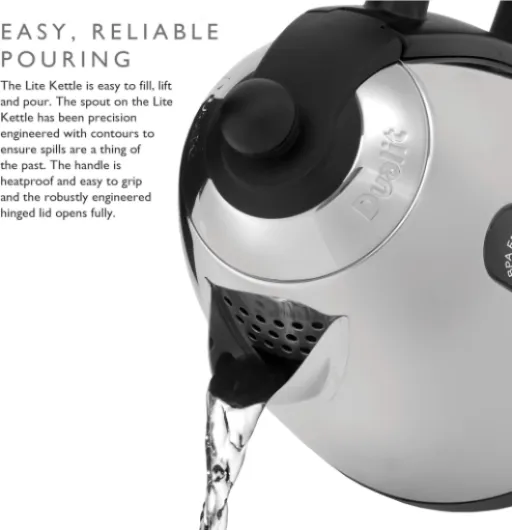
From a practical side, the shape of the spout and handle is well thought out. The spout is relatively narrow and angled so that it doesn’t gush water everywhere when you pour. The handle is big enough for larger hands and doesn’t feel awkward even when the kettle is full. The lid is hinged and you lift it manually by the knob; there’s no button to flip it open. Honestly, I prefer that: all the spring-loaded lids I’ve had eventually got stuck or broke. This one just feels basic but reliable. It opens wide enough to fill under a tap without water bouncing back out.
Overall, the design is pretty functional: easy to hold, easy to fill, and pours in a controlled way. The only real annoyance is how easily the shiny body picks up smudges. If you don’t care much about that, you’ll probably be happy with how it looks and behaves on the counter. If you want something that always looks pristine with zero effort, this finish might annoy you over time.
Comfort and daily use: easy to handle, normal noise, no drama
Day to day, this kettle is comfortable to use, which sounds basic but matters when you use it multiple times a day. The handle is chunky, with that soft grip area, and it feels stable even when the kettle is full at 1.5L. I don’t feel like I’m going to drop it or twist my wrist. My partner, who has slightly smaller hands, also finds it easy enough to hold, so it seems to suit different hand sizes. The weight is reasonable: heavier than a cheap plastic kettle, but not so heavy that it’s a pain to lift when full.
The lid mechanism is manual but smooth. You just grab the knob and lift; it opens on a hinge and stays up well enough while you fill it at the tap. I actually like this more than the push-button lids that fly open or jam over time. Here, there’s less to break. The opening is wide enough that you can fill it quickly under a tap without water bouncing off the edges. Also, it’s easy to get a descaler or sponge inside when you need to clean it, which is a bonus if you live in a hard water area.
On the noise front, I’d call it normal for a 3kW kettle. It’s not whisper-quiet, but it’s not unreasonably loud either. You can still have a conversation in the kitchen while it’s boiling, but you’ll notice the usual roar when it gets close to the boil. Compared to my previous Morphy Richards plastic kettle, it’s roughly the same, maybe slightly less rattly because the metal body feels more solid. If you’re hunting for a super quiet kettle, this isn’t that, but it’s fine for everyday use.
Pours are where the comfort really shows: the non-drip spout actually works. I can pour into a mug or a cafetière without water running down the side or splashing everywhere. When you stop pouring, the flow cuts off cleanly. It’s a small thing but anyone who has wiped up puddles from a badly designed kettle spout will appreciate it. So overall, in terms of comfort and usability, it’s just easy: no weird angles, no painful handle, and no fighting with the lid every time you fill it.
Materials: mostly solid, but still some plastic in the mix
The big selling point here is that it’s a stainless steel kettle rather than a fully plastic one. The main body is 304 stainless steel, which is standard food-grade metal used in lots of kitchen gear. Compared to my previous all-plastic kettle, this one instantly feels more solid and less “cheap toy”. When you tap the side or pick it up, there’s a bit of weight and a sense that it won’t crack if you bump it lightly against the tap.
That said, it’s not 100% metal. The handle, base, trim and parts of the lid are plastic (ABS and PP). The water level windows are also plastic but BPA free, according to the description. Inside the kettle, the inner wall is metal, but like most kettles, there’s still a plastic filter and some plastic around the spout. So if you’re trying to avoid any plastic contact with hot water at all, this is not a pure metal solution. For me, it’s a reasonable compromise: most of the structure is metal, and the plastics used feel thicker and sturdier than the really cheap kettles I’ve had.
The handle has a soft silicone-like grip section which actually makes a difference when the kettle is full. It doesn’t slip, even with slightly wet hands, and it doesn’t get hot. The lid knob is also heatproof and easy to grab, so you don’t end up burning your fingers when you open it after a boil. These are small details, but in daily use they matter more than fancy features. I’ve had kettles where the handle got warm enough to be annoying; this one stays comfortably cool.
In terms of build quality, the seams between plastic and metal are mostly clean, with no sharp edges or weird gaps on my unit. The base feels sturdy and the rotation is smooth when you place the kettle back down. It doesn’t wobble. So materials-wise, I’d say it’s pretty solid for a mid-range kettle: better than the cheap plastic stuff, but not some ultra-premium tank either. If you want full metal inside and out with almost zero plastic, you’d probably have to look at more expensive or more niche models.
Durability: feels built to last longer than the cheap stuff, but not indestructible
Durability is always a bit of a guess early on, but there are a few signs here that this kettle should hold up better than the typical bargain model. The stainless steel body is the first clue: it doesn’t flex or creak when you grab it, and it doesn’t feel thin. Compared to my last plastic kettle, which started to feel loose and rattly after a year, this one feels solid. The base connection also feels firm and doesn’t wobble when you rotate the kettle around.
The lid mechanism is simple – just a hinged lid you lift by hand – and that’s probably good for long-term use. Spring-loaded push-button lids are what failed on two of my previous kettles, leaving me with a lid that wouldn’t open properly. Here, there’s nothing fancy to jam. The hinge on my unit feels smooth with no grinding or stiffness, and it hasn’t loosened up after a few weeks of regular use. That matches up with some Amazon reviews from people who had older Dualit kettles that lasted several years, including one person who said theirs lasted since 2007 before the internal filter broke.
Inside, the concealed element helps with limescale protection. In hard water areas, exposed elements can get covered in scale quickly, which slows boiling and can eventually kill the kettle. Here, the element is hidden under the base, so scale tends to build on the bottom plate instead, which is easier to descale. I’ve already done one descale run just to test it, and it handled it fine with no weird noises or residue. The filter at the spout is plastic, so that might be a weak point over many years, but that’s pretty common across brands.
Overall, I’d say it feels like a kettle that should comfortably last several years if you treat it decently and descale it now and then. It’s still made in China, and it’s not some industrial-grade unit, so I wouldn’t expect it to survive abuse or constant commercial use. But compared to the £20–£30 kettles that start to feel tired after a year, this gives the impression of being in a different category. The reviews mentioning 4+ years of use back that up a bit, though obviously everyone’s water and usage is different.
Performance: fast boiling and clean pouring, but not silent
Performance-wise, the Dualit Lite kettle does what it says: it boils fast and pours cleanly. With its 3000W element, it’s in the top power range for standard kettles, and you can feel that in real use. From cold tap water to a full rolling boil, I got roughly these times with a stopwatch: around 1 minute 20 seconds for two large mugs (about 600–700 ml) and around 2 minutes 45 seconds for a full 1.5L fill. That lines up well with the brand’s claim of under a minute and a half for two cups. If you’re impatient like me in the morning, this matters.
The dual measuring windows are actually useful for performance because they make it easy to avoid overfilling. You just check the cup markings, fill to your number of cups, and you’re done. Less water means faster boiling and a bit less energy wasted. It’s not some revolutionary feature, but in practice it nudged me into boiling only what I need instead of lazily filling half the kettle every time. Over time that should help with energy bills and limescale build-up too.
On the downside, as mentioned earlier, noise is typical but not low. When it gets close to boiling point, it does the usual loud rumble. It doesn’t scream or rattle like some very cheap kettles, but if you’re used to a so-called “quiet boil” kettle, this will sound louder. For me, it’s not a dealbreaker at all; it’s just normal kettle noise. The auto shut-off kicks in reliably each time, and I haven’t had any weird half-boils or failures to switch off, which I did have with a cheaper brand after a year of use.
The non-drip spout is probably my favourite performance detail. Whether you’re pouring slowly into a small cup or tipping a bit faster into a big teapot, the flow is steady and controlled. I haven’t had any water dribble down the side or splash onto the worktop, which is rare enough that I noticed. Combined with the reasonably fast boil times and easy-to-read windows, I’d rate the performance as solid and reliable. Nothing flashy, but it gets the job done well every single time.
What you actually get out of the box
Out of the box, the Dualit Lite kettle is pretty straightforward: you get the kettle itself, the 360° swivel base with the power cord, and the usual bits of paperwork. No extra filters, no fancy accessories. It’s a 1.5L jug-style kettle rated at 3000W, so it’s at the typical “fast boil” power level you see on most decent kettles in the UK. The body is polished stainless steel with black plastic trim, and the overall footprint is fairly compact: around 22.2 x 16.6 x 26 cm.
The main functional features are pretty simple but actually useful: dual measuring windows on each side (cups on one side, litres on the other), a non-drip spout, a manual hinged lid (no spring-loaded button), and a concealed heating element. There’s also the usual auto shut-off and boil-dry protection, which is standard but still good to have. The capacity of 1.5L is enough for a family round of tea or to fill a saucepan, but not huge. If you’re used to a big 1.7–1.8L kettle, you’ll notice the slight drop, but for normal home use it’s fine.
What I liked straight away is that the water level windows are actually readable while you’re filling it at the sink. On some kettles, the marking is so vague or hidden behind plastic that you end up guessing. Here, the cup markings are clear enough that you can quickly fill for 1, 2, 3 cups without thinking too much. On the litre side, the markings are also clear, which is handy when you’re boiling water for cooking.
So in terms of presentation and basic setup, it’s all pretty no-nonsense. You plug in the base, give the kettle a rinse and a couple of boil-and-dumps to clear any factory smell, and you’re good to go. No weird smells after that in my case, and no odd taste in the water beyond the usual first-use metallic hint that disappeared after a day. It feels like a mid-range kettle that focuses on the basics rather than gimmicks, which suits me.
Pros
- Stainless steel body and generally solid build that feels more durable than cheap plastic kettles
- Fast 3000W boiling with clear dual measuring windows that help avoid overfilling
- Non-drip spout and comfortable handle make pouring clean and easy in daily use
Cons
- Polished stainless finish shows fingerprints and water marks very easily
- Noise level is standard rather than quiet, with no extra features like temperature control
Conclusion
Editor's rating
After living with the Dualit Lite 1.5L Jug Kettle for a while, my overall take is pretty simple: it’s a solid, no-nonsense kettle that feels better built than the usual cheap plastic ones, boils fast, and is easy to live with day to day. The stainless steel body, comfortable handle, and non-drip spout make it feel like a proper appliance rather than something disposable. The dual measuring windows are actually handy, especially the cup markings, and the manual hinged lid is basic but likely more reliable than springy flip lids that tend to fail.
It’s not perfect. The polished stainless finish shows fingerprints and water marks, the noise level is normal rather than quiet, and you’re not getting any fancy features like variable temperature. There’s still some plastic inside, so it’s not a pure metal solution. And the price is higher than entry-level models, so if you just care about boiling water as cheaply as possible, this will feel like overkill. But if you’re looking for a mid-range kettle that feels sturdier, is pleasant to use every day, and has a decent chance of lasting several years, it’s a good option.
I’d recommend it to anyone who’s fed up with flimsy budget kettles and wants something more solid without going into premium, feature-heavy territory. If you’re on a tight budget, or you specifically want ultra-quiet or temperature control, you should probably look elsewhere. For most everyday tea and coffee drinkers who value reliability and simple, practical design, this kettle gets the job done well.