Summary
Editor's rating
Value for money: worth it or just paying for the brand?
Design: looks premium, with a few practical pros and cons
Everyday comfort: handling, pouring, and small annoyances
Materials and build: metal body, decent finish, made in China
Durability and long-term feel
Performance: heats fast and hits the right temperatures
What you actually get with this KitchenAid kettle
Pros
- Solid stainless steel build with a robust feel and no plastic taste in the water
- Useful variable temperature control from 50°C to 100°C in 10-degree steps
- Fast boiling thanks to the 3000W element and easy, splash-free pouring
Cons
- Heavier and hotter to the touch than a plastic kettle, less ideal for some users
- More expensive than simple on/off kettles, value mainly if you use temp control regularly

Specifications
View full product page →| Brand | KitchenAid |
A good-looking kettle that’s more than just decoration
I’ve been using the KitchenAid 5KEK1701 variable temperature kettle (the 1.7 L Empire Red one) at home for a few weeks now. I didn’t get it for the color, to be honest, but because I wanted proper temperature control for coffee and tea without faffing around with thermometers. So this is from the point of view of someone who actually uses it several times a day, not just leaves it on the worktop to look nice.
In practice, this kettle sits in that middle zone: it’s not cheap, and it’s not some fancy barista gadget either. It’s a fairly standard KitchenAid appliance: a bit of retro style, metal body, and a few extra features that you don’t get on a supermarket kettle. If you just want to boil water as cheaply as possible, this is probably overkill. But if you’re picky about water temperature or you hate flimsy plastic kettles, it starts making sense.
What pushed me to try it was the variable temperature control from 50°C to 100°C. I drink a lot of green tea and filter coffee, and boiling water every time is not ideal. My old plastic kettle was loud, felt cheap, and only had a basic on/off switch. So I wanted to see if paying more for a KitchenAid actually changes anything day to day, or if it’s just about the logo and the paint job.
Overall, it gets the job done well, but it’s not perfect. There are things I really liked: the build, the precise temps, the quick boil. And there are a couple of things that annoyed me: weight, noise, and the price compared to simpler kettles. I’ll go through all that in detail so you can see if it fits how you actually use a kettle, not just how it looks in the product photos.
Value for money: worth it or just paying for the brand?
Let’s talk price, because that’s where opinions will split. This KitchenAid kettle sits clearly above the basic kettles you can grab for cheap. You’re paying for the variable temperature control, the metal build, and the brand. If you just want to boil water once or twice a day and don’t care about temperature precision or aesthetics, a simple on/off plastic kettle will do the job for a lot less money. In that case, this model is overkill.
Where it starts to make sense is if you actually use the temperature control regularly and you care about how the kettle looks and feels. If you drink different teas, make pour-over coffee, or just hate the feel and taste of cheap plastic kettles, then the extra cost becomes easier to justify. In that scenario, you’re not just paying for the badge; you’re paying for a more solid object that you’ll interact with several times a day. It does feel nicer than a budget model, and the temperature options are genuinely useful, not a gimmick.
Compared to other variable-temperature kettles from brands like Russell Hobbs, Bosch, or Philips, this one is usually a bit more expensive, but not wildly so. The difference is mostly in the design and the all-metal body. Some competing models offer similar temperature steps, sometimes with more digital displays or keep-warm functions. This KitchenAid keeps things simpler but sturdier. Whether that’s worth the extra money depends on what you value: flashy features and screens, or a more old-school solid feel.
Personally, I’d say the value is decent but not outstanding. It’s not a bargain, but you do get a pretty solid product that works well and feels built to last. If you’re already in the KitchenAid ecosystem or you really want a metal variable-temp kettle that looks good on the counter, it’s a sensible buy. If you’re on a tight budget or don’t care about temperatures, you can absolutely save money with a simpler kettle and you won’t be missing out on anything crucial.
Design: looks premium, with a few practical pros and cons
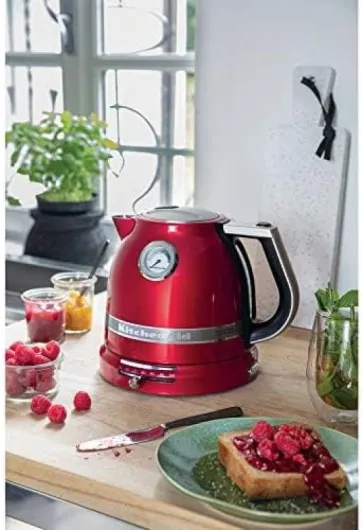
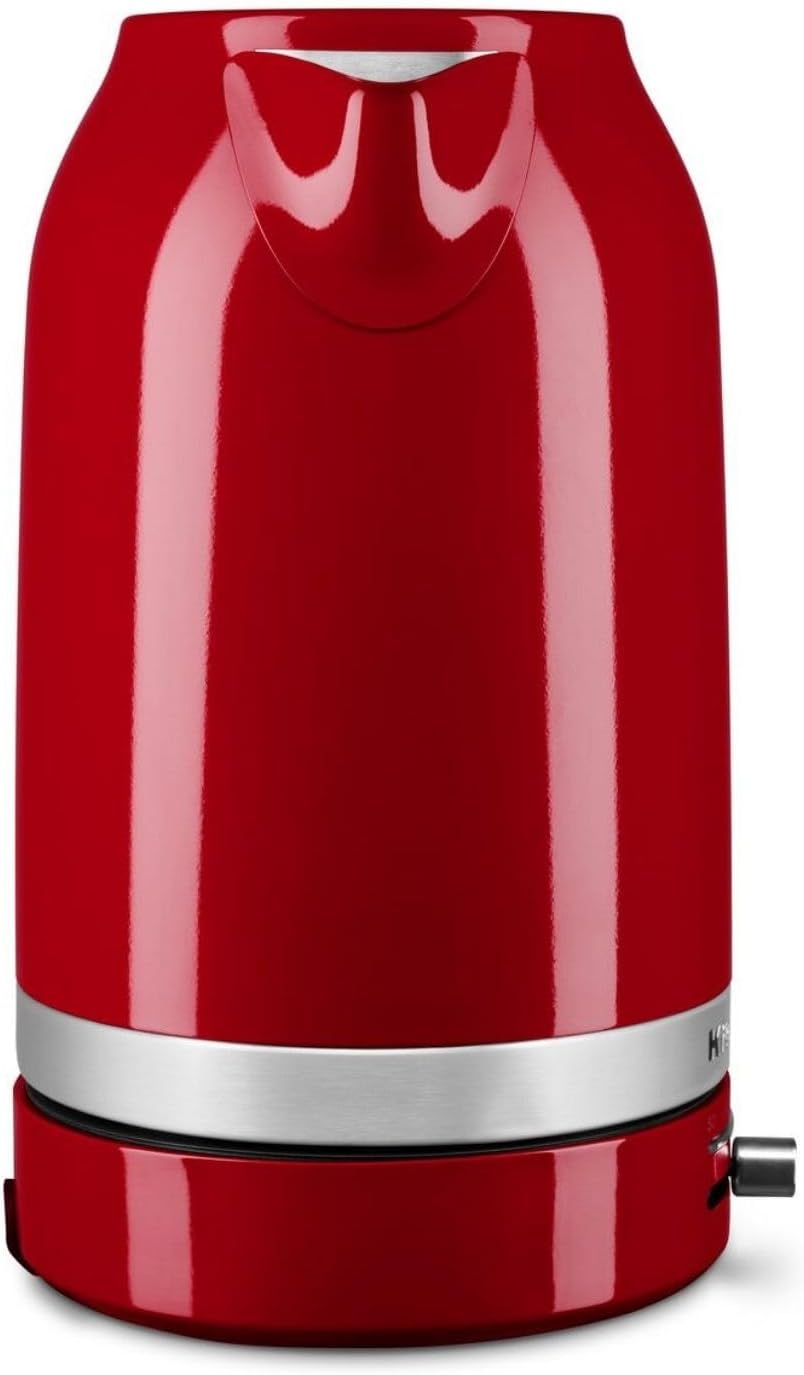
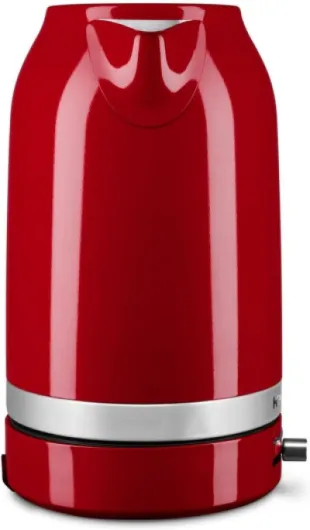
The design is clearly inspired by the classic KitchenAid mixer style: rounded shape, glossy red, and a chunky handle. On the counter, it does look pretty solid and a bit more serious than the usual supermarket kettles. If you already have other KitchenAid stuff, it matches nicely. If you don’t care about matching appliances, it still looks fine and doesn’t scream “cheap plastic”, because it isn’t.
From a practical angle, the shape is quite compact for a 1.7 L kettle. It’s not especially tall, more of a squat shape, which helps with stability. The 360° base works as expected: you can drop the kettle back on from any angle without needing to line it up perfectly. That sounds trivial, but when you’re half asleep making tea in the morning, it’s the kind of thing you notice if it’s bad. Here, it’s smooth – you just place it down and it clicks in.
The controls are basic and easy enough: you choose the temperature in 10°C steps from 50°C to 100°C, then hit the button to start. The buttons are clear, and you don’t have to go through some weird menu. After a couple of uses, you’ll know by heart where your usual temps are (e.g. 80°C for green tea, 90°C for coffee). The downside is that there’s no super fine adjustment, only those 10-degree jumps, but that’s honestly enough for home use.
The spout and lid are well thought-out. The lid opens wide enough to fill directly under the tap without banging your knuckles on the handle. Pouring is controlled, and it doesn’t splash all over the place even when the water is boiling hard. I never had water dribble down the outside like some kettles do. If I had to nitpick, the main annoyance is the weight plus the metal body: if you’re sensitive to heat or have wrist issues, repeatedly lifting it full might feel a bit heavy, especially compared to a lightweight plastic kettle.
Everyday comfort: handling, pouring, and small annoyances
In daily use, the comfort is mostly good, with a couple of things to keep in mind. The handle is thick and feels secure. There’s enough space for a full grip, even with bigger hands, and the angle makes pouring feel natural. When the kettle is full (close to 1.7 L), it is on the heavy side, but the balance is decent, so you’re not fighting it. If you usually only boil enough for 1–2 mugs, the weight isn’t really a problem.
The lid is a simple lift-off metal lid. It fits snugly, doesn’t wobble, and there’s enough clearance around the handle to fill it directly from the tap without smashing your knuckles. That sounds like a small detail, but older kettles I’ve used were annoying here. The mesh filter at the spout is easy to pull out and rinse, which helps if you’re in a hard-water area and get those little white bits. Pouring is controlled: even when it’s boiling strongly, it doesn’t spit water everywhere. That’s a good point if you’re filling smaller cups or a narrow teapot.
One downside of the metal body is that it gets hot. This is normal for a stainless steel kettle, but if you’re used to plastic ones, keep in mind you can’t just grab it anywhere. The handle stays cool enough, but the sides are hot, so if you have kids around, it’s something to consider. Also, because of the weight and heat, someone with weaker wrists or arthritis might find a lightweight plastic kettle more comfortable for everyday use.
For visibility, the water level window is clear enough to read, but it’s not backlit or anything fancy. You need some light in the room to see it properly. It does help avoid overfilling, which saves a bit of energy and time. Overall, as a daily tool, it’s pretty comfortable to use. Not perfect, but nothing that really got in the way of making drinks. The main trade-offs are weight and a hot exterior, which come with the territory of an all-metal kettle.
Materials and build: metal body, decent finish, made in China
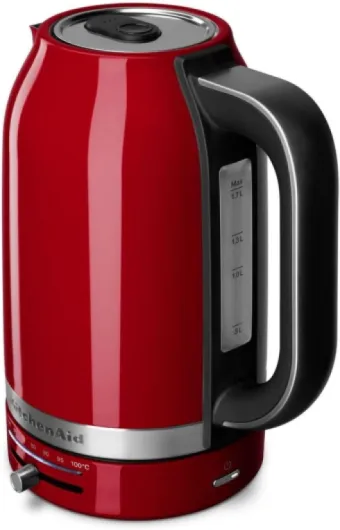
The body is stainless steel, and it feels solid when you grab it. No creaking, no cheap-feeling panels, and the handle is firmly attached. You can tell it’s not a thin tin shell; there’s some heft to it. For hygiene, I prefer stainless steel to plastic inside a kettle, mainly because it doesn’t keep smells and it’s easier to descale properly. After a few weeks, there was the usual limescale starting to appear (my water is hard), but it wiped off easily with vinegar.
Inside, everything that touches water is metal or standard kettle parts. I didn’t notice any plastic taste or smell in the water, even at the beginning. That’s something that drove me mad with my previous cheap kettle – the first few weeks everything tasted like hot plastic. With this KitchenAid, the water tasted neutral from day one, which is what you want. The mesh filter at the spout is also easy to remove and clean, which helps if you have a lot of limescale bits floating around.
The exterior paint (Empire Red) looks well-applied. It’s glossy but not tacky. I wiped it down regularly with a damp cloth, and it didn’t scratch or mark easily. Obviously, if you whack it against something metal, you can chip it, but under normal kitchen use it held up fine. The base feels more plasticky, but that’s normal; that’s where the electrics and the cord live. It still feels solid enough and doesn’t bend when you press on it.
One thing to be aware of: like most kettles in this price range, it’s made in China. So you’re paying mainly for brand, design, and quality control, not some handcrafted European build. Compared to cheaper brands, the difference is in the thickness of the metal, the finish of the handle, and the feel of the lid and buttons. It doesn’t feel luxury, but it does feel like it will last several years if you don’t abuse it. If you want something ultra-light, though, this all-metal construction might feel a bit overkill.
Durability and long-term feel
I obviously haven’t used this kettle for years, but based on the build and how it behaves, it feels like it should handle long-term use better than the really cheap ones. The stainless steel body doesn’t flex, the handle doesn’t creak, and the lid still fits tightly after lots of openings. That’s usually a good sign for how it will age. KitchenAid also has a decent reputation for appliances lasting a while, even if they’re now made in China like most brands.
The parts that usually fail on kettles are the lid mechanism, the base connection, or the switch/thermostat. Here, the lid is simple (no springy flip-top to break), which I actually see as a plus. Fewer moving parts means fewer things to fail. The 360° base connection feels solid when you put the kettle down; it doesn’t feel loose or wobbly. The switch and temperature controls responded consistently during my time with it – no double-pressing, no weird flickering, just on/off as expected.
As for limescale, that’s more about your water than the kettle, but the smooth metal interior makes it easy to descale. A bit of vinegar or descaler, rinse, and it looks fine again. There are no awkward corners inside where gunk builds up. The only thing to watch long term will be the finish on the exterior – if you’re rough with it or slide it around on rough surfaces, you might scratch the paint. During normal use, just wiping it down, I didn’t see any wear.
From what I’ve seen and from the general feedback (Amazon rating around 4.4/5 with a decent number of reviews), it seems to hold up well for most people. I wouldn’t say it’s indestructible, but compared to budget plastic kettles that start leaking or failing after a year or two, this feels like a safer bet. Just don’t expect it to be bulletproof – it’s still an electric appliance with electronics and a heating element inside.
Performance: heats fast and hits the right temperatures
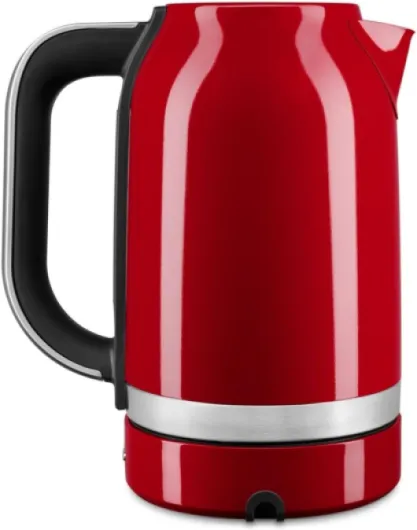
On performance, it does what it says: it boils water quickly and hits the set temperatures reliably. With its 3000W element, it’s on the more powerful side. In my tests, about 1 litre of water went from cold tap to 100°C in roughly 3 minutes, sometimes a bit less depending on starting temperature. That’s comparable to other 3000W kettles I’ve used, so nothing magical, but definitely not slow. For smaller amounts (one or two cups), it’s of course faster.
The big plus here is the variable temperature control from 50°C to 100°C in 10-degree steps. In real life, this is very handy if you drink different types of hot drinks. I used 70–80°C for green tea, 90°C for coffee and some black teas, and 100°C for things like instant noodles. The kettle stops at the chosen temperature and cuts off cleanly – no overshooting where it keeps boiling like crazy. I checked with a basic kitchen thermometer; it was usually within a couple of degrees of the target, which is good enough for home use.
Noise-wise, it’s not quiet. It’s not worse than most metal kettles, but if you’re hoping for a whisper-quiet kettle, this isn’t it. When it’s close to boiling, it’s the usual strong rumble. You can still talk over it, but in a small kitchen, you’ll notice it. There’s no annoying beeping or alarms though, just the standard click when it shuts off. For me, that’s acceptable: it’s a kettle, it makes kettle noises.
The auto shut-off works properly. It cuts off when it reaches the selected temperature and also if you accidentally turn it on with not enough water (though don’t test that too often). I didn’t have any issues with it failing to shut off or needing to be reset. Overall, performance is pretty solid: fast enough, accurate enough, and consistent. It’s not revolutionary, but compared to a basic on/off kettle, the ability to stop at lower temperatures is the main reason to consider it.
What you actually get with this KitchenAid kettle
On paper, the KitchenAid 5KEK1701 is pretty straightforward: a 1.7 L electric kettle with variable temperature control from 50°C to 100°C in 10-degree steps, 3000W heating element, stainless steel body, and a 360° rotating base. It’s cordless when you lift it, obviously, like every normal modern kettle. The one I used is the Empire Red version, which is basically KitchenAid’s classic deep red you see on their mixers.
Capacity-wise, 1.7 L is enough for a family or for making a big pot of tea. In real life, I usually boiled between 0.5 L and 1 L at a time, which gave me 2–4 mugs easily. Compared to the user reviews saying 1.2–1.25 L, I think that’s because there’s also a smaller KitchenAid kettle on the market; this model is the bigger one. If you fill it to max, it’s around 2.2–2.3 kg in the hand, so you feel it, but it’s manageable for most people.
The base is simple: a central contact, a power cord, and the temperature controls and buttons on the kettle body itself. There’s a clear water level window on the side, which is handy so you don’t overfill it and waste energy. In daily use, I ended up checking that window more than I expected, especially when making just one or two cups. You can roughly see minimum/maximum levels without having to lift the lid all the time.
There are no fancy smart features: no app, no Wi‑Fi, no voice assistant nonsense. Just temperature selection, boil, and automatic shut-off. For me, that’s a plus. Less to break, less to update, and no need to pair a kettle with a phone. It’s basically a normal kettle with better controls and a more solid body. If that’s what you’re after, this one fits that role pretty well.
Pros
- Solid stainless steel build with a robust feel and no plastic taste in the water
- Useful variable temperature control from 50°C to 100°C in 10-degree steps
- Fast boiling thanks to the 3000W element and easy, splash-free pouring
Cons
- Heavier and hotter to the touch than a plastic kettle, less ideal for some users
- More expensive than simple on/off kettles, value mainly if you use temp control regularly
Conclusion
Editor's rating
Overall, the KitchenAid 5KEK1701 is a solid variable-temperature kettle that does what it’s supposed to do without overcomplicating things. It heats water fast, hits the chosen temperatures reliably, and feels more robust than the average plastic kettle. The stainless steel body, simple controls, and classic KitchenAid look make it a nice piece of kit if you care about both function and appearance on your kitchen counter.
It’s not perfect, though. It’s heavier than plastic kettles, the metal body gets hot, and the price is clearly higher than basic models. If you only ever boil water to 100°C and don’t drink much tea or coffee that needs specific temperatures, you’re basically paying extra for features you won’t use. In that case, a cheaper kettle will do the job just as well for you.
I’d recommend this kettle to people who: drink a mix of teas and coffees and actually use lower temperatures; prefer metal to plastic for build and taste reasons; and like the KitchenAid style enough to pay a bit more for it. If you’re on a budget, need something super light, or just want the simplest possible kettle, you can skip this and go for a more basic option without feeling like you’re missing out on anything essential.