Summary
Editor's rating
Value: worth the money or overhyped gadget?
Design: looks great on the counter, with a couple of quirks
Daily comfort: nice to use, but watch that hot body and small capacity
Materials and build: solid stainless steel, but hot to the touch
Durability and maintenance: feels solid, but time will tell
Performance: precise, fast enough, but the smart stuff is a bit niche
What this kettle actually is (and what it isn’t)
Pros
- Accurate to-the-degree temperature control with useful presets and 60-minute hold
- Solid stainless steel build with comfortable handle and controlled, wide spout pour
- Quiet operation and handy brew timer for tea and coffee
Cons
- Small 0.9 L capacity means frequent refills for families or heavy use
- Single-wall stainless body gets very hot to the touch
- High price compared to other temperature-control kettles with fewer design frills

Specifications
View full product page →| Brand | Fellow |
A £200+ kettle… seriously worth it or just kitchen jewellery?
I’ve been using the Fellow Corvo EKG Pro Matte Black as my main kettle for a few weeks, and I’ll be honest: I bought it half out of curiosity and half because I was tired of guessing water temperature for coffee and tea. Before this, I had a very basic plastic 1.7L kettle that just boiled water and shut off. It cost a fraction of the price and never connected to WiFi, obviously. So this Fellow kettle had a lot to prove.
The first thing that hit me is how small it is. 0.9 L looks okay on paper, but in practice it’s basically enough for two decent mugs or a French press, and that’s it. If you’re used to filling a big teapot or making drinks for the whole family in one go, you’ll have to do multiple boils. So from day one, it felt more like a coffee/tea nerd tool than a family kettle.
On the other hand, the temperature control and the way it heats are clearly a step up from a cheap kettle. You set the exact temperature you want on the little colour screen, it gets there pretty fast, and it actually holds it. No guessing, no waiting around forever. For pour-over coffee and green tea, that makes a real difference in day-to-day use. It’s not just a gadget; the precision does change how you brew.
But it’s not perfect. The price is high, the body gets hot because it’s not insulated, and a couple of the “smart” features feel a bit overkill once the novelty wears off. So this review is basically: if you’re tempted by this kettle, here’s what it actually feels like to live with it, the good and the annoying, without any marketing sugarcoating.
Value: worth the money or overhyped gadget?
This is where it gets tricky. The Fellow Corvo EKG Pro is clearly on the expensive side for a 0.9 L kettle. You can get a perfectly functional temperature-control kettle from other brands for much less. So you’re paying for a mix of design, build quality, and smart features. The question is whether you’ll actually use and appreciate those things, or if you just need hot water as cheaply as possible.
What you get for the price: precise temperature control, a quiet and relatively fast heat-up, a nice-looking stainless steel and wood build, a good handle, a decent pour, a hold function up to 60 minutes, a brew timer, some smart options like scheduling and altitude adjustment, and WiFi for firmware updates. If you’re into coffee and tea and you brew different types regularly, that combination does make daily use smoother and more consistent. Compared to my old cheap kettle, my coffee and green tea are more repeatable and less guessy.
On the flip side, you’re giving up a few things: capacity (only 0.9 L), insulation (the body gets hot), and a bit of simplicity (more menus and options than a basic kettle). If you live in a shared flat or family house where people just hammer the boil button all day, the extra features might be wasted, and the price will feel hard to justify. There are cheaper temperature-control kettles that don’t look as nice but do 80% of the job.
So in terms of value, I’d say it’s good but not amazing for a specific type of user: someone who cares about brewing, likes nice objects in the kitchen, and is okay paying extra for that mix. If you’re just trying to save money or want maximum capacity, this is not the best deal. If you’re a coffee/tea nerd who actually uses temperature presets and timers and you like clean design, you’ll probably feel you got your money’s worth.
Design: looks great on the counter, with a couple of quirks
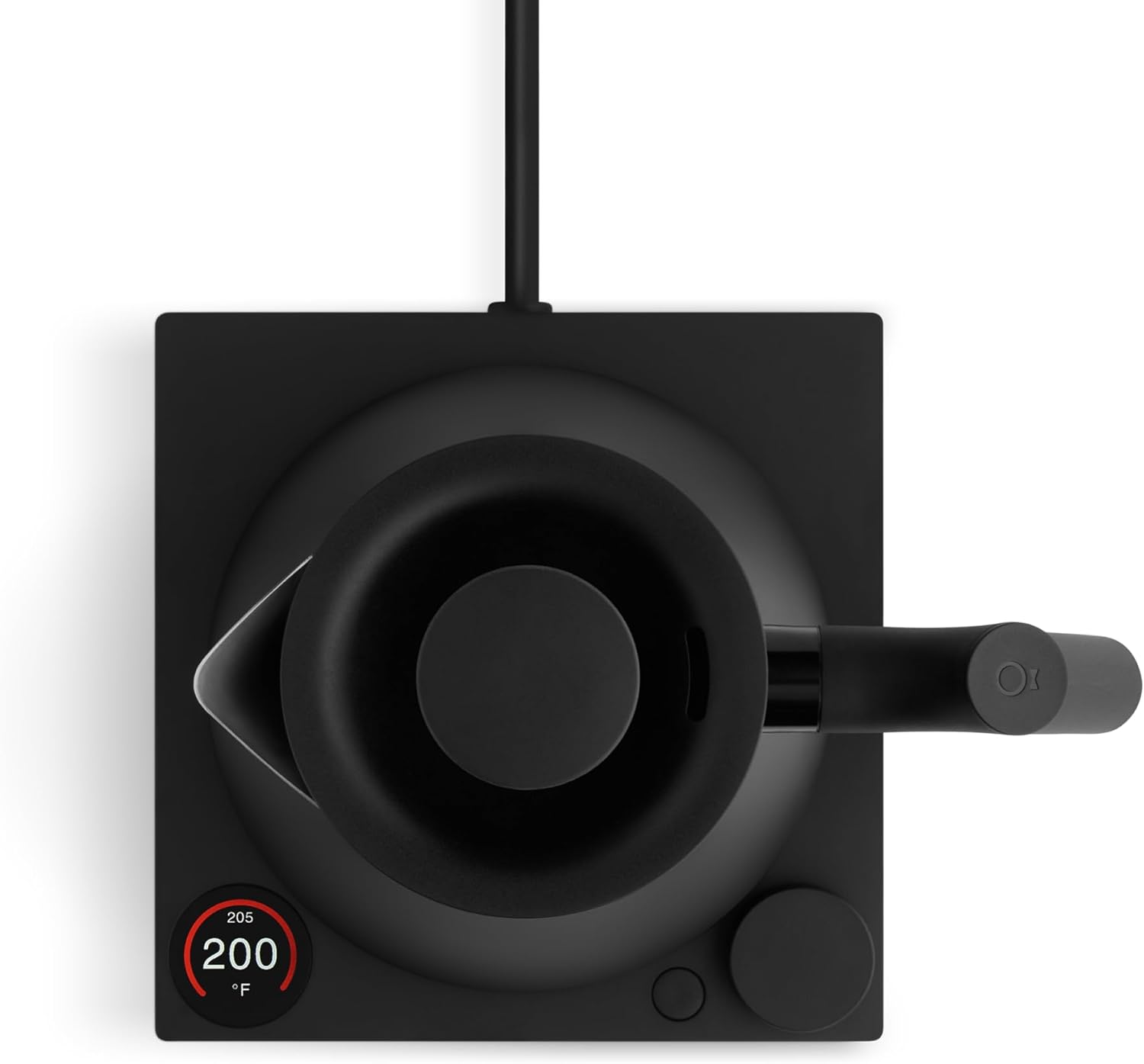
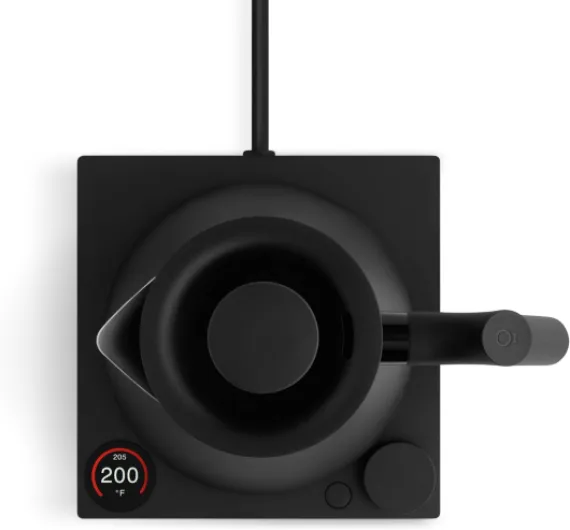
Visually, this thing is clearly designed to sit on a countertop and get noticed. The matte black finish, the clean lines, the simple base with the colour screen – it all feels very modern and minimal. Compared to a regular supermarket kettle, it definitely looks more high-end. When friends came over, several people commented on it without me saying anything, which never happened with my old plastic kettle. So if you care how your kitchen looks, it scores points there.
The handle is one of the better parts of the design. It has a nice angle, feels secure in the hand, and stays cool when pouring. Even when the kettle is full, it’s easy to control the pour, and the wide spout is accurate enough. It’s not as precise as a gooseneck for super slow pour-overs, but for normal coffee and tea, it’s absolutely fine. One thing I noticed: when it’s filled close to the max, the weight is decent but not insane. One Amazon reviewer said it’s a bit heavy for them; personally, I think it’s okay, but if you have weaker wrists, you might feel it.
On the downside, the body is not insulated. That means the metal gets very hot to the touch when it’s near boiling. This is normal for many stainless steel kettles, but at this price I kind of expected some insulation or double-wall design. You quickly learn to only touch the handle and lid pull, but it’s something to know, especially if you have kids around or are used to plastic kettles that don’t get as hot on the outside.
The display is a nice idea, but it’s not perfect. It’s colour, it shows the temperature clearly, and the menu is fairly easy to navigate with the dial. But like one of the reviewers mentioned, the brightness isn’t very strong. In bright daylight or if the kettle is under a strong light, it can be a bit hard to read at a glance. At night or in a dim kitchen it’s fine. Overall, I like the design and it feels thought-out, but it’s not just pure looks – you do have to live with the hot body and the not-so-bright screen.
Daily comfort: nice to use, but watch that hot body and small capacity
Using this kettle every day is mostly pleasant, but there are a few things you notice after the first “new toy” phase. First, the handle and balance: both are good. The handle angle is natural, you don’t feel like you’re fighting the kettle when you pour, and the wooden part stays cool. Even when it’s full, the weight feels centred. I make a lot of pour-over and tea, and I never had issues with wrist strain, but I can see how someone with weaker grip might find it a bit heavy when it’s full, like one reviewer mentioned.
The small 0.9 L capacity is where comfort takes a hit if you’re not the only one using it. For one or two people, it’s fine – you boil once, everyone gets a mug. For more than that, you’re repeating the process. Coming from a 1.7 L kettle, I found myself refilling more often than I expected, especially when cooking (like making pasta and wanting hot water to speed things up). If you’re used to a big family kettle, this feels more like a personal brewer than a household workhorse.
The controls are simple: a knob to set temperature and navigate menus, and a button to start/stop. Once you understand the menu, it’s easy enough. But if you live with people who just want to hit one big “boil” button and don’t care about temperatures, they might find it slightly overcomplicated at first. The not-super-bright screen also doesn’t help if your kitchen is very bright; you sometimes have to lean in a bit to read the numbers clearly.
The biggest comfort downside for me is still the hot exterior. I haven’t burned myself, but I definitely brushed the body once or twice and got a quick reminder to only grab the handle. If you’re careful, it’s fine, and this is common with metal kettles. Still, at this price, a double-wall insulated design would have made it more forgiving. Overall, it’s comfortable to use if you’re the kind of person who cares about how you pour and what temperature you use. If you just want something brainless and safe for everyone to grab, there are simpler and cheaper options.
Materials and build: solid stainless steel, but hot to the touch
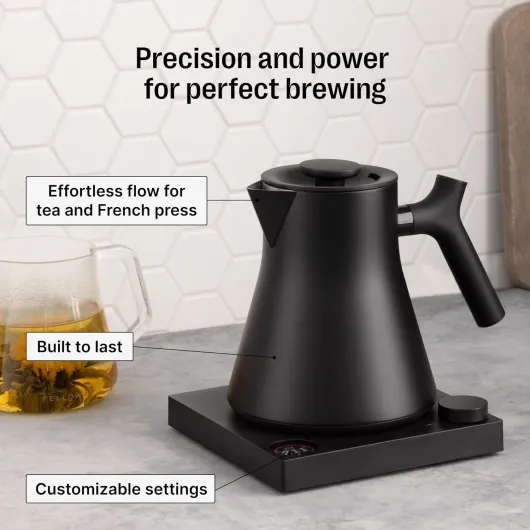
The kettle is made from 304 18/8 stainless steel, which is pretty standard good-quality stainless. It feels solid when you tap it or knock it lightly; there’s no cheap, hollow plastic feel. The base has metal and glass, and the handle and lid pull on this version are walnut wood. The wood touch is nice in the hand and doesn’t heat up. If you hate the idea of your boiling water touching plastic, this model is reassuring – the water chamber is all stainless steel, and multiple reviewers highlight that there’s basically no plastic contact with the water.
The matte black coating looks nice and, so far, seems to hold up well. I haven’t had any chipping or weird marks, even with daily use. Obviously, it’s not dishwasher safe, so you’re just wiping it with a damp cloth and occasionally descaling the inside. Descaling is straightforward – same as any other kettle: a bit of vinegar or descaler, rinse, done. Fellow even mentions that mineral deposits are normal and expected, so nothing surprising there.
One trade-off with this material choice and single-wall design is heat on the outside. The metal gets very hot when the water is near boiling. If you accidentally brush your hand against the body, you’ll feel it. It’s not a design flaw exactly – a lot of stainless kettles are like this – but when you’re paying this much, it’s fair to expect a bit more comfort. An insulated double wall would have made it safer to handle and would probably keep the water hot longer without relying on the hold function.
Overall, the build quality feels pretty solid. Nothing rattles, the lid fits well, the handle is secure, and the base doesn’t feel flimsy. It gives the impression it can last several years if you descale regularly and don’t abuse it. But it’s still made in China like most appliances, so don’t expect some handcrafted miracle. It’s just a well-built stainless steel kettle with nicer finishing touches than average.
Durability and maintenance: feels solid, but time will tell
In terms of durability, I obviously can’t judge five years of use after a few weeks, but I can talk about how it feels and what I’ve noticed. The kettle itself feels sturdy – no loose parts, no wobble on the base, and the lid sits properly without rattling. The stainless steel body and metal/glass base give a more premium feel than typical plastic kettles. It doesn’t creak or flex when you grab it, which is a good sign.
Fellow gives a 2-year limited warranty, which is better than the 1-year you see on a lot of cheaper kettles. That doesn’t guarantee it will last forever, but it does show they’re at least a bit confident in the product. Since it’s all metal inside, there’s no plastic to warp or crack from heat over time, which is something I’ve seen on very cheap kettles. The wood handle and lid pull also feel solid; they don’t feel like they’re going to loosen quickly, as long as you don’t soak them or put the kettle in a dishwasher (which you shouldn’t anyway).
Maintenance is pretty standard: regular descaling to avoid mineral build-up (especially if you have hard water). Fellow even mentions that stains on the bottom from minerals are normal. I did one light descale already, and it cleaned up easily. The removable lid makes it easier to see inside and give it a proper rinse, which is nicer than kettles with tiny openings where you can barely fit a sponge or brush.
The only real long-term worry I’d have is the electronics: the screen, the control board, and the WiFi module. These are the parts that can fail and are harder to repair than a simple on/off switch in a basic kettle. There’s no obvious problem now, but it’s something to keep in mind: you’re buying a relatively complex device compared to a basic jug kettle. If something goes wrong out of warranty, it might not be worth repairing. For now, though, it feels well built and robust enough for daily use.
Performance: precise, fast enough, but the smart stuff is a bit niche
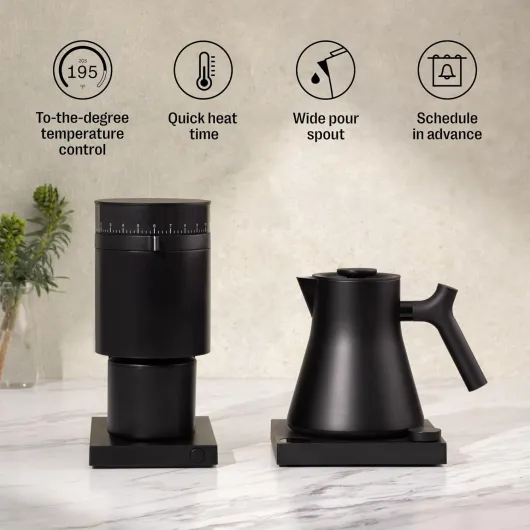
In daily use, the heating performance is good for a 1200 W, 0.9 L kettle. From room temperature to boiling, you’re looking at a few minutes, which is perfectly fine for this size. It’s not dramatically faster than a normal higher-power 1.7 L kettle when you’re only boiling half a litre, but it’s not slow either. Noise level is quite low; you hear it, but it’s more of a soft hum than a harsh boil. Several reviewers mentioned it’s quiet, and I agree – you can easily have a conversation next to it without raising your voice.
The big difference compared to a cheap kettle is the temperature control. You can set, for example, 80°C for green tea, 93–96°C for pour-over coffee, or 100°C for black tea. The preset temperatures in Guide Mode are useful if you’re not sure what to pick; you just select the drink type and it chooses for you. I tested it side by side with a basic thermometer, and the reading was close enough that I trust it. The hold function that keeps water at the set temperature for up to 60 minutes is genuinely handy if you’re making multiple drinks or get distracted.
The brew stopwatch is a small but nice touch. You heat the water, pour it, then tap the button to start timing your steep. For tea and French press, that makes it easier to be consistent. Is it life-changing? No. But once you get used to it, you start using it without thinking. The altitude adjustment is more niche – unless you live at high altitude where water boils at lower temperatures, you’ll probably never touch that setting.
As for the WiFi and firmware updates: this is where it feels a bit gimmicky. Yes, it’s nice in theory that the kettle can get new features, but in practice you set it up once, maybe play with the app, and then just use the kettle from the base as usual. It’s not like a smart speaker or something you interact with constantly. So performance-wise, what really matters is: it heats reliably, the temperature is accurate, the pour is controlled, and it’s quiet. On those fronts, it does the job well.
What this kettle actually is (and what it isn’t)
The Fellow Corvo EKG Pro is a 0.9 L electric kettle with precise temperature control from about 135°F to 212°F (roughly 57–100°C), 1200 W heating, and a small full-colour LCD screen on the base. It’s the “Corvo” version, so it has a wider spout instead of the long gooseneck you see on their pour-over models. So it’s meant more as a general-purpose hot water kettle for tea, coffee, and cooking, not just slow pour-overs.
The core features are pretty clear: you can set the exact temperature you want, it heats relatively fast, and it can hold the temperature for up to about an hour. There’s also a built-in brew timer (stopwatch) you can start once the water is ready, which is handy for timing tea steeps or French press. On top of that, you get some more niche stuff: WiFi updates via an app, altitude adjustment, scheduling boils, and a bunch of options in the settings menu (units, chimes on/off, hold mode behaviour, etc.).
Important detail: this UK version runs on 230V and has a capacity of 0.9 L. That’s smaller than most standard electric kettles. In daily use, I usually get two big mugs of tea or one French press plus a bit leftover. If I try to fill a big teapot or cook with a lot of hot water, I have to refill and reboil. So it’s more suited for one or two people who care about brewing properly than a large household that just wants endless boiling water.
In short, if you just want something that boils water as cheap as possible, this is overkill. If you often brew different teas and coffee and you like control, it starts to make sense. The kettle does what it says in terms of precision and control, but you need to be the kind of person who will actually use those features. Otherwise you’re basically paying a premium for a fancy-looking small kettle that still just boils water.
Pros
- Accurate to-the-degree temperature control with useful presets and 60-minute hold
- Solid stainless steel build with comfortable handle and controlled, wide spout pour
- Quiet operation and handy brew timer for tea and coffee
Cons
- Small 0.9 L capacity means frequent refills for families or heavy use
- Single-wall stainless body gets very hot to the touch
- High price compared to other temperature-control kettles with fewer design frills
Conclusion
Editor's rating
After using the Fellow Corvo EKG Pro for a while, my overall feeling is that it’s a pretty solid premium kettle aimed at people who care about how they brew, not just how fast they can make a cup of tea. The precise temperature control, quiet operation, and 60-minute hold function are genuinely useful if you drink different types of tea and coffee and want consistency. The build feels sturdy, the handle is comfortable, and the pour is controlled enough for pour-over and French press. On the counter, it looks good and doesn’t feel like a cheap appliance.
It’s not perfect, though. The 0.9 L capacity is small if you’re used to a standard 1.7 L kettle, and the uninsulated stainless steel body gets very hot to the touch. The display could be brighter, and some of the smart features (WiFi, firmware updates, altitude settings) feel a bit niche once the initial excitement passes. You’re paying a clear premium for design and extra features, and there are cheaper kettles that will boil water and even control temperature without all the extras.
I’d recommend this kettle to: people who brew a lot of speciality coffee or tea, live in smaller households (one or two people), and genuinely care about temperature and consistency. If you’re the kind of person who already owns a decent grinder and a pour-over setup or a French press, this fits nicely into that routine. If you just want a big, straightforward kettle for the family that boils water as fast and cheap as possible, you can safely skip this and save your money.