Summary
Editor's rating
Is it worth the money once you add filters and hassle?
Compact enough, but still another box on the counter
Unboxing and setup: straightforward but not fancy
Build quality and how it holds up with constant use
Speed, temperature, and noise in real life use
What this machine actually does (and doesn’t do)
Does it actually make feeding easier (or is it a gimmick)?
Pros
- Consistently warm bottles in about 90 seconds to 2 minutes, much quicker and easier than the kettle method
- Antibacterial filter and hot shot process give good peace of mind about water and formula safety
- Night-feed friendly with soft lights, simple controls, and relatively quiet operation
Cons
- Ongoing cost of replacement filters every couple of months
- Takes up counter space and still requires regular cleaning and descaling
- Doesn’t automate powder dispensing or remote start, so it’s not a fully smart machine

Specifications
View full product page →| Brand | Tommee Tippee |
Formula feeds without the kettle dance
I’ve been using the Tommee Tippee Perfect Prep Machine for a few weeks now with an infant who eats like it’s a competitive sport. Before this, I was doing the classic kettle method: boil, wait, top up with cooled boiled water, shake, test, adjust. It works, but at 3 a.m. with a screaming baby, it feels like it takes an hour. I bought this machine mainly to see if it actually cuts the stress, or if it’s just another bulky baby gadget taking up counter space.
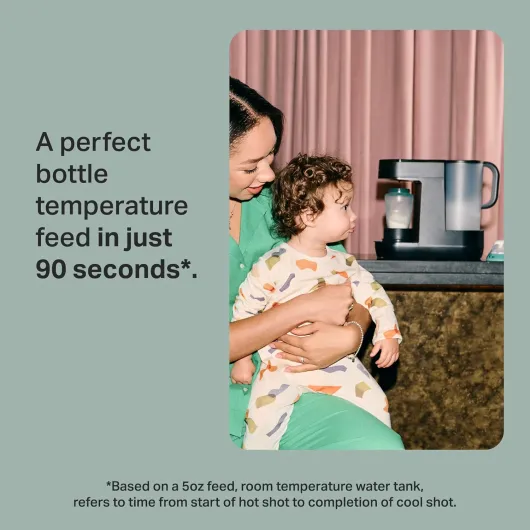
In practice, the main thing this machine offers is speed and consistency. You press a button, it gives a hot shot to kill bacteria, you shake, then it tops up with cooler filtered water to roughly body temperature. From cold start to bottle ready, it’s around a minute and a half to two minutes depending on faffing with scoops and lids. That’s definitely quicker and more predictable than messing about with kettles and cold water jugs.
It’s not perfect. You have to buy specific antibacterial filters, you need to keep on top of cleaning cycles, and it’s not totally silent despite the marketing. Also, it’s another thing on the worktop that needs plugging in, so if you already have a small kitchen, you’ll notice it. But compared to my old routine of guessing water temperature and baby screaming while I cool the bottle under the tap, it’s a clear improvement in day-to-day use.
So this review is basically: does it really make feeds easier, is it safe enough to trust, and is it worth the money versus just using a kettle and a bit of planning? I’ll go through how it’s built, what it’s like at 3 a.m., how annoying the filters really are, and where it actually saves time versus where the brand is maybe overselling it a bit. I’m not sponsored, I paid for it, and if it was just an expensive kettle replacement I’d say so.
Is it worth the money once you add filters and hassle?
On the money side, this isn’t the cheapest baby gadget, but it’s also not in the crazy price bracket of some fully automatic formula machines. You pay once for the unit, then you’re on the hook for filters roughly every two months if you use it regularly. Those filters are not dirt cheap, but they do last a fair while and the water quality is noticeably good – tastes clean, no odd smell, and I feel fine using it for the baby’s bottles. Compared to buying bottled water or messing about with separate jugs and kettles, it’s a cleaner, more straightforward setup.
Value really depends on how often you’re using it. If you’re doing formula feeds multiple times a day, especially through the night, the time and hassle it saves start to feel worth the cost. The stress reduction at 3 a.m. alone has value in my book. If you’re only using formula occasionally, or as a backup to breastfeeding, then it’s harder to justify the price and the ongoing filters. In that case, the kettle method is probably fine and costs you nothing extra.
Compared to just using a kettle, you’re basically paying for convenience and consistency. The machine doesn’t make your baby less hungry or magically stretch out feeds, but it does get you from zero to ready bottle faster and with less brain power. For tired parents, that’s not nothing. It also means both parents or carers can follow the same simple process without arguing over which way is “right”, which, let’s be honest, happens.
So in my opinion, the value is good but not mind-blowing. It’s worth it if formula is a big part of your routine and you can afford the upfront cost plus filters. If money is tight, I’d say stick to the kettle and maybe invest in a good flask or jug system instead. The Perfect Prep is one of those “nice to have that becomes very handy” products rather than an absolute essential, but once you get used to it, going back to the old way feels like a step backwards.
Compact enough, but still another box on the counter
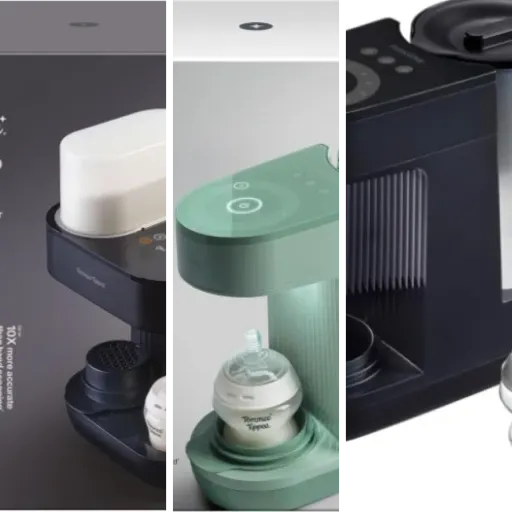
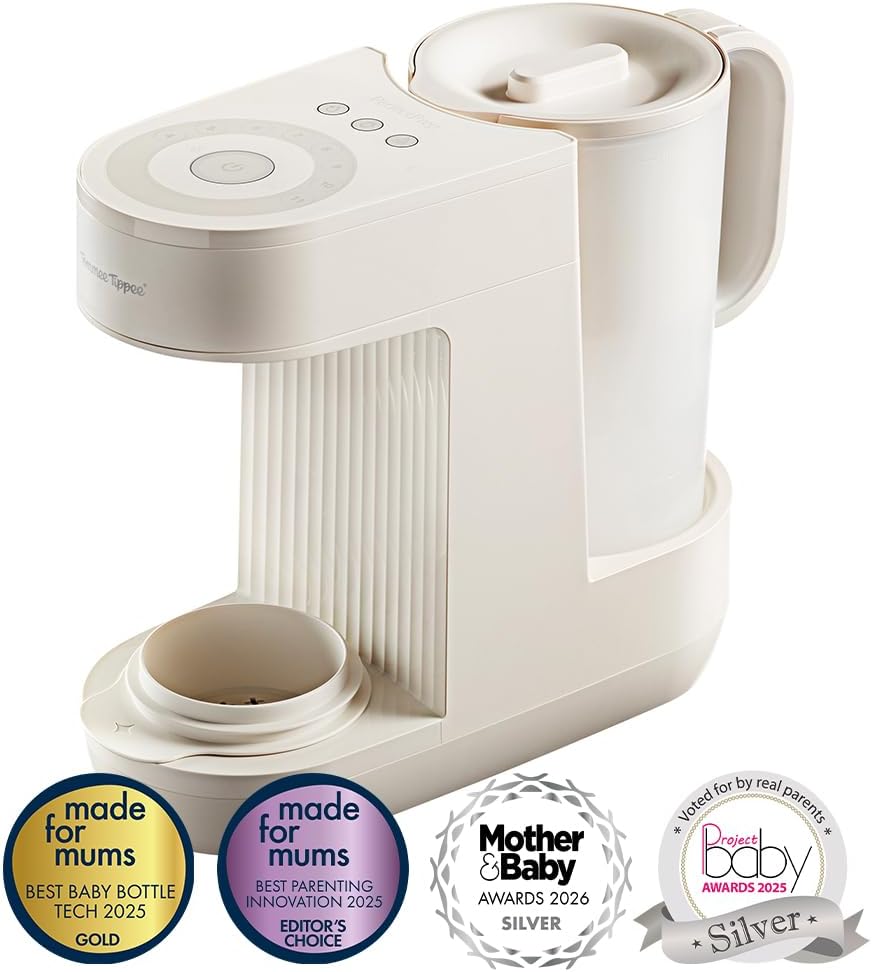
Design-wise, the Perfect Prep is pretty straightforward. It’s a white plastic box, about 15.8 cm wide, 26 cm high, and 33 cm deep. So it’s not tiny, but it’s slimmer than a lot of coffee machines and it does sit fairly neatly against the wall. I’ve had it on a standard kitchen counter without it feeling like it’s taking over the whole space, but if your kitchen is already crowded, you’ll notice the extra footprint. The look is simple – it blends in with other white appliances, nothing fancy, nothing ugly either.
The front has a small display, a dial to choose the feed size, and a single main button to start the process. It’s easy to understand without reading the manual for hours, which I appreciated when I was half-asleep. There’s a removable stand/plate that lets you adjust the height so different bottle sizes fit under the spout without splashing everywhere. I’ve tried standard bottles and slightly wider ones, and they all fit with a bit of tweaking.
For night feeds, the soft glow lights are actually useful. They give enough light to see what you’re doing without lighting up the whole room like a football stadium. The dispensing is quieter than a kettle boiling, but don’t expect total silence – there’s still a clear motor/pump noise. In the middle of the night it’s noticeable, but it’s not outrageous. If you’re in a tiny flat with thin walls, you’ll probably still hear it in the bedroom, though.
The water jug being removable is a small but handy touch. You can fill it from the tap without dragging the whole unit to the sink, and you can technically use it as a filtered water jug for yourself too. That said, it lives in the machine 99% of the time for me. Overall, the design is practical rather than pretty. It’s clearly built for parents who just want something simple that works, not a showroom gadget. I’d call it functional and decent, not stylish, but that’s fine for what it is.
Unboxing and setup: straightforward but not fancy
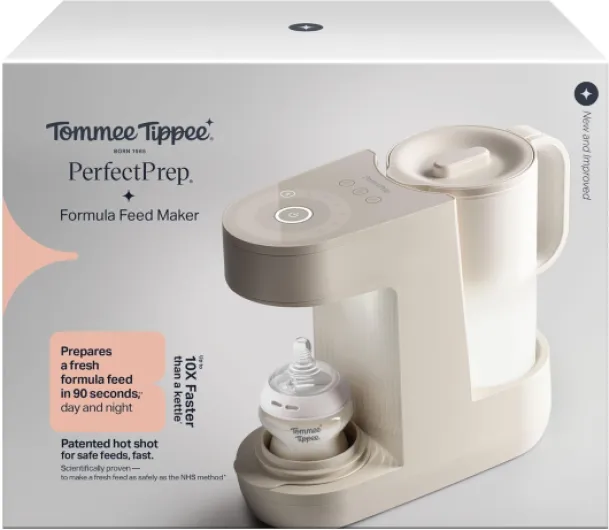
The packaging is pretty standard for a baby appliance. You get a branded cardboard box with the machine well protected inside using cardboard inserts and some plastic wrapping. Nothing premium, nothing cheap – it just does the job of getting it to you in one piece. There isn’t a ton of unnecessary padding, which I appreciate, but it’s still a decent amount of packaging you’ll be breaking down and binning or recycling after.
Inside the box, you get the machine, the removable water jug, a milk storage lid, and the usual paperwork. The instructions are clear enough, and the app basically walks you through the same steps with videos. Setup involves flushing the system, prepping the filter (ideally soaking it in water first to avoid black bits and slow flow), and running a cleaning cycle. It’s not instant, but it’s a one-time job that took me maybe 20–30 minutes while I was doing other things in the kitchen.
One thing I liked is that they don’t drown you in random leaflets and marketing junk. It’s mainly the manual and a quick start guide, plus a nudge to download the app. The app itself is actually useful – it gives you step-by-step guides with visuals, and later on it reminds you about cleaning and filter changes. For tired parents, not having to dig out the paper manual every time is a plus.
Overall, the packaging and setup experience is practical and simple. It doesn’t feel premium or special, but it also doesn’t feel cheap or confusing. You open it, follow the steps, and you’re up and running without much drama. For something that’s aimed at new parents who already have a lot going on, that’s exactly what you want. No nonsense, just enough guidance to get started without feeling like you’re assembling a spaceship.
Build quality and how it holds up with constant use
The machine is mostly plastic, so don’t expect some heavy, premium metal build. That said, the plastic doesn’t feel flimsy. The buttons have a decent click, the dial turns smoothly, and the removable jug and bottle stand slot in firmly without wobbling. After a few weeks of daily use, nothing feels loose or creaky. I’ve wiped it down plenty of times, and the finish hasn’t scratched or discoloured yet, even with formula splashes here and there.
The part that will clearly need ongoing spending is the antibacterial filter. Realistically, you’re changing it around every two months if you’re using the machine regularly. That’s not a durability issue in the sense of the machine breaking, but it does mean the running cost is built into owning this thing. The filters themselves seem solid – they don’t fall apart or leak charcoal if you prep them properly by soaking. If you skip that step, you’ll probably complain about black bits or slow flow, but that’s more user error than poor quality.
Internally, I obviously haven’t taken it apart, but from use there’s been no sign of leaks or weird drips around the spout or inside the housing. The only time I’ve seen any water where it shouldn’t be is when I didn’t seat the bottle properly and it splashed – that’s on me, not the machine. The pump still sounds the same as day one: no grinding, no changes in volume, no rattling. For something that’s used multiple times a day, that’s a good sign, even in the short term.
Long term, I’d say as long as you stick to the cleaning and descaling routine, this feels like it will last a full baby cycle (or more) without drama. It’s not some tank-like piece of equipment, but it’s not cheap junk either. If you’re hoping to use it for more than one child over several years, I don’t see an obvious reason it wouldn’t manage that, assuming you look after it a bit. So durability feels decent for the price point, with the caveat that filters are a recurring cost you just have to accept.
Speed, temperature, and noise in real life use
In daily use, the big question is: how fast and how consistent is it really? For me, from pressing the button to a ready-to-feed bottle, it’s around 90 seconds to 2 minutes, depending on how fast I scoop and swirl. That’s clearly faster than the kettle method where you have to wait for it to boil, then cool, then guess the right mix of hot and cold. With this, the temperature has been very consistent – warm but not hot, basically body temperature. I still spot-check on my wrist out of habit, but I haven’t had a single bottle that felt too hot.
The hot shot feature is the key part: it blasts in a small amount of very hot water first, meant to kill bacteria in the powder. Then you swirl or shake to dissolve it properly. After that, the machine tops it up with cooler filtered water. The volumes have been accurate for me – if I set it to 7oz, the bottle ends up on the 7oz line every time. No obvious underfilling or overfilling. That reliability is honestly what I like most; I don’t have to think about it, I just pick the number and go.
Noise-wise, it’s quieter than a kettle but not silent. There’s a pump sound when it dispenses, like a small water cooler. At 3 a.m., you hear it, but my baby doesn’t care and it doesn’t wake anyone else in the house. The machine itself boots up quickly; I haven’t had any weird lag or errors. The only slowdown is when you’ve just changed the filter and not soaked it properly – then the flow can be slower at first, so pre-soaking the filter in a jug of water for a while is worth doing.
In terms of reliability, after regular use I haven’t had misfires, leaks, or random alarms. It just does the same cycle each time. You do need to keep up with descaling and cleaning as they recommend, especially if you have hard water. If you ignore that, I can see it clogging or slowing down over time. But used properly, I’d say the performance is pretty solid and honestly the main reason I keep using it rather than going back to the kettle.
What this machine actually does (and doesn’t do)
Functionally, the Tommee Tippee Perfect Prep Machine is a dedicated formula bottle maker. You still have to scoop the formula yourself, so it’s not like those high-end machines that dispense powder too. The process is: put a sterilised bottle under the spout, add the powder, choose feed size (4–11oz) with the dial, press the button. It gives a short hot shot of water, you swirl or shake to dissolve the powder, then press again and it tops up with cooler filtered water to get you to the volume you picked at roughly body temperature.
It uses an antibacterial filter that’s meant to be as effective as boiling water, and the hot shot is there to kill bacteria in the formula powder itself. This is basically their way of automating the NHS method but faster. You still need to change filters roughly every couple of months (depending on use), and the machine warns you when it’s getting close. The app is more of a support tool than anything smart – setup guides, cleaning reminders, filter re-order prompts – but it’s handy if you tend to forget maintenance stuff.
Important point: it’s not a full-on smart appliance. You can’t start a bottle from your phone, it doesn’t weigh powder, and it doesn’t track feeds. The Bluetooth connection is mostly there for setup and support, not remote control. If you expect a Nespresso-style automated bottle at the touch of a button with powder included, that’s not this machine. It’s more like a very specific hot-and-cold water dispenser calibrated for formula.
Overall, the machine gets the job done for what it’s supposed to do: give you a consistent temperature bottle quickly, with filtered water, without having to think too much. But you’re still involved in the process: scooping, shaking, and cleaning. If you go in expecting a magic robot nanny, you’ll be disappointed. If you just want to ditch the kettle and guessing game, it fits that role pretty well.
Does it actually make feeding easier (or is it a gimmick)?
For me, the main test was simple: does this actually make life easier when the baby is yelling? And honestly, yes, it does. Instead of trying to remember when I boiled the kettle, or whether the water is cool enough yet, I just scoop, press, swirl, press. That mental load drop is a big deal when you’re sleep deprived. Bottles come out at a consistent temperature, and I’m not running back and forth to the tap trying to cool something that’s too hot.
In terms of safety, the combo of the antibacterial filter and the hot shot gives me more confidence than what I was doing before, which was basically a rough version of the NHS method with a lot more guesswork. I’m not a scientist, but knowing it’s designed around that method and tested to match it is reassuring. The app also helps here, with reminders for cleaning and filter changes, so you’re less likely to forget and end up using it in a sketchy state.
Where it’s less effective is if you’re someone who already batch-preps bottles for the day and stores them in the fridge. If that’s your routine and it works, this machine doesn’t suddenly make that obsolete. It’s more useful for people who prefer fresh bottles on demand. Also, if you’re mixed feeding or only doing one or two formula feeds a day, the cost and the counter space might not feel justified. The machine really shines if you’re using it several times a day, including nights.
Overall, I’d say it’s not magic, but it’s genuinely practical. It cuts down on waiting time, guesswork, and faff. It doesn’t remove all effort – you still have to scoop powder, clean bottles, and maintain the unit – but it smooths out the roughest part of formula feeding, especially overnight. If you’re expecting it to do absolutely everything for you, you’ll be underwhelmed. If you just want reliable, quick bottles at a safe temperature, it does that job well.
Pros
- Consistently warm bottles in about 90 seconds to 2 minutes, much quicker and easier than the kettle method
- Antibacterial filter and hot shot process give good peace of mind about water and formula safety
- Night-feed friendly with soft lights, simple controls, and relatively quiet operation
Cons
- Ongoing cost of replacement filters every couple of months
- Takes up counter space and still requires regular cleaning and descaling
- Doesn’t automate powder dispensing or remote start, so it’s not a fully smart machine
Conclusion
Editor's rating
After using the Tommee Tippee Perfect Prep Machine regularly, my view is pretty clear: it’s very handy if you’re doing a lot of formula feeds, especially at night, but it’s not some miracle device. It speeds up bottle prep, keeps the temperature consistent, and takes a lot of the guesswork and faff out of the process. The antibacterial filter plus hot shot combo gives decent peace of mind on the safety side, and the app support makes setup and maintenance easier than reading through a thick manual. The design is compact enough for most kitchens, the soft lights are genuinely useful at 3 a.m., and the noise level is acceptable.
On the flip side, you’re committing to ongoing filter costs and a bit of cleaning and descaling. It also still needs you to scoop the powder and handle the bottle, so if you’re expecting full automation, you’ll be disappointed. If you’re mostly breastfeeding or only using formula occasionally, I’d say this is overkill and your kettle is fine. But if formula is your main feeding method and you can afford the machine plus filters, it’s a solid, practical upgrade to your routine. For me, the reduced stress during night feeds and the consistent results make it worth it, even if it’s not perfect.