Summary
Editor's rating
Value for money: you’re paying a design premium
Design: looks great, shows every fingerprint
Daily use: pouring, handling, cleaning
Materials and build: mostly metal, feels solid
Durability and reliability: solid feel, but some doubts
Performance: quiet, fast enough, and the temps are useful
What you actually get with this kettle
Pros
- Very clean, all-metal design that looks good on the counter
- Quiet boiling with double-wall construction and cooler exterior
- Useful temperature settings (40–100°C) with simple LED indicator system
Cons
- High price compared to other variable-temperature kettles
- Polished stainless shows fingerprints and marks easily
- Amazon rating and some reviews raise questions about long-term reliability

Specifications
View full product page →| Brand | aarke |
A £200 kettle… seriously?
I’ve been using the Aarke stainless steel kettle for a few weeks now, and I’ll be honest: I bought it mainly because I was sick of ugly plastic kettles on the counter. This one clearly plays in the “design object” category, and the price reflects that. It’s not cheap at all for something that just boils water, so I went in pretty skeptical. If I’m paying this much, I want more than just a pretty shell.
Day to day, I use a kettle a lot: coffee in the morning with a specific water temperature, green tea during the day, boiling water for instant noodles at night when I’m lazy. So the multiple temperature settings were a key selling point for me. I also wanted something quieter and with less plastic in contact with the water, because my last kettle ended up smelling a bit like burnt plastic after a year.
In practice, this Aarke kettle is a mix of very good things and a few annoyances. It’s clearly built with care, feels solid in the hand, and looks good on the counter. But it’s still a kettle: it doesn’t magically make water boil faster than physics allow, and at this price I pay attention to every small downside. I also checked other user reviews before and during my test, and I can see why the overall rating sits around 3.8/5 and not 5/5.
If you’re wondering whether it’s just an overpriced design toy or a genuinely practical kettle, I’d say it’s somewhere in between. It works well and feels premium, but you’re paying a hefty design tax. The rest of this review goes through the main points: design, materials, performance, usability, durability signs so far, and whether I think it’s worth the money for most people.
Value for money: you’re paying a design premium
Let’s talk about the elephant in the room: the price. Around £200 (or similar in euros) for a kettle is a lot, no way around it. You can find variable-temperature kettles from big brands for a fraction of that, often in the £40–£80 range. Those won’t look as nice, they’ll use more plastic, and they may be noisier, but they will still boil water and give you temperature control. So in terms of pure function per pound, the Aarke is not a bargain at all.
What you’re paying for here is mainly the design, the heavy use of stainless steel, the double-wall construction, and the overall feel. If you care a lot about how your kitchen looks and you want appliances that match a certain aesthetic, then this kettle fits that niche. It’s like buying a designer lamp instead of a basic one from the supermarket: both give you light, but one looks nicer and costs more. Whether that makes sense for you depends on your budget and priorities.
For me personally, I’d rate the value as average. I like the kettle, I enjoy using it, and I appreciate the quieter boiling and the all-metal look. But I’m also aware that I paid a premium that doesn’t really show up in the actual drink in my cup. The tea doesn’t magically taste better just because the kettle is polished steel. If money is tight, I’d say skip this and get a decent mid-range temperature-control kettle; you’ll get 80% of the function for 30–40% of the price.
If you’re comfortable spending more for design and you want a kettle that feels more like a long-term object than a disposable appliance, then the price might be acceptable. Just go in knowing that you’re buying a stylish, solid kettle, not a miracle device. The Amazon score of 3.8/5 also hints that at this price, some people expected more. So I’d say it’s good, but the value is very dependent on how much you care about looks and materials.

Design: looks great, shows every fingerprint
The design is clearly the main selling point. It’s very minimal: a clean cylinder with a spout, a straight handle, no big plastic windows or huge logos. On my counter, it looks more like a piece of hi-fi gear than a kettle. If you’re into that Scandinavian, clean kitchen style, this fits right in. Compared to the usual bulky plastic kettles, this one definitely feels more grown-up. I honestly bought it partly as a decor item, which sounds stupid for a kettle, but there you go.
The flip side of the polished stainless finish is that it’s a fingerprint magnet. After a couple of days of normal use, you see smudges where you grab it, especially around the lid and handle area. You can wipe it with a microfiber cloth and it comes back to looking nice, but you have to accept that if you’re picky about marks. My old matte plastic kettle looked cheaper, but it didn’t show every touch like this one does.
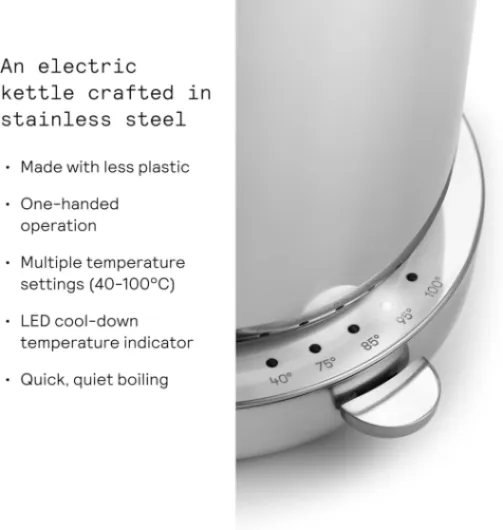
I like that the base matches the kettle body, also in polished steel, instead of the usual black plastic puck. The round base with a single metal button and small white LEDs looks discreet. When it’s on the table or counter, it doesn’t scream “appliance”, it just blends in. There’s minimal visible plastic, mostly hidden under the base or around the rear hinge of the lid. People who hate seeing plastic in their kitchen will appreciate that.
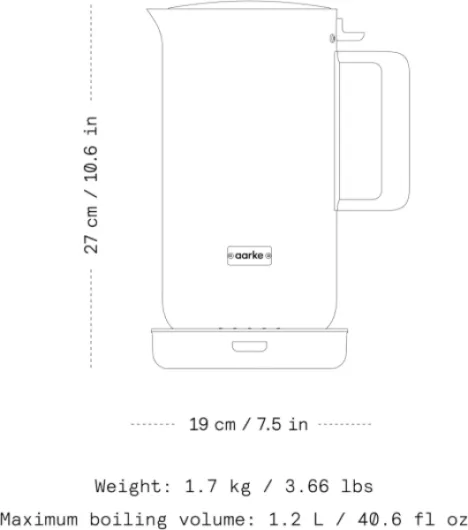
In terms of size and proportions, it’s compact and doesn’t take too much counter depth. The 1.2 L capacity keeps it fairly slim. It looks balanced, doesn’t wobble on the base, and the 360° swivel means you can place it in any orientation. Overall, design is a strong point, but you have to be okay with a shiny surface that constantly needs wiping if you want it to look as good as in the product photos.
Daily use: pouring, handling, cleaning
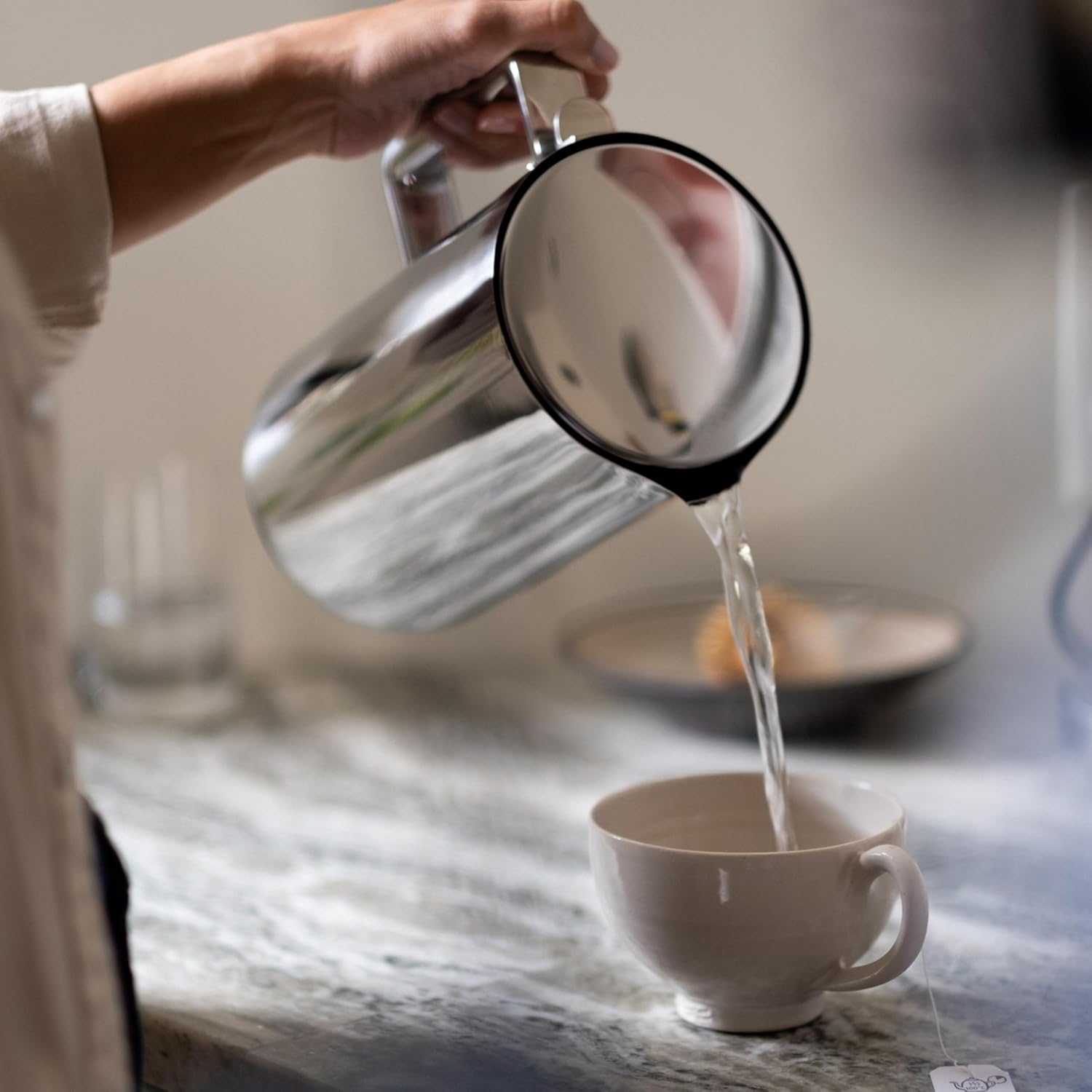
Using it every day, the first thing I noticed is the handle and balance. Even when it’s full, it feels stable and well-balanced. The handle is thick enough to grip firmly, and because it doesn’t heat up too much, you never have that “do I need a towel for this?” moment. The kettle slots easily onto the 360° base; you don’t really have to look, it just finds its place. That sounds minor, but on busy mornings it matters more than you think.
The spout is advertised as non-drip, and I’d say it’s pretty good. When you pour at a normal angle, the flow is smooth and controlled. I haven’t had water running down the side of the kettle or splashing everywhere, which happened often with my previous one. If you try to pour super slowly at a weird angle, you can still get a small drip, but for normal use it’s clean. For tea and coffee, it’s accurate enough that you can fill cups without spilling on the saucer.
Cleaning is relatively easy thanks to the wide opening and seamless inner surface. You can get a sponge inside without fighting the edges, and there are no weird corners full of scale. There is a removable limescale filter at the spout in 100% stainless steel, which you can pop out and rinse. In a hard water area, you’ll still get scale over time, but at least it’s easy to see and scrub. The outside, on the other hand, will need regular wiping to deal with fingerprints and water spots, especially if you have hard water that leaves marks.
From a usability point of view, the single-button temperature control is simple, but not perfect. You need to cycle through the temperatures each time, which is fine but can be a bit annoying if you always use the same setting and overshoot it. There’s no dedicated “boil” button; you just keep pressing until you reach 100°C. Still, once you get used to the pattern of LEDs, it becomes second nature. Overall, comfort in daily use is good, with small quirks but nothing that ruins the experience.
Materials and build: mostly metal, feels solid
One of the reasons I went for this kettle is the heavy use of stainless steel. My previous kettles had a lot of plastic, including inside, and after a while they picked up weird smells and discoloration. Here, the visible parts are basically all metal: polished stainless on the outside, brushed stainless on the inside. The filter at the spout is metal mesh, not a flimsy plastic frame. You can see screws and a more “engineered” assembly when you look closely, which I actually like because it feels more repairable than a fully glued plastic shell.
The double-wall construction is a nice touch. The outer wall stays much cooler than a standard single-wall metal kettle. It’s not ice cold, but you can touch it without burning yourself, which is reassuring if you have kids around or if you’re clumsy like me. The inner wall is the one in contact with water and is also stainless. There’s a silicone seal around the lid that feels thick and well-fitted. I didn’t notice any plastic smell from the first use, which is something I’ve had with cheaper kettles.
The handle is metal too, but it’s mounted on insulated pads so it doesn’t heat up too much. After boiling to 100°C, the handle is still safe to grab without thinking about it. The lid mechanism has a bit of plastic around the hinge, but this part doesn’t touch the water and is barely visible when closed. So if you’re trying to minimize plastic in contact with hot water, this kettle does a decent job. It’s not 100% plastic-free, but it’s far better than most mainstream kettles.
In the hand, the kettle feels heavy in a good way. At 1660 grams empty, plus water, it has some weight, but not to the point of being annoying. It just doesn’t feel hollow or flimsy. I can see why some people say it feels premium. That said, there is at least one negative review mentioning reliability issues, so solid materials don’t automatically mean perfect long-term performance. But so far, from a materials and build perspective, it feels like a high-quality object, not a disposable appliance.
Durability and reliability: solid feel, but some doubts
I haven’t owned this kettle for years, so I can’t pretend to know exactly how it will age, but I can give some early impressions and what I’ve seen from other users. After a few weeks of daily use, there are no functional problems: it heats properly, shuts off correctly, and the lid mechanism still feels tight. No weird noises, no rattling, no loosening of the handle. The metal surfaces haven’t discoloured, and the inside still looks clean apart from the usual bit of limescale starting to appear.
The overall construction feels robust. The base doesn’t flex, the kettle body doesn’t feel thin, and the hinge on the lid doesn’t wobble. Compared to cheaper kettles I’ve had where the lid started to misalign or the base connection became sloppy within a year, this one gives a better first impression. The fact that many parts are screwed rather than clipped might help if it ever needs repair, but that’s speculation until something actually breaks.
However, the Amazon rating of around 3.8/5 shows that not everyone is fully happy. There’s at least one one-star review mentioning reliability issues, which is something to keep in mind at this price. When you pay this much, you kind of expect bulletproof reliability, and it doesn’t seem to be perfect on that front. Also, polished stainless will inevitably pick up micro-scratches over time, especially if you wipe it a lot. So visually it might lose some of its shine after a year or two of daily use.
Based on what I see so far, I’d say durability looks promising but not guaranteed. The materials and build quality are there, but electrical parts can always fail, and being made in China doesn’t automatically mean good or bad—just that quality control matters. If you buy it, I’d keep the receipt and maybe register any warranty if available, because at this price, you don’t want it dying after a year with no recourse.
Performance: quiet, fast enough, and the temps are useful
On performance, I’d say it does what it should, and it does it fairly well. With 2200W, boiling a full 1.2 L from room temperature to 100°C takes roughly the same time as other kettles I’ve owned in this power range. It’s not a miracle worker, but it’s not slow either. For one mug (around 300 ml), it’s quick. I didn’t time it with a stopwatch, but in daily use I never felt like I was waiting forever. If you’re used to a 3 kW UK kettle you might find it a touch slower, but nothing dramatic.
The noise level is lower than the average kettle. It still makes the usual boiling sound, obviously, but it’s more of a soft whoosh than a loud roar. The double-wall construction seems to help with that. I can have a conversation in the kitchen while it’s boiling without raising my voice, which wasn’t always the case with my previous cheap kettle. If you work from home and make drinks during calls, this is actually quite nice.
The temperature settings are the main extra feature. Press the button to cycle: 40°, 75°, 85°, 95°, 100°C. For me, the 40° is good for lukewarm water or baby bottles, 75°–85° for green tea, 95° for coffee, and 100° for everything else. In practice, the 85° and 95° modes are the ones I use most. It’s much nicer than boiling to 100° and then guessing how long to wait for it to cool. The LEDs that stay lit after boiling to show remaining temperature are a small but handy touch; it tells you if the water is still hot enough for a second cup without reboiling.
In terms of accuracy, I don’t have a lab thermometer, but comparing to a basic kitchen thermometer, the set temperatures seem roughly right, maybe off by a few degrees at most. The kettle always shuts off correctly and hasn’t overboiled or spluttered on me yet. So performance-wise, I’m satisfied: quiet, controlled, and predictable. It’s not doing anything revolutionary, but it gets the job done with less noise and more control than a basic on/off kettle.
What you actually get with this kettle
The Aarke kettle is a 1.2 litre electric kettle with multiple temperature settings: 40°, 75°, 85°, 95° and 100°C. Power is 2200W, so it’s in the normal range for kettles in Europe. The body and base are polished stainless steel, and the inside is also stainless, with a double-wall design. The manufacturer pushes the idea of quiet boiling, a non-drip spout, and minimal plastic in contact with water. On paper, it ticks a lot of boxes for people who are picky about materials and design.
Out of the box, you get the kettle, the 360° swivel base with the power button and temperature LEDs, and a simple instruction leaflet. No extra accessories, no fancy descaling products or anything like that. The base has a cord winder underneath, which is basic but handy if you don’t want a long cable snaking across your counter. It uses a standard UK plug in my case, and the cable itself feels thicker and more solid than on cheap kettles I’ve owned.
The controls are very simple: one button on the base that you press repeatedly to cycle through the target temperatures. White LEDs show which temperature you’ve selected, and after boiling, the LEDs show the approximate remaining water temperature. There’s also dry-boil protection, so it should shut off if there’s no water inside. Capacity is 1.2 L, which is smaller than a lot of 1.7 L kettles, so if you regularly make tea for a crowd, this might feel a bit tight. For 1–3 people, it’s fine.
Overall, from a pure feature list point of view, it’s a pretty solid but standard kettle with temperature control, wrapped in a premium stainless shell. You’re not getting any smart Wi-Fi nonsense or app control, which honestly I prefer. But compared to cheaper variable-temperature kettles from brands like Russell Hobbs or Bosch, the main difference is the design and materials, not some wild new functionality.
Pros
- Very clean, all-metal design that looks good on the counter
- Quiet boiling with double-wall construction and cooler exterior
- Useful temperature settings (40–100°C) with simple LED indicator system
Cons
- High price compared to other variable-temperature kettles
- Polished stainless shows fingerprints and marks easily
- Amazon rating and some reviews raise questions about long-term reliability
Conclusion
Editor's rating
After using the Aarke stainless steel kettle for a while, my overall impression is positive but not mind-blown. It’s a good kettle that looks very nice and feels solid. The double-wall design keeps noise down and the outside relatively cool, the multiple temperature settings are genuinely useful, and the pouring is clean and controlled. If you care about having less plastic in contact with water and you like a clean, metal-heavy look in your kitchen, it ticks those boxes pretty well.
On the other hand, the price is high, and that’s where the doubts come in. Functionally, it doesn’t do much more than cheaper temperature-control kettles. You’re mostly paying for design, materials, and brand. The polished finish also means regular cleaning to keep it looking good, and the Amazon rating around 3.8/5 shows that not everyone is fully satisfied, especially on the reliability side. It’s not a bad product at all, but it’s not perfect either, and there are more affordable options that will heat water just as effectively.
In short: if you have the budget, care about aesthetics, and want a mostly metal, quiet kettle, you’ll probably be happy with it. If you just want hot water for tea and coffee and don’t care how the kettle looks, there are better value options out there. For me, it’s a good, premium-feeling kettle with a noticeable design tax attached.