Summary
Editor's rating
Is it worth the money once you add everything up?
Big, shiny, and very obviously a machine
Build feels solid, but internals are the big question mark
Will it last? Depends how lucky and how careful you are
Shot quality and steaming: strong, but only if your grinder keeps up
What you actually get with the Dual Boiler
Does it actually make better coffee than cheaper machines?
Pros
- Dual boiler setup lets you brew and steam at the same time with good temperature stability
- Strong control over brew temperature, pre-infusion, and shot volume for dialing in espresso
- Produces café-level espresso and milk drinks at home when paired with a good grinder
Cons
- Large footprint and heavy; takes up serious counter space
- Real cost includes a decent grinder and 58 mm accessories on top of the machine price
- Long-term reliability can be hit and miss, with some costly failures reported after several years

Specifications
View full product page →| Brand | Sage |
A home machine for people who actually care about espresso
I’ve been using the Sage Dual Boiler at home for a while now, and it’s very clear who this machine is for: people who are past the capsule stage and actually want to dial in their coffee. It’s not a cheap toy, it’s more like a hobby tool. If you just want to press one button half-asleep and get coffee, this is probably overkill. But if you’re the type who knows what a puck is and you’re willing to tweak grind size and shot time, then it starts to make sense.
In my case, I came from a smaller machine with a single boiler and a basic thermoblock. So I was used to that annoying wait between pulling a shot and steaming milk. With the Dual Boiler, that problem basically disappears. You can brew and steam at the same time, or at least one right after the other without waiting for the temperature to swing around. In day-to-day use, that’s the main difference I felt straight away.
From the first few days, what stood out was the level of control. You can set the brew temperature, play with pre-infusion, and program shot volumes. The flip side is you actually need a decent grinder and you have to care a bit about puck prep. If you just throw random supermarket pre-ground coffee in there, you’re wasting the machine. When I paired it with a good grinder, the shots were consistent and honestly better than most high-street chains I’ve tried.
It’s not perfect though. It’s big, it’s heavy, and you have to think about maintenance: descaling, changing the water filter, and keeping an eye on leaks or weird noises. Also, reading other owners’ feedback, longevity can be hit and miss if you’re unlucky with boiler joints or if you skip maintenance. So my feeling is: it’s a pretty solid home espresso setup if you’re ready to babysit it a bit and accept that repairs on something this complex can be painful down the line.
Is it worth the money once you add everything up?
Value really depends on where you’re coming from and how deep you already are into the coffee rabbit hole. If you’re upgrading from capsules or a basic automatic machine, the Dual Boiler will feel like a big jump in both price and involvement. But if you already own a decent grinder and you’re playing with shot times and ratios, the price starts to look more reasonable for what it does: stable temperature, strong steam, and good control over pre-infusion and volume. It sits in that middle zone between cheap home machines and true commercial gear that costs several thousand.
However, the machine itself is only part of the cost. If you’re moving from a 54 mm Sage system (like a Bambino or Barista Express), you’ll need new accessories: 58 mm tamper, dosing funnel, leveller, maybe a bottomless portafilter. That easily adds another chunk of money. And if your current grinder is something like the Sage Smart Grinder Pro, it will work, but the machine really benefits from a better grinder. A lot of owners, including me, ended up planning a grinder upgrade (DF64, Mignon, etc.) after a while. So the real “system” price can climb quite a bit beyond the machine alone.
On the positive side, the coffee quality you can get out of it is genuinely better than most high-street chains once you’re dialled in. I’ve had flat whites from this machine that I’d happily pay for in a café, and over time that does offset the cost if you’re the type who usually buys daily coffees out. The convenience of having café-level drinks at home, with a timer that warms the machine before you wake up, is worth something in day-to-day life.
Where value takes a hit is the uncertainty around long-term reliability and repair costs. If you get 5+ solid years with only basic maintenance, it’s good value for money. If you hit a major leak and a dead circuit board after 4–5 years and the machine is written off, then it suddenly feels expensive. So I’d rate value as good for enthusiasts who understand the trade-offs, and more questionable for casual users who just want a simple, long-lasting appliance.
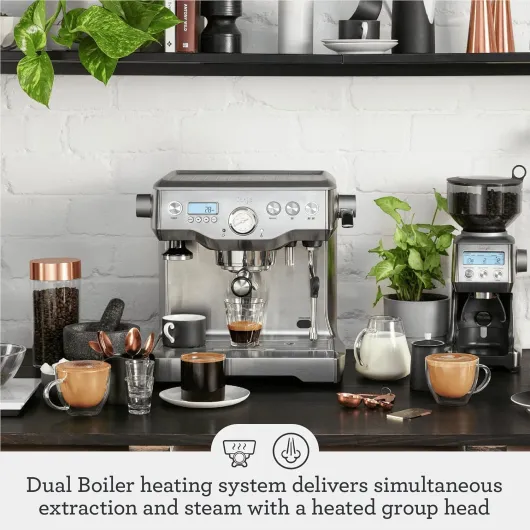
Big, shiny, and very obviously a machine
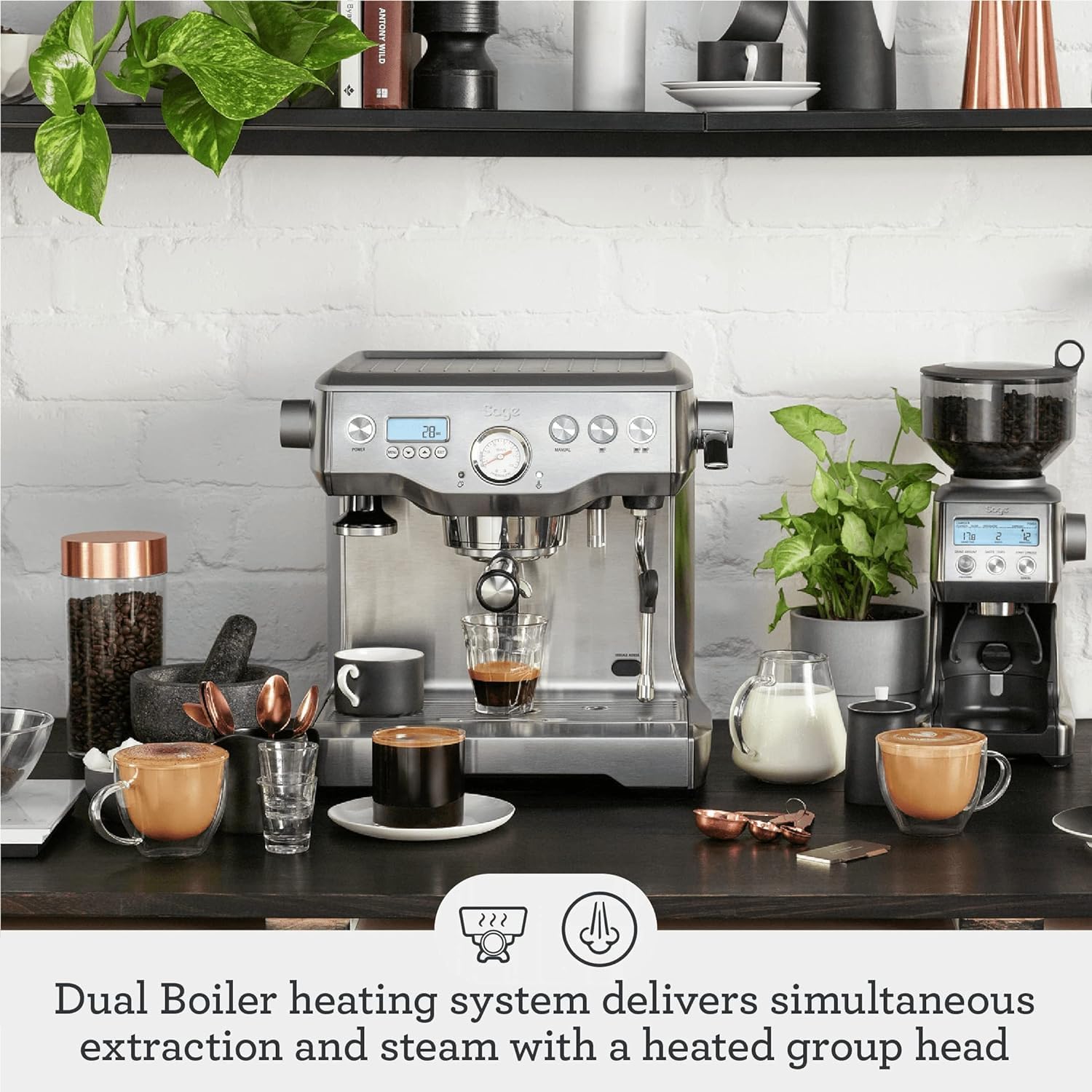
Design-wise, the Dual Boiler looks like a shrunken-down café machine rather than a sleek gadget. It’s brushed stainless steel, quite boxy, and takes up a decent chunk of counter space: about 37.3 cm deep, 40.3 cm wide, and 37.8 cm high. It’s not a small footprint, and it’s heavy enough that once you put it somewhere, you’re not going to move it around every day. Personally, I like that industrial look; it feels like a proper tool, not kitchen decor. But if you’re tight on space or you want something discreet, this will dominate the counter.
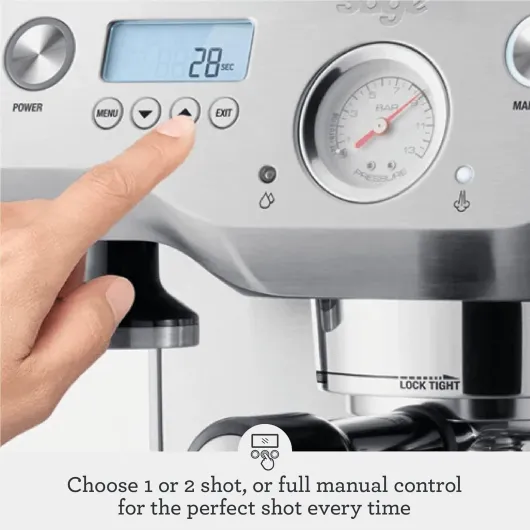
The controls are straightforward: physical buttons and a small display. No glossy touch panel nonsense. You’ve got buttons for single and double shots, menu settings, hot water, and steam. The layout is logical enough that after a couple of days, I was operating it without thinking. The pressure gauge in the middle is also handy to see if you’re in the right ballpark for your grind and tamp. It’s not absolutely essential, but for someone learning, it’s a nice feedback tool.
The top cup warmer is actually useful because the machine does get properly warm, especially if you leave it on for a while. I usually keep two or three cups on top so they’re not stone cold when I pull a shot. The drip tray is big and easy to slide out, with a simple indicator that pops up when it’s getting full. That sounds minor, but with daily use, you do end up emptying it quite often, and at least it’s not a fiddly operation. The water tank is rear-mounted but accessible enough; still, if your machine is under low cupboards, pulling it out can be a bit annoying.
Overall, the design is more about function than style. It looks decent in a modern kitchen thanks to the stainless finish, but it’s not trying to be a piece of art. I appreciated the practical touches more than the looks: big drip tray, clear buttons, and a robust steam knob. If I had to nitpick, I’d say the machine could use slightly clearer labelling on some of the advanced settings, but once you’ve done the setup a few times, it’s fine. In short, it’s a practical, slightly bulky machine that feels built for people who actually use it every day, not for Instagram photos.
Build feels solid, but internals are the big question mark
On the outside, the Dual Boiler feels pretty solid. The brushed stainless steel panels don’t flex, the knobs and buttons don’t feel cheap, and the portafilter has a decent weight to it. It doesn’t give that flimsy plastic vibe you get from cheaper machines. Even the drip tray, which is often where brands cut corners, feels sturdy and slides in and out smoothly. From a user’s point of view, you get the impression of a serious appliance and not a disposable gadget.
However, the real story with materials is hidden inside, and that’s where some owners have had issues. One long-term user mentioned that after almost five years, the steam boiler area and the bracket holding the steam valve were badly rusted and basically seized up. The tech who opened the machine said that steam leaks from poor joints at the top of the boilers are a known cause of failure. In that case, the escaping steam also damaged a circuit board, and the machine was written off as not worth repairing. That’s the kind of failure that makes you question long-term durability, especially given the price of this machine.
To be fair, not everyone will hit that problem, and a lot of people seem to get several good years out of it with regular descaling and filter changes. But it’s worth understanding that this is a complex machine with multiple boilers, valves, and electronics packed in a tight space. If a seal fails and you don’t catch it early, the moisture can slowly chew through metal parts and electronics. So while the exterior materials look and feel premium, the internal design and sealing matter just as much, and that’s harder to judge until something goes wrong.
My takeaway on materials is pretty simple: externally, it feels like a quality bit of kit, but you need to respect the maintenance schedule and keep an eye on odd behaviour (like the pump running when it shouldn’t, or hot spots around the steam valve). If you ignore those signs, the internal metal parts can suffer. For someone willing to maintain it properly and maybe even open it up for a visual check now and then, it’s fine. For someone who just wants to plug it in and forget about it for 7–10 years, it might be a bit of a gamble.
Will it last? Depends how lucky and how careful you are
Durability is where my feelings about this machine get mixed. On the one hand, day-to-day it feels solid. The exterior shows no obvious weak points, and basic components like the portafilter, steam wand, and buttons handle regular use without feeling loose or cheap. With normal cleaning (backflushing, wiping the wand, descaling when prompted), it should easily last past the 2-year warranty in terms of basic function. The 2-year repair/replace/refund guarantee from Sage is at least some reassurance in the short term.
On the other hand, there are real stories from owners whose machines failed in the 4–5 year range due to internal leaks and corrosion. One review described steam escaping from poor joints on top of the boilers, heating up the area around the steam valve and slowly damaging internal parts. By the time it fully failed, the bracket holding the steam valve was so rusted it couldn’t be unscrewed, and a circuit board had been killed by the moisture. The official repair guy basically wrote the machine off as unrepairable, and the user paid over £100 just to be told that. That’s a pretty bitter pill to swallow for a machine in this price range.
To be fair, that’s one case, and plenty of people are happily using their Dual Boilers daily for several years. But it highlights two things: first, this is a complex piece of gear with boilers, valves and electronics tightly packed, and second, when something serious goes wrong out of warranty, repairs can be expensive or not worth it. If you’re unlucky with a bad seal or you ignore warning signs (like the pump running when it shouldn’t, or weird overheating around the steam area), you might end up with internal damage that isn’t obvious until it’s too late.
My personal view: I wouldn’t buy this expecting 10+ carefree years. I’d treat it as a 4–7 year machine where you get very good coffee during its life, but you accept that a major failure might mean replacement, not repair. If that idea annoys you and you want something you can keep running for decades with simple part swaps, you’re probably better off with a simpler, more mechanical machine from a more traditional espresso brand. If you’re okay with the idea that this is a high-performance but somewhat complex appliance, then the durability is acceptable, just not bulletproof.
Shot quality and steaming: strong, but only if your grinder keeps up
In terms of pure performance, this machine can produce very good espresso, but it’s picky about what you feed it. With a halfway decent grinder and fresh beans, I was pulling consistent shots in the 25–30 second range without much drama. The ability to tweak brew temperature and pre-infusion actually makes a difference, especially if you like lighter roasts or you’re trying to troubleshoot channels in the puck. Once I dialled in my grind and tamp, the taste was clean, with good body and no harsh bitterness. Friends who usually dump sugar in their coffee were drinking flat whites straight, which says a lot about how forgiving the machine can be when set up right.
The dual boiler setup is where it really shines in daily use. You can brew and steam together, or at least jump from one to the other without waiting. The steam pressure is decent for a home machine, definitely stronger than entry-level models like the Bambino. I could get microfoam good enough for latte art in under a minute, and the wand gives enough control to texture milk properly once you get the hang of it. For someone who drinks a lot of milk drinks like cappuccinos or flat whites, that speed and consistency are a big plus.
However, the machine is only as good as your grinder. One reviewer nailed it: this machine basically demands a matching grinder. When I tried it with a mid-range grinder like the Sage Smart Grinder Pro, the results were okay, but I felt the machine could do more. Swapping to a better grinder (something in the DF64 / Mignon range) noticeably improved consistency and flavour. So if you’re upgrading from a smaller Sage, be prepared that the Dual Boiler will expose the limits of your current grinder. In my opinion, a grinder upgrade often makes a bigger difference than the move from a mid-range machine to this one.
On the automation side, you get programmable shot volumes and options for manual shots, which is handy if you like to experiment. The timer and auto-on feature also make it easier to fit into a morning routine, so you’re not standing there waiting for it to warm up. Overall, performance is strong for home use, but only if you’re willing to treat it like a small café setup: good grinder, consistent puck prep, and a bit of patience when dialing things in.
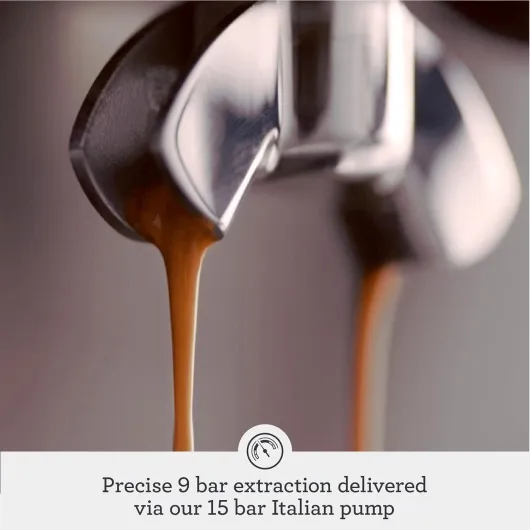
What you actually get with the Dual Boiler
The Sage Dual Boiler is basically a prosumer-style espresso machine squeezed into a home-friendly shell. You get a 2.5 L water tank, dual boilers (one for brew, one for steam), a manual steam wand, a cup warmer on top, and a front panel with a small display and buttons. Out of the box, you also get the usual accessories: portafilter, baskets, milk jug, and the integrated water filter system. There’s no built-in grinder on the UK Dual Boiler, so despite what some generic specs say, you do need a separate grinder if you want good results.
Specs-wise, it runs at 2200 W and 220–240 V, so it heats up fairly quickly for a boiler machine. Mine was ready to pull a shot in roughly 10 minutes, but I usually let it sit closer to 20 minutes if I want everything properly heat-soaked, including the group head and portafilter. The machine lets you choose between single and double shots, manual mode, and you can program shot volumes and brew temperature. There’s also pre-infusion control, which is a big plus if you like to squeeze the most out of lighter roasts or dial in tricky beans.
In terms of actual use, the front interface is simple enough: physical buttons, no silly touch screen that fails after two years. I liked that. You can set an auto-on time so the machine is already warm when you stumble into the kitchen in the morning. That sounds like a small thing, but it turns a fussy machine into something you can actually use before work. One owner mentioned they use this every workday morning and I get why; it fits that routine well.
The one thing you have to keep in mind is that the machine expects a "grown-up" 58 mm ecosystem. If you’re coming from a smaller Sage like the Bambino or Barista Express, your old tampers, funnels and distribution tools probably won’t fit. I ended up buying a new tamper and leveller. So the real “package” cost is not just the machine; you’ll likely add a grinder upgrade and a few accessories if you’re serious about espresso. That’s not a deal-breaker, but it’s something I wish I had factored into the budget from the start.
Does it actually make better coffee than cheaper machines?
In practice, yes, the Dual Boiler can produce better coffee than the cheaper Sage models and most capsule or pod machines, but only if you put in the work. When I took the time to dial in grind size, dose, and tamp, the shots had more body and cleaner taste than what I was getting from my previous single-boiler machine. The main difference for me was consistency: once everything was set, I could reproduce very similar shots day after day. Friends commented that the flat whites tasted like something from a decent independent café, not a chain. That doesn’t happen automatically though; it comes from a mix of the machine’s stability and your own prep.
The dual boiler setup is very effective at reducing faff for milk drinks. Being able to steam milk almost immediately after brewing (or at the same time) means you can make two or three drinks in a row without feeling like you’re waiting on the machine. Compared to cheaper thermoblock machines where you have to flip between brew and steam modes and wait for temperatures to catch up, this feels much closer to a real café workflow. If you regularly make drinks for two or more people, that time saving adds up and makes the machine feel worth it.
Where it doesn’t magically fix things is bad beans or a poor grinder. I tried a few shots with old supermarket beans and a lazy grind setting, and the results were just “meh but it works”. Not terrible, but nothing special. The machine can’t compensate for stale coffee or wildly off grind size. It’s more like a clear amplifier: if your input is good, the output is very good; if your input is bad, it just shows you how bad it is. That’s why some users say the grinder upgrade matters even more than the machine upgrade.
Overall, in terms of effectiveness, it gets the job done very well for someone who wants café-style espresso and milk drinks at home. If you’re willing to learn a bit, it absolutely outperforms entry-level gear and pod machines. If you’re not interested in learning and just want to press a button, then you’re paying for features you’ll barely use, and a simpler automatic machine might make more sense.
Pros
- Dual boiler setup lets you brew and steam at the same time with good temperature stability
- Strong control over brew temperature, pre-infusion, and shot volume for dialing in espresso
- Produces café-level espresso and milk drinks at home when paired with a good grinder
Cons
- Large footprint and heavy; takes up serious counter space
- Real cost includes a decent grinder and 58 mm accessories on top of the machine price
- Long-term reliability can be hit and miss, with some costly failures reported after several years
Conclusion
Editor's rating
The Sage Dual Boiler is a solid choice for people who actually care about espresso and are ready to treat coffee as a small hobby rather than just a drink. It offers real control over brew temperature, pre-infusion, and shot volume, and the dual boiler design makes milk drinks fast and convenient. With a good grinder and fresh beans, it can easily beat most chain coffee shops in terms of taste, and the routine of setting the timer so it’s warm when you wake up makes it usable even on busy weekdays.
It’s not all positive though. The machine is big, not cheap, and expects you to invest in a proper grinder and 58 mm accessories. Long-term durability is the main concern: some owners have had failures around the 4–5 year mark due to steam leaks and internal corrosion, and repairs out of warranty can be costly or not worth it. So this isn’t a set-and-forget appliance you keep for decades; it’s more like a high-performance tool that might need replacing if something major goes wrong later on.
I’d recommend the Dual Boiler to coffee enthusiasts who already own (or plan to own) a good grinder, like to tweak settings, and drink a lot of espresso or milk drinks at home. If you’re a casual coffee drinker, want something small and simple, or you’re very focused on long-term durability with minimal maintenance, you’re probably better off with a cheaper Sage machine or a more basic but robust traditional espresso machine.