Summary
Editor's rating
Value for money: who should actually buy this
Design: functional with a few quirks
Everyday comfort and ease of use
Durability and long-term concerns
Performance: fast heating and pretty accurate temperatures
What you actually get out of the box
Pros
- Fast heating with fairly accurate temperature presets for tea and French press
- Comfortable, stay-cool handle and easy one-touch controls on the handle
- Useful 30-minute keep-warm and memory feature for everyday use
Cons
- More expensive than basic kettles that just boil water
- Keep-warm and heavy use may stress electronics over time if you’re not careful
- Scale filter and mineral buildup can be annoying if you don’t descale regularly

Specifications
View full product page →| Brand | Cuisinart |
A kettle for people who are picky about hot water
I’ve been using the Cuisinart PerfecTemp CPK-17P1 every day for a few weeks for coffee, tea, and random stuff like instant noodles and oatmeal. Before this, I used a basic no-temperature electric kettle and sometimes just a pot on the stove. So I’m not coming at this like a barista, just someone who drinks a lot of hot drinks and got tired of guessing water temperature. My main interest was the preset temperatures and the keep-warm function, because I hate waiting around or re-boiling water.
Right away, what stands out is that this kettle is clearly made for people who care about specific temperatures, not just “boil and hope for the best.” You get presets for different teas and French press, and they’re actually pretty close to what a thermometer shows. It doesn’t turn your kitchen into a science lab, but for daily use, it’s accurate enough that you can taste the difference, especially with green tea and French press coffee.
In everyday life, the kettle heats 1–2 mugs of water in just a couple of minutes, and 1.7L in not that much longer. The 30-minute keep-warm is handy, but it can also be overkill if you leave it on all the time. I noticed the base and electronics get used a lot more if you constantly let it hold temp, so I usually just shut it off unless I know I’m making a second drink soon.
Overall, it’s not perfect and it’s not cheap, but it does what it says: it heats water fast and lets you pick a temperature without fuss. If you only ever boil water for ramen and don’t care about taste differences, it might feel like overkill. But if you drink a lot of tea or French press and are tired of timing the cooldown from boiling, this type of kettle actually makes daily life easier.
Value for money: who should actually buy this
In terms of value, the Cuisinart CPK-17P1 sits in the mid-to-high price range for electric kettles. You can easily find basic models for half the price that simply boil water and shut off. So the question is: are the extra features worth the extra money? For someone who only uses boiling water for instant noodles, cocoa, or the occasional tea bag and doesn’t care about taste differences, I’d say this is overkill. A simple kettle or even a pot on the stove will do the same job for less.
Where this kettle starts to justify its cost is if you regularly drink green, white, oolong teas or French press coffee, and you actually notice when they taste harsh or bitter. The preset temps aren’t marketing fluff; they really do help keep you from accidentally wrecking more delicate teas with boiling water. Even with basic supermarket tea, I could tell the difference between using boiling water and the lower presets. Same with French press: 200°F from the kettle is far more consistent than my old routine of boiling water and waiting some random time for it to cool.
The convenience side also adds value: 30-minute keep-warm, memory function, clear controls, and auto shutoff. These aren’t life-changing, but they do make daily use smoother. It’s the kind of appliance you end up using a lot more than you think, especially if you work from home or drink hot drinks all day. If it lasts several years, the cost spread over that time doesn’t feel crazy.
That said, it’s not the best choice for everyone. If your budget is tight, or you’re rough on appliances and don’t want to think about descaling or treating electronics gently, I’d lean toward a cheaper, simpler kettle. If you’re the type who likes temperature precision, drinks multiple kinds of tea, and wants something more accurate than guessing, then the price feels more reasonable. In short: good value for people who actually use the features; just average value if you only ever hit the Boil button.
Design: functional with a few quirks
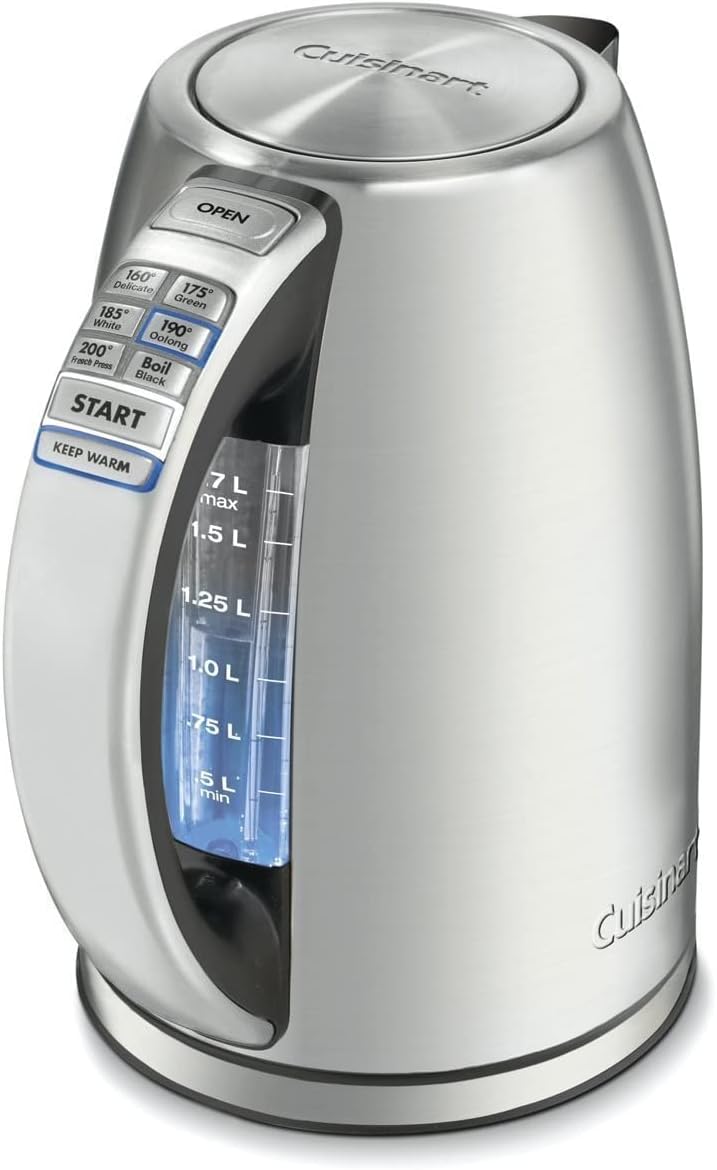
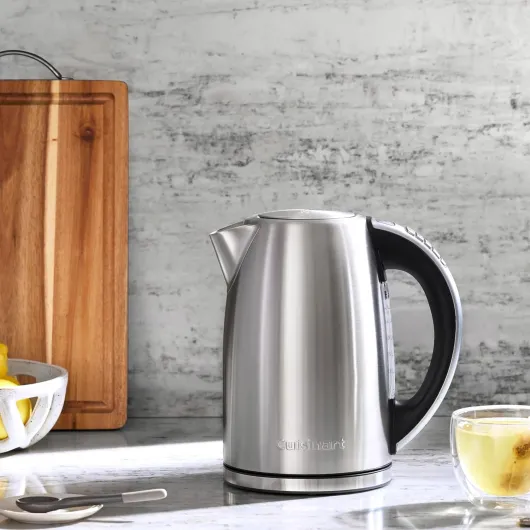
Design-wise, the CPK-17P1 sits somewhere between practical and slightly bulky. It’s not tiny, and on a small counter you will notice it, but it’s not absurdly big either. The brushed stainless steel hides minor smudges better than glossy metal, but you’ll still see fingerprints if you’re picky. A quick wipe with a damp cloth takes care of it. The blue backlit water window is actually useful, not just for show: you can clearly see the water level when the light is on, and the markings are easy to read.
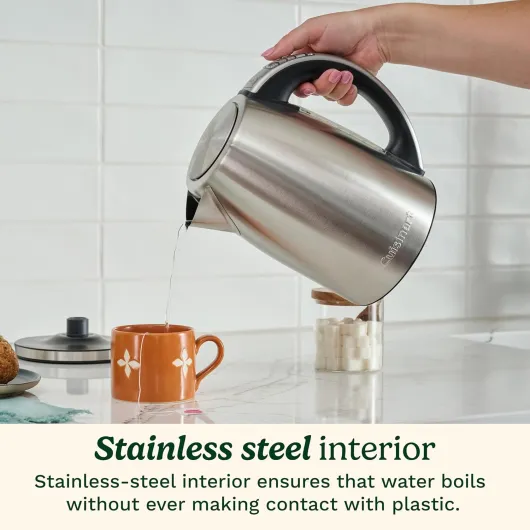
One design detail I liked is the stay-cool handle. Even after boiling a full kettle, the handle never felt hot, just slightly warm at most. The grip is solid and has a nonslip texture, so even when my hands were a bit wet, I never felt like I would drop it. The spout is reasonably well designed: it pours in a controlled stream without splashing all over the place, and the “dripless” claim is mostly true as long as you don’t try to dump water out at weird angles. If you pour slowly, it’s clean; if you flip it upside down like you’re emptying a bucket, you may get a few drops.
The controls on the handle are convenient, but they do mean you’re pressing electronics that are directly attached to hot water all the time. So far, the buttons feel solid and click nicely, but this is an obvious stress point for long-term durability. The memory feature is also tied to this design: you can lift the kettle off the base for about 2 minutes and it “remembers” the setting, so when you put it back, it continues what it was doing or holds the temperature. In daily use, that’s handy when you pour one cup and then put it back for a second cup soon after.
The only design choice I’m not a fan of is the internal scale filter near the spout. It’s removable, which is good, but with it in place, a little bit of water tends to stay trapped at the bottom when you’re trying to empty the kettle completely. Once I pulled the filter out, it poured fully and felt less annoying. If your water is very hard, the filter might help catch scale, but you can also just descale it regularly with vinegar and skip the filter. Overall, the design gets the job done and is easy to live with, but it’s more about practicality than looking fancy.
Everyday comfort and ease of use
Using this kettle several times a day, comfort and convenience matter more than specs on paper. The first thing I noticed is that the weight is reasonable. At around 0.9 kg (about 2 lbs) empty, it’s not featherlight, but even filled with water it’s easy enough to handle one-handed. The handle is thick and shaped well, so you don’t feel like you’re gripping a sharp edge or a slippery tube. Even when I filled it close to max, pouring still felt controlled, not like I was wrestling a full pot.
The button layout on the handle is pretty intuitive. You grab the kettle, press the temperature you want with your thumb, hit Start, and that’s it. There’s no weird menu or long-press nonsense. The blue LEDs help you see what’s going on at a glance, especially in a dim kitchen early in the morning. The only mild annoyance is the beeps: they’re useful, but if you’re very sensitive to sounds or have a sleeping baby nearby, you might wish there was a silent mode. It’s not painfully loud, just noticeable.
Filling the kettle is easy: hit the lid release, it pops open smoothly, and you can fill it from the tap without needing to hold the lid. The water window on the side is readable from a normal standing position, especially once the blue light comes on when it’s on the base. I didn’t have any trouble hitting the right water level. Cleaning is also pretty straightforward. The wide opening lets you rinse the inside easily, and because the heating element is concealed, there’s no exposed coil to scrub. For scale, I just do a 50/50 vinegar-water boil every few weeks and rinse it out.
In daily comfort terms, what I liked most is that I don’t have to babysit it. I press a temperature, walk away, and it shuts itself off or holds temp. No worrying about forgetting a pot on the stove or overboiling. The auto shutoff and boil-dry protection are reassuring: I did once turn it on with very little water inside by mistake, and it shut itself down before anything bad happened. So from a “live with it every day” standpoint, it’s easy and low-stress to use.
Durability and long-term concerns
Durability is the big question with this kettle, especially because it’s been on the market for years and you can find both very positive long-term reviews and some horror stories. I can’t speak to 5–10 years personally, but I can combine my use so far with what makes sense technically. The stainless steel body feels solid, not thin or flimsy. The lid hinge and handle don’t wobble, and the base sits flat without flexing. Nothing about it feels like cheap plastic that’s going to snap in a month.
Where issues usually show up with kettles like this is in the electronics and the heating base. The keep-warm function and frequent reheating cycles obviously stress the internal components more than a simple on/off kettle. One long-term user pointed out something that makes sense: if you pour a cup and then just drop it back on the base and let it sit in keep-warm mode all the time, you’re basically making it work way more than needed. That’s extra wear on the thermal fuse and heating system. If you treat it more simply—turn it off when you’re done, only use keep-warm when you actually need it—you’re likely to get a longer life out of it.
Inside, you will see mineral deposits over time, especially if you have hard water. Some people mistake this for the bottom flaking or coating peeling. In reality, it’s usually just scale. I’ve seen the same thing on every kettle and coffee maker I’ve owned. A quick vinegar treatment (fill with half vinegar, half water, boil once or twice, then rinse) cleans it up without scraping. If you never descale it, it’s not the kettle’s fault that the performance drops or it starts to look crusty.
One thing to be aware of: this is designed for standard North American voltage. If you try to use it in countries with different voltage and rely on a cheap converter, you’re asking for trouble. There’s at least one user who burned out the coil that way. Used on the correct voltage, and with some basic care (descaling, not abusing keep-warm, not dropping it), it feels like it should last several years. But yes, given the price, I’d expect that. If you want something indestructible and ultra-basic, a no-frills stovetop kettle will probably outlive everything, but you’ll lose all the temperature control.
Performance: fast heating and pretty accurate temperatures
Performance is where this kettle actually earns its price, at least if you care about more than just boiling. With 1500W of power, it heats water fast. In my tests with room-temperature tap water, about 0.5L (enough for a big mug) hit 200°F in roughly 2–3 minutes, and a full 1.7L took around 6–7 minutes to reach a full boil. It’s not dramatically faster than every other electric kettle, but it’s consistently quick and doesn’t feel sluggish, even when filled to the max line.
The six preset temperatures are the main feature. I checked them with a basic kitchen thermometer right when the kettle beeped and shut off. The readings were usually within about ±3°F of the target, depending on where I placed the probe. That’s totally fine for home use. Once you pour the water into a cold mug or teapot, you instantly lose around 5–10°F anyway, so expecting lab-level precision is pointless. What matters is consistency, and this kettle is consistent enough that my green tea and oolong actually taste less bitter compared to when I used boiling water.
The keep-warm function holds the water at the selected temperature (or near it) for up to 30 minutes. In real life, that means you can heat water, walk off, answer a couple of emails or take a shower, and come back to water that’s still usable without reboiling. The downside is that if you leave it on keep-warm by default after every pour, you’re putting extra wear on the heating system. I noticed the base stays warm to the touch during long keep-warm sessions. So I now only turn keep-warm on when I know I’ll be making several drinks back-to-back.
Noise-wise, it’s about what you’d expect: a low hum that gets louder near boiling, plus a few clicks from the relay and a beep when done. It’s quieter than a whistling stovetop kettle, louder than a silent appliance, but totally normal for an electric kettle. In daily use, the performance is solid: fast heat-up, reliable presets, and no weird behavior like random shutoffs or failure to boil. If your only goal is speed and you don’t care about temperature control, a cheaper plain kettle will do. But if you want set-and-forget temps for tea and coffee, this one does its job well.
What you actually get out of the box
Out of the box, the CPK-17P1 is pretty straightforward: you get the kettle, the 360° swivel base with the power cord, and a short manual. No fancy extras, no random accessories. The kettle itself is stainless steel with a brushed finish, and there’s a blue backlit water window on the side. The handle houses all the main controls: temp buttons, start, and the keep-warm button. Everything is labeled clearly, so you don’t really need the manual unless you’re curious about the memory feature or safety notes.
The capacity is 1.7 liters, which in real life means around 6–7 normal mugs or 3–4 big travel mugs. The minimum fill line is 0.5L, so if you’re only ever making a tiny cup, you’ll always be heating a bit more water than you strictly need. Not a deal breaker, but something to know if you usually drink small cups. The base is light but stable, and the kettle locks into place easily from any angle thanks to the 360° swivel. I never really have to “aim” it when putting it back.
The interface is simple: six preset temperature buttons (160, 175, 185, 190, 200, and Boil), plus a Start/Stop button and a Keep Warm button. Each button has a blue LED that lights up when selected, and it beeps when it reaches temperature. The beeps are audible but not crazy loud; you’ll hear them in an average kitchen, but they won’t wake up the whole house. There’s also a lid release button on top of the handle that pops the lid open smoothly for filling.
In practice, the overall presentation is pretty no-nonsense. It looks like a slightly more serious kettle than the basic plastic ones, but it doesn’t scream “luxury gadget.” It feels like an appliance meant to be used heavily, not just sit pretty on the counter. If you want a super minimalist look with hidden buttons and no lights, this isn’t that. If you want to plug it in, press one or two buttons, and get water at roughly the right temperature with minimal thinking, it’s well set up for that.
Pros
- Fast heating with fairly accurate temperature presets for tea and French press
- Comfortable, stay-cool handle and easy one-touch controls on the handle
- Useful 30-minute keep-warm and memory feature for everyday use
Cons
- More expensive than basic kettles that just boil water
- Keep-warm and heavy use may stress electronics over time if you’re not careful
- Scale filter and mineral buildup can be annoying if you don’t descale regularly
Conclusion
Editor's rating
The Cuisinart PerfecTemp CPK-17P1 is a solid pick if you actually care about what temperature your water hits. It heats quickly, the temperature presets are reasonably accurate, and the 30-minute keep-warm feature is genuinely useful when you’re making multiple drinks in a row. Day to day, it’s easy to use: grab the handle, tap a button, walk away, and it beeps when it’s ready. The handle stays cool, the pour is controlled, and cleaning is simple as long as you descale it once in a while.
It’s not perfect. The price is on the high side compared to simple kettles, the beeps might annoy very noise-sensitive people, and long-term durability depends a lot on how you use it. If you constantly run keep-warm or never clean out mineral buildup, you’re more likely to run into problems. Also, if you only ever use boiling water and don’t notice any difference in taste between 175°F and 212°F, a cheaper kettle makes more sense.
If you drink a lot of green or oolong tea, French press coffee, or you just want to stop guessing water temperature, this kettle is pretty solid and does what it claims without much hassle. If you just want hot water as cheaply as possible, skip the fancy features and save your money. For the right user, it’s a good, practical upgrade; for the wrong user, it’s just an expensive way to boil water.