Summary
Editor's rating
Value: who should actually spend this much on a kettle?
Design: looks great, with some trade-offs
Materials and build: quality feel with a few small worries
Durability and daily wear (early impressions)
Performance: precise, steady, and deliberately slow
What you actually get out of the box
Effectiveness for coffee and daily use
Pros
- Precise temperature control with reliable hold function up to 60 minutes
- Very controlled, steady pour ideal for V60, Chemex and other pour-over methods
- Solid build and attractive smoke green + maple design with compact base
Cons
- High price compared to other kettles that also boil water
- Slow pour and 0.9 L capacity make it less practical as a general-purpose kitchen kettle
- Wood handle and knob may show wear or staining over long-term use

Specifications
View full product page →| Brand | Fellow |
A fancy kettle… for water?
I’ve been using the Fellow Stagg EKG Smoke Green with maple handle for a few weeks now, mainly for V60 and Aeropress. Before this, I had a basic £25 electric kettle and a cheap stovetop gooseneck, so this was a big step up in price. I wanted to see if paying this much for something that just boils water actually made any sense in daily use, or if it was just coffee-nerd decoration.
Right away, what stands out is how focused this thing is on pour-over. It’s not a general-purpose kitchen kettle that happens to have a gooseneck. It’s basically: pour-over first, everything else second. The spout is slow, the capacity is modest (0.9 L), and the temperature control is way more precise than most people need for making a quick cup of tea. So if you’re expecting a fast, big family kettle, it’s the wrong product.
In daily life, I used it 2–3 times a day: morning coffee, sometimes an afternoon cup, and the odd tea at night. I played with different temps (92–96°C for coffee, 80–85°C for green tea), and I used the hold function a lot more than I expected. I also tried pouring like an impatient zombie at 6 a.m. to see if it would leak or misbehave like some reviews mentioned.
Overall, it’s not perfect, but it does exactly what it says: heats water to a precise temperature and lets you pour slowly and consistently. For pour-over, it’s pretty solid. For general kitchen use, it’s kind of overkill and a bit annoying. Whether it’s worth the price depends a lot on how much you actually care about coffee and how often you brew manually.
Value: who should actually spend this much on a kettle?
Let’s be honest: this is not a budget kettle. You can boil water for a fraction of the price, and if that’s your only requirement, this thing makes no sense. Where it starts to justify the cost is if you’re already into manual coffee brewing and you actually care about temperature, flow control, and having a tool that you use every single day without thinking too much about it.
Compared to a regular £25–£40 electric kettle, what you’re paying for here is: to-the-degree temperature control, hold function, controlled gooseneck pour, and nicer materials and design. If those things matter to you, the price becomes easier to swallow. If they don’t, you’re basically buying a very expensive status object that doesn’t boil water any faster than a cheaper one. For pure performance per pound, cheaper kettles win. For brew control and aesthetic satisfaction, the Stagg EKG has a clear edge.
There are also cheaper gooseneck kettles with temp control on the market. They often have clunkier interfaces, less accurate temps, or less solid build quality, but they get you 70–80% of the way there for less money. So if you’re on a tight budget, those are worth considering. The Fellow is more like the “nice tool you buy once” if you’re willing to pay extra for design and a slightly more polished user experience.
So in terms of value, I’d say it’s good for a specific crowd: people who brew pour-over several times a week, care about the details, and like having well-designed gear on the counter. If you just want hot water, it’s poor value. If you’re deep enough into coffee that you’re already buying decent beans, a grinder, and maybe a scale, then this fits right into that ecosystem and starts to feel like a reasonable, if still pricey, upgrade.
Design: looks great, with some trade-offs
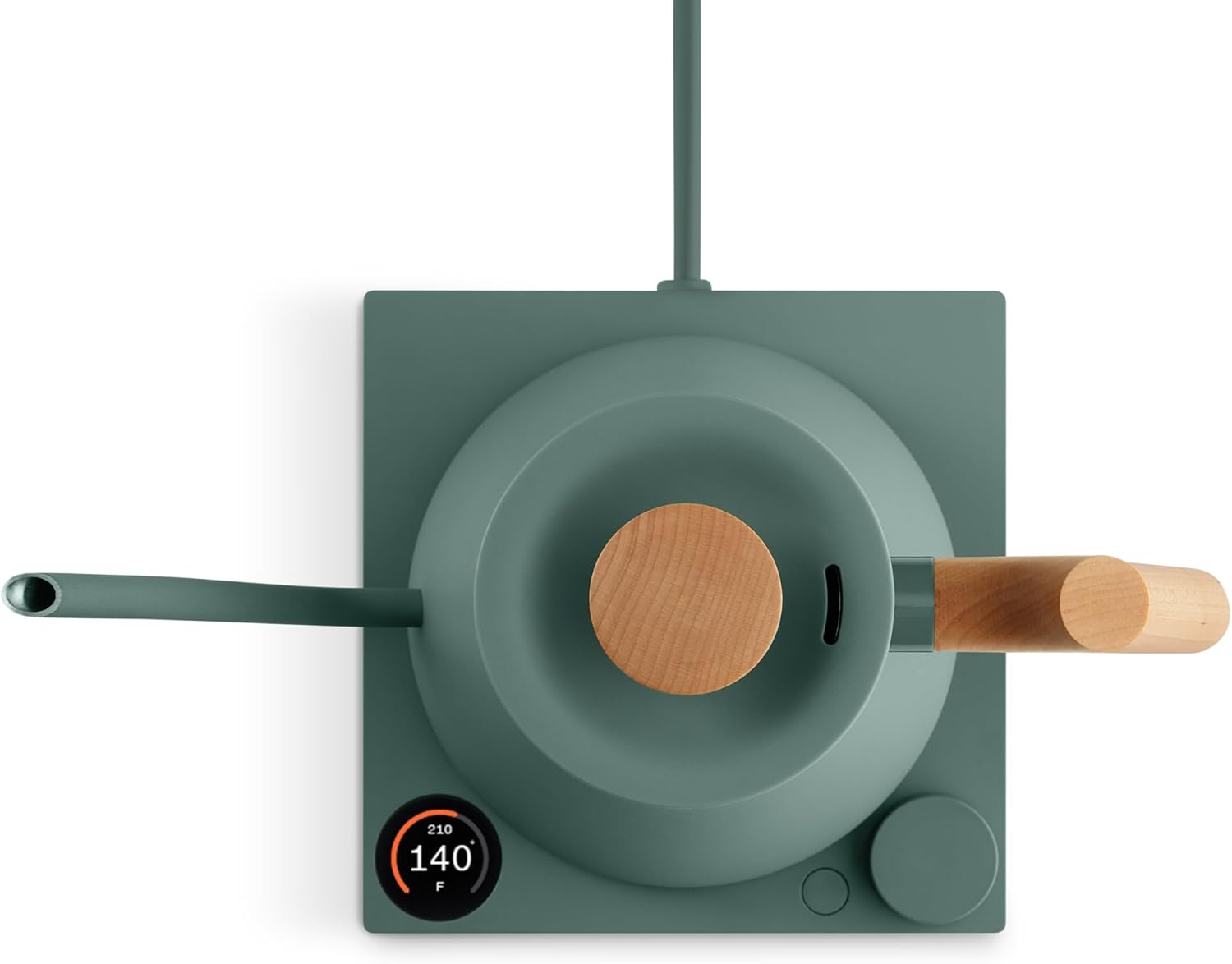
The design is clearly one of the big selling points. The smoke green color with the maple handle looks good on the counter. It’s not screaming for attention, but it doesn’t look like a random office kettle either. The base is compact and flat, so it doesn’t hog too much space, which I appreciated on a small kitchen counter. Compared to my old chunky plastic kettle, this one definitely looks more thought-out and less cluttered.
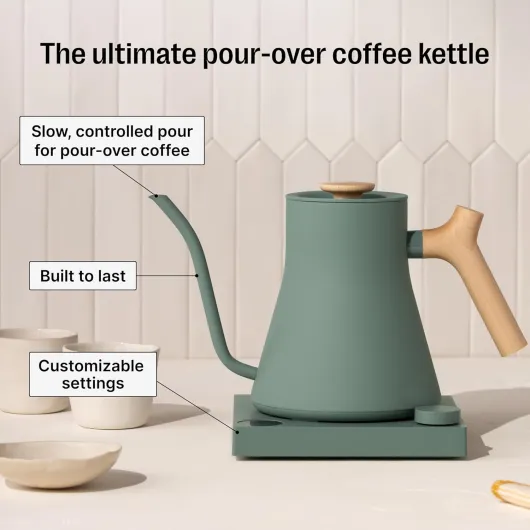
The gooseneck spout is long and slim, and that’s what gives you that slow, controlled pour. But it also means this is not a “fill the pan in 5 seconds” kettle. If you try to rush it and tip it too far, like some reviews mentioned, yes, it can dribble a bit around the lid. Used properly—around that 45-degree tilt angle—the flow is smooth but slow. So the design is great for pour-over, slightly annoying for anything else.
The control layout is simple: the dial is front and center, the small LCD is clear, and there’s no overload of buttons. The downside is that if you’re used to just hitting a big ON button and walking away, you have to adjust. You need to set a temperature (or at least confirm it) and then press the dial to start heating. After a day or two, it becomes muscle memory, but the first couple of times, it feels less obvious than a standard kettle.
From a design point of view, it’s purpose-built. It looks good, it’s tidy, and it fits in a modern kitchen. But the same things that make it nice for coffee—slim spout, modest capacity, precise controls—also make it less versatile for a family kitchen where people just want fast, boiling water without thinking. So visually, big thumbs up; practicality-wise, it depends a lot on your use case.
Materials and build: quality feel with a few small worries
The kettle body is 304 stainless steel, and it feels solid in the hand. The smoke green finish looks good and doesn’t feel cheap or plasticky. After regular use, I didn’t see any weird discoloration or flaking. Inside, it’s just bare stainless steel, no coating, which I prefer. No weird smells out of the box either; I rinsed it twice and it was fine. Compared to cheaper kettles I’ve had, this one definitely feels more solid and less rattly.
The maple handle and knob are the “premium” touch here. They look nice, and they stay cool enough to handle comfortably. The downside is that wood can age differently than plastic or metal. I’m always a bit cautious about water stains, oil, or general wear on wood parts in the kitchen. After a few weeks, mine still looked clean, but I can imagine over a year or two you might see some patina or marks if you’re not careful. It’s not a deal-breaker, but you do feel like you have to treat it with a bit more respect than a fully plastic handle.
The base is mostly plastic with the electronics inside, but it doesn’t feel flimsy. The cable is standard, nothing special, but it does the job. The LCD screen is clear and hasn’t fogged up or scratched easily in normal use. No loose parts, no wobbling, the kettle sits securely on the base. So overall, build quality feels solid, and it matches the price point better than I expected, especially compared to mid-range kettles.
My only slight concern long-term is limescale and how the finish will deal with regular cleaning. Like any kettle, if you live in a hard water area, you’ll need to descale it regularly. The interior shape is a bit narrow at the top, so getting all the way in there with a sponge is not super convenient. Realistically, you’ll be using descaling liquid or vinegar rather than scrubbing. Not a huge problem, but worth mentioning if you like to really get in there and clean things by hand.
Durability and daily wear (early impressions)
I haven’t had it for years, so I can’t pretend to know exactly how it will age, but after several weeks of daily use, a few things stand out. The stainless steel body holds up well: no dents, no weird noises, no loosening of the spout or handle. The lid still fits snugly, and there’s no rattling when pouring. I’ve heated it multiple times back-to-back, and the base never got worryingly hot.
The maple handle is the one part I’m slightly cautious about. Wood in the kitchen tends to pick up marks and darken with time. I’ve been careful not to splash too much water on it and to wipe it down if I do. So far, it still looks nice, but I can easily see it developing a bit of patina after a year or two. That’s not necessarily bad, but if you expect it to stay looking factory-fresh, you’ll probably be a bit disappointed down the line.
From a reliability standpoint, the electronics have been stable. The temperature readings are consistent, the buttons and dial still feel firm, and the base hasn’t shown any glitchy behavior. It reaches and holds temperature the same way it did on day one. The 1-year warranty (plus an extra year if you register in the US) is reassuring, but I’d like to see a longer standard warranty at this price, to be honest.
Overall, my early take is that it feels like it will last if you treat it with normal care: don’t drop it, descale it reasonably often, and don’t soak the wooden parts. It doesn’t scream “indestructible tank,” but it also doesn’t feel fragile. I’d call the durability promising but not bulletproof, with the main long-term question being how the wood and finish will hold up under heavy use.
Performance: precise, steady, and deliberately slow
Performance-wise, this is where the Stagg EKG starts to make sense. The 1200W heating element isn’t the fastest on earth, but it’s not painfully slow either. From room-temperature water to around 94°C, it took me roughly 3–4 minutes with about 600–700 ml in the kettle. That’s slightly slower than my old 2000W basic kettle, but not by a huge margin. The trade-off is that you get to-the-degree control instead of just full boil.
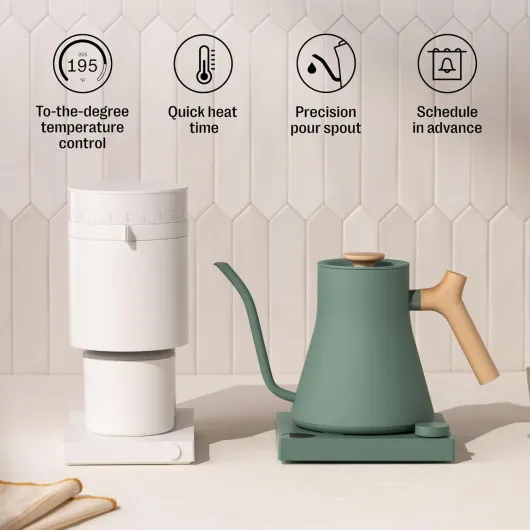
The temperature control is honestly the main value here. You can set it degree by degree, and the real-time temperature on the screen is pretty accurate. I checked it with a separate thermometer, and it was usually within 1–2 degrees, which is more than good enough for coffee and tea. The hold function (up to 60 minutes) is actually very handy: I’d heat to 94°C, grind my coffee, rinse the filter, and the water would still be at 94°C when I started pouring. It’s a small thing, but it makes the routine smoother.
The pour itself is very controlled. If you’re doing V60, Chemex, or similar, it’s easy to keep a thin, steady stream and hit specific spots in the coffee bed. No sudden gushes, no random splashes. But again, it’s slow. If you’re trying to fill a big French press or a pot of tea quickly, you’ll probably get annoyed. If you keep the tilt angle reasonable, I didn’t have any leaking issues. When I forced it and tipped it almost horizontal, yes, it started to dribble around the lid. Used normally, it behaved well.
Noise-wise, it’s quieter than a lot of cheap kettles. There’s a noticeable hum when it’s close to the target temperature, but nothing crazy. Compared to a standard kettle that roars when it’s boiling, this one is more discreet. Overall, if your main goal is precise temperature and controlled pour, the performance is very solid. If your main goal is speed and volume, there are better, cheaper options.
What you actually get out of the box
Out of the box, the Fellow Stagg EKG is pretty straightforward: kettle body, base with LCD screen and dial, power cable, and a small manual. No extra nonsense, no accessories, no filters or cleaning tools. For the price, I half-expected at least a little cleaning brush or something, but no, just the essentials. Setup takes about 30 seconds: plug in the base, put the kettle on it, flip the switch at the back, and you’re ready.
The interface is simple: one main dial, a small button for the stopwatch, and a little switch at the back for HOLD and for switching between °C and °F. The screen shows two numbers: the set temperature and the actual temperature in real time. After a couple of uses, you don’t really think about it anymore, it’s pretty intuitive. The only slightly weird thing at first is that it doesn’t behave like a normal kettle that just boils and clicks off; you actually choose the temperature, and it stops there.
In practice, the presentation is clearly aimed at people who have at least some interest in brewing. The manual talks about pour-over, extraction, timing, etc. If you’re just someone who wants boiling water for instant noodles, you’ll probably find the whole thing a bit overthought. But if you’ve used a V60, Kalita, or Chemex before, the features make sense pretty quickly: to-the-degree setting, hold function, and a built-in brew timer.
Nothing in the box feels cheap, but nothing feels generous either. It’s very much: here’s the kettle, here’s the base, figure it out. Luckily, it’s easy. For the price bracket, I’d say the presentation is clean but minimal—no real wow factor beyond the product itself, but also nothing to complain about in terms of clarity or setup.
Effectiveness for coffee and daily use
For pour-over coffee, this kettle does exactly what you want. Being able to set the water to, say, 93°C instead of a rolling boil makes a noticeable difference if you’re picky about extraction and bitterness. I used it for V60 mostly, with 15–20 g doses, and the slow, even pour made it easy to hit consistent brew times and patterns. The built-in stopwatch is simple but handy: click, start blooming, keep an eye on the time without needing your phone.
Compared to my old method (boil water in a normal kettle, wait 30–60 seconds, then pour from a cheap gooseneck), the Stagg EKG mainly brings consistency. Every brew, I know the water is at the same temperature, and it stays there throughout the pour thanks to the hold function. That doesn’t magically fix bad coffee or bad technique, but it removes one variable. Over a week or two, my cups were more repeatable, and dialing in a new coffee felt a bit easier.
For tea, it’s a bit mixed. You can set the right temperature for green tea or oolong, which is nice, but the slow spout makes filling a big mug or teapot slightly tedious. It works, but it’s not ideal if you’re making tea for several people. For quick tasks like instant noodles or topping up a pan, it’s frankly not the best tool. It will do it, but you’ll be standing there longer than you’d like, and it feels like using a scalpel to cut cardboard.
So in terms of effectiveness, I’d say: great for coffee nerds, decent for tea drinkers who care about temperature, and overkill for anyone else. If you mostly drink instant coffee or just want boiling water as fast and easily as possible, this kettle is more fuss and more money than you need. If you’re already invested in manual brewing, it fits in nicely and actually helps keep things consistent day to day.
Pros
- Precise temperature control with reliable hold function up to 60 minutes
- Very controlled, steady pour ideal for V60, Chemex and other pour-over methods
- Solid build and attractive smoke green + maple design with compact base
Cons
- High price compared to other kettles that also boil water
- Slow pour and 0.9 L capacity make it less practical as a general-purpose kitchen kettle
- Wood handle and knob may show wear or staining over long-term use
Conclusion
Editor's rating
After using the Fellow Stagg EKG Smoke Green with maple handle daily, my take is pretty straightforward: it’s a very solid tool for pour-over fans, and just an expensive toy for everyone else. The temperature control works well, the hold function is genuinely useful, and the gooseneck gives you a slow, steady pour that makes it easier to be consistent with V60, Chemex, Kalita, etc. It heats fast enough, it’s quieter than many kettles, and it looks good on the counter.
On the flip side, the 0.9 L capacity, the deliberately slow spout, and the higher price mean it’s not a great all-round family kettle. Filling a big teapot or pan feels slow, and if you just want boiling water for tea bags or instant meals, this is overkill. The wood handle looks nice but might show wear over time, and for the money, you could get a basic kettle plus a cheaper gooseneck and still have cash left.
If you’re into manual coffee, brew several times a week, and actually care about hitting specific temperatures and having a smooth pour, then this kettle makes sense and is pleasant to use every day. If you’re more casual about your hot drinks, you’re better off saving your money and going for something simpler and cheaper.