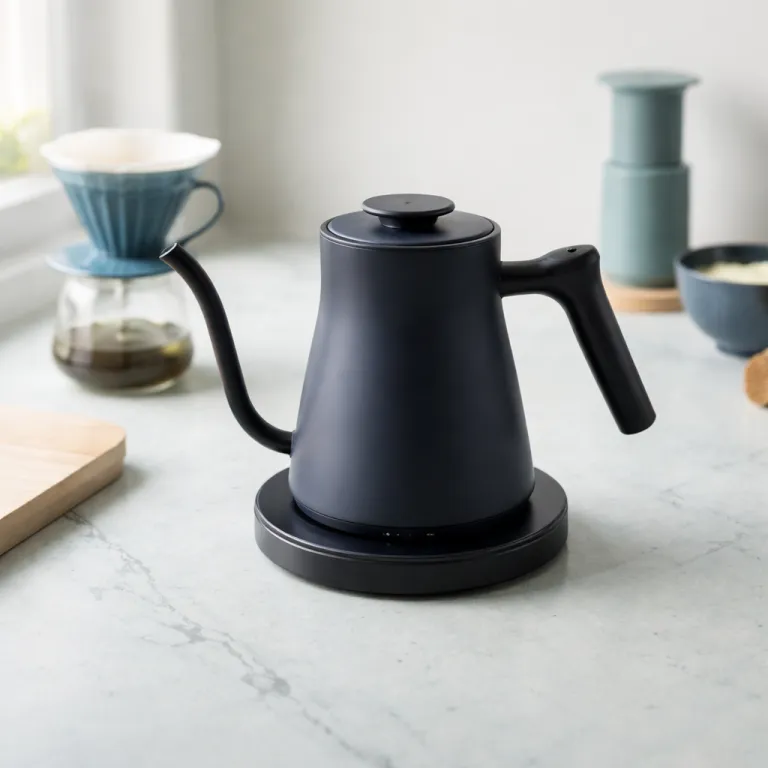
Why the best kettle for pour over coffee starts with your brew method
The best kettle for pour over coffee is not a generic appliance. It is a brewing tool that shapes how water meets coffee grounds, how the pour develops, and how flavours emerge in your cup. Treat the electric kettle as part of the brewing chain, not background noise.
If you mainly brew pour over coffee with a V60, Kalita, or Chemex, you need a gooseneck kettle that gives precise flow and stable temperature control across the whole brew. AeroPress fans can live with a standard coffee kettle or tea kettle, but variable temperature and a comfortable spout still matter for repeatable results. For matcha and delicate coffee–tea hybrids, the right electric gooseneck or compact pour over kettle should hit lower temperatures reliably and pour gently without splashing.
Think in terms of methods, not marketing claims or shiny stainless steel finishes. Pour over demands a narrow gooseneck spout and a predictable flow rate, while French press mainly needs enough hot water and decent insulation. Once you map your routine, the field of kettles shrinks fast and the best kettle for pour over coffee becomes easier to identify.
For most home brewers, a 0.8 to 1 litre electric kettle is ideal for one or two pour over brews. Larger kettles promise capacity but often compromise on balance, spout control, and evenness of pouring over coffee grounds. Remember that 1.7 litres on a spec sheet rarely translates into a comfortable four mug pour without awkward tilting.
Gooseneck versus standard spout: when precision really matters
A gooseneck kettle exists for one reason: to control the flow of water. The curved stainless gooseneck spout lets you pour slowly, trace circles over coffee beds, and avoid channeling that ruins extraction. Standard kettles with wide spouts dump water quickly and make fine control almost impossible.
For pure pour over brewing, gooseneck kettles are not theatre, they are tools that shape extraction and flavour clarity. When you pour over coffee with a narrow spout, you can maintain a steady flow rate, keep the coffee bed flat, and adjust your pouring pattern mid brew. With a regular tea kettle, you end up fighting the spout instead of focusing on the coffee itself.
Models like the Fellow Stagg electric gooseneck kettles, the Hario Buono gooseneck kettle, and the Brewista Artisan electric gooseneck kettle all prioritise spout geometry and balance. Independent reviewers consistently describe these kettles as offering slow, controllable flow that is suitable for spiral pours as well as larger brews. Their stainless steel bodies and carefully tuned spouts give you a slow, even kettle pour that feels almost like writing with ink. Among these, the Fellow Stagg EKG stands out for pairing that controlled flow with precise temperature control and a stable base.
If you mostly brew French press or make quick coffee–tea blends, a standard electric kettle with a short spout can be perfectly adequate. However, once you start chasing consistent pour over brewing, a dedicated pour over kettle with a slim gooseneck becomes non negotiable. For a detailed look at a compact precision model, see this review of a fast boil gooseneck pour over kettle (affiliate) that focuses on spout accuracy and energy use.
Temperature control, keep warm, and why a few degrees matter
Water temperature is the quiet variable that separates flat coffee from a balanced cup. For pour over, most specialty roasters recommend brewing between 90 and 96 degrees Celsius, while green tea prefers 70 to 80 degrees and oolong sits around 85 to 90 degrees. A good electric kettle with reliable temperature control lets you hit these windows without guesswork.
The Fellow Stagg EKG electric gooseneck kettle, the EKG Pro variant, and the Brewista Artisan all offer variable temperature control with digital displays and a keep warm or hold feature. In many hands on tests by reviewers and home baristas, the Stagg EKG is praised for holding close to the set temperature over a typical brewing session, while the Brewista Artisan is noted for similarly stable performance. That keep warm function matters more than most marketing suggests, because it maintains your chosen temperature while you rinse filters, grind coffee, and set up your pour over. Holding around 93 degrees Celsius for the time it takes to brew is the difference between a rushed pour and a calm, repeatable routine.
If you rarely brew delicate teas, you might not need one degree increments, but you still benefit from a kettle that does not overshoot and scorch your coffee. A basic electric kettle without control often boils hard, then cools unpredictably, forcing you to guess when to pour over coffee grounds. Variable temperature models, especially those with stainless steel interiors and clear markings, give you consistent water every time.
For a mid range option that balances fast heating, precise pouring, and automatic shut off, look at this test of a barista focused electric gooseneck kettle (affiliate). It shows how a compact coffee kettle can combine accurate temperature control, a comfortable handle, and a narrow spout without drifting into luxury pricing. When you evaluate any model, ask whether its temperature claims are backed by stable performance or just a crowded control panel.
Real world standouts: Fellow Stagg EKG, Hario Buono, Brewista Artisan and more
Among serious home brewers, the Fellow Stagg EKG has become a reference point for the best kettle for pour over coffee. Its stainless steel body, balanced handle, and thin gooseneck spout give you slow, controlled pouring, while the LCD screen and dial offer precise temperature control from low tea settings to near boiling. The Fellow Stagg design also keeps the centre of gravity low, so the kettle feels stable even when full of hot water.
The Hario Buono gooseneck kettle started as a stovetop icon, but its electric versions bring that same graceful flow to a plug in base. You do not get the same granular temperature control as the Stagg EKG or EKG Pro, yet the flow rate and spout shape remain excellent for pour over brewing. In typical use, the electric Buono heats 800 ml of water to brewing temperature in around four to five minutes and holds reasonably steady once off the base. For many coffee drinkers, a Hario Buono electric gooseneck kettle paired with a separate thermometer still beats a cheap variable temperature kettle with a clumsy spout.
The Brewista Artisan electric gooseneck kettle sits between these two in both price and feature set. It offers multiple presets for coffee and tea, a keep warm function, and a distinctive design that emphasises both aesthetics and ergonomics. Its stainless steel construction and tuned flow make it a strong candidate if you want one kettle for coffee, tea kettle duties, and occasional coffee–tea experiments.
Not every household needs a premium Fellow Stagg or Brewista Artisan though. Some people will be better served by a simpler electric kettle with a narrower spout and no advanced display, as long as the flow is predictable and the interior is stainless steel. The best kettle for pour over coffee in your kitchen is the one whose pouring, temperature stability, and capacity actually match how you brew every day.
| Model | Capacity | Temp range | Keep warm | Typical price band |
|---|---|---|---|---|
| Fellow Stagg EKG | 0.9 L | 40–100 °C | Up to ~60 min | £120–£160 |
| Hario Buono Electric | 0.8–1.0 L | Single boil setting | None | £60–£90 |
| Brewista Artisan | 0.9–1.0 L | 40–100 °C | Up to ~60 min | £100–£150 |
Budget tiers, maintenance, and making your kettle last
Price alone does not tell you whether a kettle will brew great coffee. In the £40 to £80 range, you can find capable electric gooseneck kettles with basic temperature settings, decent stainless steel interiors, and acceptable flow for pour over. These models may lack advanced displays or long keep warm times, but they still outperform generic plastic kettles for brewing control.
Move to the £80 to £120 tier and you start seeing precise temperature control, better balance, and more refined spout design. This is where many versions of the Fellow Stagg EKG, Hario Buono electric, and similar pour over kettle designs sit, offering a strong mix of performance and durability. Above £120, you mostly pay for premium finishes, extended warranties, and sometimes marginal gains in flow rate or insulation rather than dramatic leaps in brewing quality.
Whatever you spend, maintenance decides how long your electric kettle remains safe and pleasant to use. Limescale builds up first around the spout and base, and if you ignore it, you will see flakes in the first pour over coffee of the day. In soft water areas, descaling every eight to twelve weeks with a mild solution of white vinegar and water (roughly one part vinegar to three parts water) is usually enough. In hard water regions, plan on descaling every four to six weeks, or more often if you notice visible deposits or slower boiling.
Think of it this way: the best kettle for pour over coffee is not just the one with the sharpest design or the highest wattage. It is the one that still pours smoothly and heats reliably after hundreds of brews, not the one that looks good but clogs on the tenth kettle of limescale. When you choose a kettle, you are choosing the daily rhythm of your brewing, from the first click of the base to the last slow pour over coffee grounds.
Variable temperature kettles and when precision genuinely improves your brew
Not every drink demands laboratory level precision, but some clearly benefit from it. Light roast pour over coffee, high grade green tea, and carefully prepared oolong all respond noticeably when water temperature is tuned within a narrow band. In these cases, a variable temperature electric kettle with a reliable sensor and stable keep warm mode earns its place on your counter.
For darker roasts or casual coffee–tea blends, a five degree swing rarely ruins the cup, so a simple electric gooseneck kettle with a few presets can be enough. The key is knowing when you are chasing meaningful improvements and when you are paying for features you will never use. A good rule is that the more you adjust grind size, brew time, and pour pattern, the more you will appreciate precise temperature control and a responsive kettle pour.
If you want a deeper technical breakdown of how preset degrees interact with extraction, this guide on variable temperature kettles and meaningful presets (affiliate) is worth reading. It explains why holding 93 degrees Celsius for pour over coffee matters, while obsessing over 1 degree differences for boiling pasta water does not. Once you understand those trade offs, you can choose between simple kettles, advanced models like the Stagg EKG Pro, or multi purpose tea kettle designs with confidence.
In the end, the best kettle for pour over coffee is the one that aligns your habits, your beans, and your budget. A well chosen stainless steel gooseneck kettle with honest temperature control will quietly improve every brew you make. When the flow feels natural, the spout lands exactly where you want, and the water tastes clean, the kettle stops being a gadget and becomes part of your daily brewing craft.
FAQ
Do I really need a gooseneck kettle for pour over coffee
If you brew pour over coffee regularly, a gooseneck kettle is worth it. The narrow spout and controlled flow rate help you pour evenly and avoid channeling in the coffee bed. For occasional pour over, a careful pour from a standard spout can work, but it is harder to repeat consistently.
What capacity is best for a home pour over kettle
For one or two cups, a 0.8 to 1 litre kettle is ideal. This size gives enough hot water for a typical V60 or Chemex brew without making the kettle heavy or unbalanced. Larger kettles can feel awkward to tilt slowly, which makes precise pouring more difficult.
How important is variable temperature control for coffee and tea
Variable temperature control matters most for light roast coffee and delicate teas. Green tea and oolong need lower temperatures than pour over coffee, so presets or adjustable controls help avoid bitterness. If you only brew dark roasts, exact degrees are less critical, but a stable temperature is still helpful.
How often should I descale my electric kettle
Descale your electric kettle every four to eight weeks, depending on water hardness. Heavy limescale builds up faster in hard water areas and can affect both heating speed and flavour. Regular descaling with a diluted white vinegar solution keeps the stainless steel interior clean and prevents flakes from appearing in your first pour.
Can one kettle work well for both coffee and tea
Yes, a good electric gooseneck kettle with variable temperature can handle both. Look for stainless steel construction, a comfortable handle, and a keep warm feature for longer tea sessions. Just remember to rinse thoroughly between strong coffee and delicate tea to avoid flavour carryover.